
July 29, 2024 | 5 min read
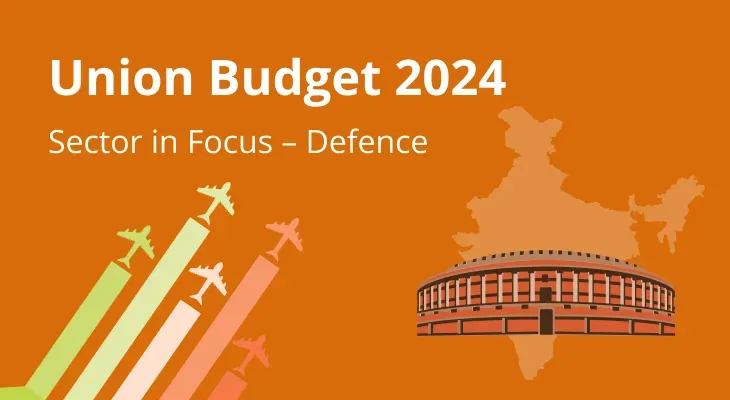
Union Budget 2024: Sector in Focus – Defence
As India awaits the first Union Budget of the NDA 3.0 government, the defence sector remains a critical area of focus. Several defence stocks have seen a major rally in recent times with many of them reaching their 52-week highs. This attention is driven by recent budgetary allocations, evolving geopolitical challenges, and long-term strategic goals. The impact on defence stocks has been profound, with the Nifty India Defence index delivering an amazing 74.44% returns YTD.
Why is the Defence sector in focus for Union Budget 2024?
Interim Budget Highlights
In the interim budget, the government allocated over ₹6.21 trillion to the Ministry of Defence (MoD), marking a 4.72% increase from the previous year's allocation. Despite this rise, the allocation as a percentage of government expenditure and GDP remains below two percent, a trend observed over multiple years. Many experts believe that this allocation is insufficient for the substantial modernisation and capital acquisition needed for the defence sector.
Defence Production Goals
India has set an ambitious target to achieve ₹3 trillion in annual defence production by FY29. To meet this goal, the defence capital acquisition budget needs to grow by at least 25% year-on-year for the next five years. This target aligns with the government’s broader strategy to boost defence exports, aiming to reach over ₹50,000 crore by FY29. The private sector is expected to play a crucial role in this growth, having already increased its share in defence production significantly.
Geopolitical Context
The budget considerations are heavily influenced by the security environment in India’s neighbourhood. Ongoing military challenges along India’s international borders require a robust budget to support defence home-production and modernisation efforts. Enhanced border security and modern weapons systems are critical priorities to address these challenges.
Investment In Technology And R&D
Investment in research and development (R&D) is another critical area. The government had previously announced a 25% allocation of the MoD's R&D funds for industry and academia. This allocation aims to foster innovation and advanced technology development, crucial for maintaining a modern and self-reliant defence sector. Higher R&D budget incentives for niche technologies are also being considered to bolster the defence ecosystem.
Capital Expenditure And Indigenisation
Capital expenditure in the defence budget is vital for upgrading infrastructure, weapons, and defence systems. The FY25 Union Budget is expected to prioritise these areas to ensure that India can meet its long-term defence objectives on its own. Security experts are of the opinion that India’s military needs to allocate at least 50% of its total defence budget to capital accounts, which currently stands at about 27.67%.
Strategic Reforms And Long-Term Planning
The Ministry of Defence is moving towards an integrated perspective planning approach, replacing the 15-year Long Term Integrated Perspective Plan (LTIPP) with a 10-year Integrated Capability Development Plan (ICDP). This reform aims to ensure that budgetary commitments align with long-term military capability goals.
What does this mean?
The upcoming Union Budget for FY25 may play a crucial role in shaping the future of India’s defence sector. With significant goals set for production and exports, alongside the need for enhanced border security and technological advancements, the budgetary allocations will need to reflect these priorities. Observers and industry stakeholders are closely monitoring the budget announcements to see if the government can meet the ambitious targets set for the defence sector.
What does this mean for Investors?
The budget has seen a significant rise in defence spending, driven by the need to enhance national security and modernise military capabilities. This increase has impacted the stocks and bonds associated with defence manufacturing and technology in the past. However, for investors interested in the defence sector, it is essential to be aware of the key players in the industry, recent policy changes, and how these factors might influence market performance. One must also take in to account the budget allocation and strategic focus areas highlighted in the Union Budget 2024-25 before investing.
Investors looking to tap into the defence sector (both pre- and post-budget) have several options, including direct investment in stocks of companies operating in this sector or via mutual funds, index funds, and exchange-traded funds (ETFs) that provide exposure to such companies. Investing in the defence sector can offer long-term growth potential while strengthening our nation’s security and boosting manufacturing growth. If you wish to invest in this sector, online stock market platforms like m.Stock provide easy access to a range of defence-related investment options, offering detailed market analysis and investment tools to help you make informed decisions and manage your portfolio efficiently.
Notable stocks in the defence sector include:
Bharat Dynamics Ltd. (BDL)
Bharat Electronics Ltd. (BEL)
Cochin Shipyard Ltd.
Garden Reach Shipbuilders & Engineers Ltd.
Hindustan Aeronautics Ltd. (HAL)
Mazagoan Dock Shipbuilders Ltd.
Paras Defence and Space Technologies Ltd.
Sectoral indices such as the Nifty India Defence Index tracks the performance of the sector and aims to provide returns that are in line with the overall returns offered by the defence sector. It comprises 10 leading companies in the sector that are selected based on their liquidity and free float market capitalisation. This list is periodically reviewed to ensure it accurately reflects the performance of the sector.
More Related Articles
Union Budget 2026: Key Demands from the Manufacturers
 April 24, 2026 | 0 mins read
Ahead of Budget 2026, manufacturing expectations are centred on a familiar formula of lower input friction + predictable policy + incentives. It can improve global competitiveness especially when there are trade headwinds and tariff uncertainties growing before budget coverage. The manufacturing sector looking for policy continuity and targeted support to accelerate India’s journey towards becoming a global manufacturing hub. Industry leaders are keen that the Budget balances fiscal prudence with incentives that boost exports, and technology adoption across sectors.

Upcoming Union Budget Focus on Affordable Housing Sector
April 24, 2026 | 0 mins read
Learn about the significant allocations to the Pradhan Mantri Awas Yojana (PMAY), tax benefits, and public-private partnerships aimed at expanding access to affordable housing. Understand how these measures support the 'Housing for All' mission and present investment opportunities in the real estate sector. One of the first decisions that the Union Cabinet took after the new government took office in June 2024 was to approve a proposal to build 3 crore new houses under the Pradhan Mantri Awas Yojana (PMAY). This has set the tone for the full Union Budget 2024 in July, where the expectation is that there will be many measures take to promote affordable housing across India. This continues from the Interim Budget of 2024-25 ahead of the general elections when the Finance Minister Nirmala Sitharaman had reiterated the government’s commitment to addressing the need for affordable housing, a critical component of the government’s broader social welfare agenda. The focus continues to be on expanding access to housing for low and middle-income groups, promoting urban development, and driving economic growth through increased housing investments.

Budget 2026 direct tax playbook: no slab cuts, STT on F&O increases, but big rule changes you can’t ignore
February 27, 2026 | 0 mins read
Budget 2026 didn’t bring major changes to direct tax slabs, but it laid out a clear roadmap for future reforms. The government has left individual income tax slabs unchanged under both the old and new regimes. But it has quietly rewritten several rules that will impact how you file returns, trade in F&O, taxation on share buybacks, hold Sovereign Gold Bonds, and manage foreign remittances. For retail investors and salaried taxpayers, Union Budget 2026 shifts focus from rate cuts to cleaner compliance, tighten loopholes, and a push toward long-term, tax-efficient investing over speculation.