

May 22, 2026 | 2 min read
What are the charges for buying/selling using MTF on m.Stock?
Have you heard of margin trading facility (MTF) and wondered how it can enhance your purchasing power? MTF is designed to increase investors' purchasing power by having a minimum amount in the account. However, it's important to understand how they work and the brokerage charges. Keep reading to find out more about MTFs and how they could benefit your trading strategy.
What is Pay Later (MTF)
Pay Later lets you borrow money from a broker to purchase securities with just a click of a button. It's like having a personal genie to amplify your investing power without needing a lamp. So whether you're a seasoned pro or new to trading, Pay Later is your key to unlocking the market's full potential.
Why should you choose m.Stock’s Pay Later facility?
Pay Later gives more buying power to investors, takes it to the next level by providing funding up to 80% of the position in exchange for one of the lowest interest rates of 8.99% p.a.
Let us look at the charges related to MTF on m.Stock:
Charges | Pay Later (MTF) |
|---|---|
Interest Rate | 8.99%—14.99% p.a. |
Brokerage | ₹ 10 per order |
Subscription Fee | Zero |
Pledge Charges | Pledge creation & closure charges will be ₹32 per PSN per day |
GST | 18% on (brokerage + transaction charges) |
DP (Depository Participant) Charges | ₹18 + GST per ISIN per transaction per day will be charged as DP charges for sell transactions charged by CDSL & m.Stock |
Pay Later (MTF) interest slabs (per day)
Above ₹5 crore 0.0246%
Above ₹25 lakh to ₹5 crore 0.0274%
Up to ₹25 lakh 0.0411%
Here are 6 reasons for you to choose Pay Later (MTF) with m.Stock
Features | m.Stock | Industry |
|---|---|---|
Interest rate | Starting from 8.99% p.a. | Up to 18% p.a. |
Holding Period | Unlimited | 365 days |
Funding % | Up to 80% | 50%—70% |
Pledge charges | ₹32 | Up to ₹35 |
Subscription Charges | ₹0 | Up to ₹10,000 |
Hidden Charges | No Hidden Charges | Other subscription charges |
More Related Articles
How Long Can Beginners Hold Shares Using MTF?
 August 11, 2026 | 0 mins read
Many investors enter the stock market with strong conviction about certain stocks, but may not always have enough capital to buy the desired quantity outright. This is where Margin Trading Facility (MTF) has become increasingly popular in India.

How to Add Funds to Your MTF Position Easily?
August 11, 2026 | 0 mins read
Margin Trading Facility (MTF) has become a widely used trading feature among investors who want greater buying power in the stock market without paying the full transaction amount upfront. Instead of funding the entire purchase independently, you contribute an initial margin while the broker finances the remaining portion.
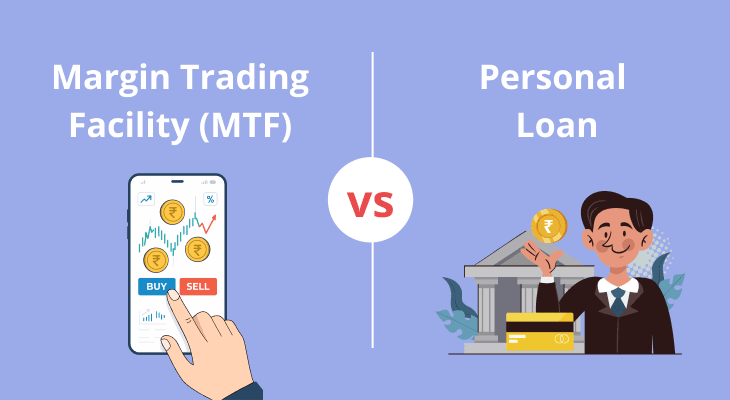
Margin Trading Facility (MTF) vs Personal Loan: Which is Smarter for Leveraged Investing?
July 3, 2026 | 0 mins read
Many investors reach a point where they want to invest more than their available capital. At that stage, you may consider borrowing to invest. Two common ways to do this are using a Margin Trading Facility (MTF) through your broker or taking a personal loan from a bank.
FAQ
To find the top stocks for Margin Trading, you should look for companies with high liquidity and steady performance. Brokers like m.Stock typically allow MTF on stocks that are easy to buy and sell quickly and reduce the risk while using leverage. Generally, large-cap stocks in the Nifty 50 or Nifty Next 50 are safer because they tend to fluctuate less.
When you choose stocks for MTF, it’s important to check the broker’s approved list and pick scripts that get up to maximum funding. The right stocks will depend on your trading strategy, risk tolerance, and the options provided by your broker.