
How to Read an Annual Report Like a Pro
- What an annual report reveals about a company
- Importance of each section in the report
- Key components and what they signify
- How to locate and interpret essential information
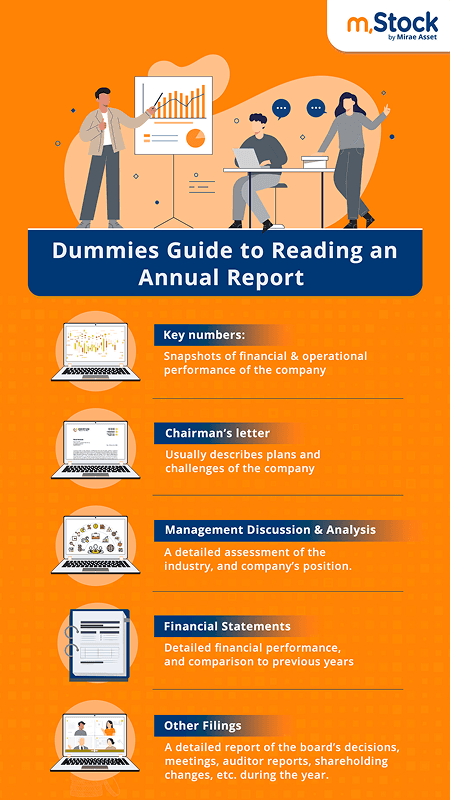
Reading an annual report might feel overwhelming at first, especially if you're just starting your investing journey. But with the right approach, this skill becomes a powerful tool in your decision-making arsenal. Consider this your guide to navigating the annual report with clarity and confidence one section at a time.
By now, you understand that every company releases its annual report yearly, and no two reports across different years even for the same company, are exactly alike. That’s why it's critical to examine each year’s report carefully to assess a company’s progress, goals, and health.
What’s Included in an Annual Report?
To truly understand how a company is performing, you need to dive into its annual report. Here's what typically makes up the document:
Cash Flow Statement
Chairman/CEO's Message
Directors’ Report
Management Discussion and Analysis (MDA)
Auditor’s Report
Notes to Accounts & Related Party Transactions
Let’s explore these one by one and how to read between the lines for maximum insights.
Deep Dive: Reading Between the Lines of Each Section
Notice to Resolution
This section may include proposals like raising directors’ remuneration. While it's legally allowed within limits, pay increases that far outpace company income growth could be a red flag for governance issues. Always evaluate management compensation in the context of company performance.
Message from the Company Head
Usually penned by the Chairman, MD, or CEO, this letter outlines achievements and future outlook. It offers a strategic view, but take it with a grain of salt cross-reference with the numbers in the financial statements to verify claims. Over time, you'll get better at decoding this corporate-speak.
Example: One MD might highlight cost controls in tough times, while another warns about growing competition. Each message reveals more than what’s written it shows the leadership’s mindset.
Directors’ Report & Management Discussion and Analysis (MDA)
This section often addresses industry trends, risks, opportunities, and segment-wise performance. It’s your go-to for understanding what drives the company’s growth and profitability and what could derail it.
Compare this across multiple companies in the same sector to get a macro view of industry trends and how well each company is positioned.
Corporate Governance Report
More investors especially institutions now scrutinize non-financial disclosures just as seriously. Governance reports shed light on internal controls, risk management, board independence, and compliance with ethical standards.
ESG (Environmental, Social, and Governance) practices are now a key lens through which long-term viability is assessed. Look for how the company handles resource use, employee rights, and legal compliance it speaks volumes about future stability.
Pro Tip: This section isn’t about numbers, but it reflects the soul of the organization.
Business Responsibility Report
This report explains the company’s CSR initiatives, employee welfare efforts, and environmental practices. It shows how socially responsible and employee-centric the company is which, in the long run, affects brand loyalty, talent retention, and operational resilience.
The Financial Core: Your Investment Compass
Financial Statements
These include:
Balance Sheet (Assets vs. Liabilities)
P&L Statement (Revenue vs. Expenses)
Cash Flow Statement (Actual cash generation from operations, investing, and financing)
These figures are the heartbeat of a business. Read them over several years and compare them with competitors to identify trends. Use financial ratios (like ROE, debt-to-equity, EBITDA margins) to evaluate strength and sustainability.
Auditor’s Report
This section gives the auditor’s independent opinion on whether the financial statements are fair and accurate. Look out for:
Qualified Opinions
Adverse Comments
Frequent Auditor Changes
If an auditor has resigned citing lack of transparency, tread carefully this could be a serious red flag.
Related Party Transactions
While not illegal, excessive related-party dealings can suggest potential conflicts of interest or misallocation of funds. Look for details like nature, value, and terms of such transactions and how transparently they are reported.
Points to Remember
Don’t skip any section both financial and non-financial reports offer crucial context
Read annual reports of multiple years to understand growth trajectory and recurring patterns
Compare with peers in the industry for a 360-degree view
Read the CEO’s vision, but always validate it against the data
Treat annual reports as your foundation before buying or holding any stock