
Stay Informed about Stock Market Sectors
- Overview of different sectors in the stock market
- How to perform sectoral analysis
- Where to find credible information on market sectors
- Understanding and evaluating businesses within sectors
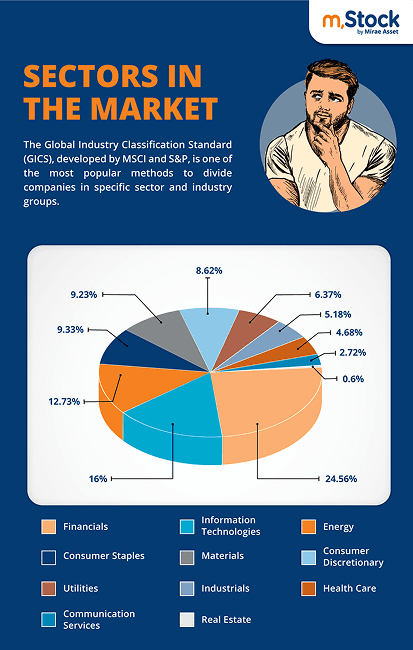
Understanding stock market sectors is fundamental for anyone looking to build a strong investing foundation. In market terminology, a sector refers to a specific segment of the economy grouped by related business activities—such as automobiles, banking, healthcare, or IT.
Companies in the same sector often experience similar growth trends, risks, and regulatory impacts. For example, a surge in crude oil prices may influence logistics and transportation companies, while a disruption in semiconductor supply may ripple across the automobile sector.
By tracking these sectors and their developments, investors can make informed decisions and align their portfolios with the prevailing economic landscape.
Top 10 Stock Market Sectors in India (by Market Cap as of 17 March 2022)
Sector | Market Cap (₹ Cr) |
|---|---|
Automobile & Ancillaries | 14,17,320 |
Banks | 29,70,567 |
Chemicals | 12,75,896 |
Finance | 20,74,690 |
FMCG | 16,98,241 |
Healthcare | 14,16,075 |
Metals & Mining | 12,07,851 |
Oil & Gas | 21,95,112 |
Power | 8,61,745 |
Software & IT Services | 36,78,139 |
Pro Tip: Mastering sectoral knowledge is a core skill for anyone aiming to become a proficient fundamental analyst.
Where to Find Reliable Sector Information
1. Industry Associations
Every major sector in the Indian stock market has an associated industry body. These associations represent the collective interests of member companies and often interact with government agencies for regulatory matters. Importantly, they publish detailed reports on capacity, production, and sector-wide challenges.
Sector | Industry Body |
|---|---|
Cement | Cement Manufacturers Association |
Automobiles | Society of Indian Automobile Manufacturers |
Sugar | Indian Sugar Mills Association |
Tyres | Automotive Tyre Manufacturers Association |
Software & IT | National Association of Software and Service Companies |
Chemicals | Indian Chemical Council |
Real Estate | National Real Estate Development Council (NAREDCO) |
These organizations are treasure troves for sector data and offer clarity on issues impacting industry performance.
2. Newspapers & Online Portals
Business newspapers and financial news portals are daily sources of updates. Keeping up with them helps investors spot macroeconomic trends, policy changes, and sector-specific developments that may impact investments.
3. Annual Reports of Companies
Public companies are legally bound to share annual reports with their shareholders. Within these reports, the Management Discussion and Analysis (MD&A) section provides a snapshot of the sector’s performance and challenges. These insights often include detailed commentary on the economic environment, supply chains, and regulatory factors.
4. Analyst Conference Calls
After quarterly results, companies often host conference calls with analysts. These sessions provide real-time insights into company and sector trends, demand-supply dynamics, input costs, and future guidance. Many companies upload transcripts on their investor relations pages or stock exchange filings.
5. Economic Surveys and Union Budget
The Economic Survey, released annually before the Budget, offers an overview of the performance and outlook for various sectors. Meanwhile, the Union Budget lays out specific allocations and policy changes impacting sectors like infrastructure, housing, agriculture, and manufacturing.
6. Company Prospectus
Whenever a firm plans to raise funds via an IPO or FPO, it must file a prospectus with SEBI. These documents outline sectoral trends, growth projections, and industry-specific risks. It’s a valuable source for understanding sector dynamics from a company's lens.
How to Analyse Sectors Effectively
Now that you know where to find sectoral data, the next step is learning how to interpret it. Effective sector analysis involves regularly tracking both macroeconomic and microeconomic indicators relevant to the industries you follow.
Key Factors to Monitor:
1. Demand-Supply Trends
Understanding the balance (or imbalance) between supply and demand is crucial. Disruptions like factory shutdowns, capacity expansions, or labor strikes can skew this equilibrium and impact prices significantly.
2. Anticipated Demand
Sector growth often mirrors the health of related user industries. For instance, a rebound in the real estate sector typically boosts the demand for cement, tiles, and construction equipment.
3. Raw Material Availability
Global events—ranging from wars to natural disasters—can impact the availability and cost of raw materials. Take the Russia-Ukraine conflict as an example: it spiked global prices for oil, metals, and fertilizers.
4. Government Policies
Budget announcements, tax revisions, and new schemes can dramatically shift sectoral outlook. For instance, programs like Swachh Bharat Mission and the promotion of LED usage created tailwinds for related manufacturing sectors.
5. Global Events
Always factor in international developments. Export-import regulations, geopolitical tensions, or agricultural issues abroad can affect domestic industries. An analyst must keep a global radar while assessing local sector dynamics.
Points to Remember
Sectoral analysis is a crucial pillar of top-down fundamental investing. With fewer sectors than individual stocks, tracking sectors allows you to simplify your research process and make more strategic investment choices.
By staying informed through the right sources and refining your analytical lens over time, you’ll be better equipped to spot opportunities—and risks—across different phases of the economic cycle.