
December 11, 2025 | 3 min read
Flight schedule cut hits IndiGo parent InterGlobe Aviation's share price
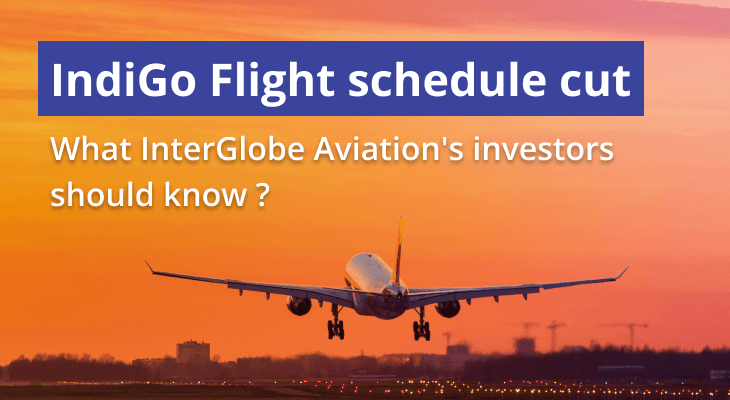
India’s largest airline by market share, IndiGo, was ordered by the aviation ministry to cut 10% of its winter schedule. Following this order, IndiGo cut its Q3FY26 capacity and passenger revenue guidance, acknowledging that both available seat kilometers (ASKs) and unit revenues will be weaker than earlier estimates.
InterGlobe Aviation Ltd share price fell around 16% in the past week to under ₹5,000. This was the first time in 8 months that the company’s shares traded below ₹5,000. It erased over ₹34,000 crore in market value of the company amid the cancellation news, DGCA orders, and guidance cuts.
The latest turbulence for India’s largest airline is not just about flights on the ground. It is also about how investors should reassess risk, earnings, and valuation over the next few quarters.
How will this impact InterGlobe Aviation’s investors?
The impact shows up across multiple dimensions like the airline’s expansion plans, profitability, possible leadership changes, market share, and operational impact.
1. Long-term impact on IndiGo’s fleet and capacity
Over the winter schedule, IndiGo is asked to cut about 10% of its approved flights, which is roughly 230 services a day. Management needs to redeploy aircraft and crew to ensure that the reduced schedule runs on time. Over the medium term, this can slow the pace at which IndiGo ramps up new routes or frequencies, especially on marginal or experimental sectors.
2. Effect on global expansion
For global expansion, management will likely be more cautious in opening new international destinations or increasing capacity until operational reliability is fully restored. Large commitments, like orders for new aircraft or setting up international bases, could slow down if regulators or the board require more cautious planning.
3. Leadership crisis risk
The Civil Aviation Minister, Ram Mohan Naidu, called IndiGo’s problems an ‘internal mess and directly blamed crew rostering and planning, in an interview to a news channel. He also alluded to the possibility of the central government relieving the CEO of the airline of his duties. This expands the crisis for IndiGo from a mere operational concern to an issue of governance and leadership. Understand how it will impact the airline’s leadership below.
- Weaken management’s negotiating position with regulators and staff,
- If the CEO or key operations heads are replaced or reshuffled
- Decision-making could slow down during the transition period
- Business strategy needs to be reevaluated, and execution risks will crop-up
4. How can competitor’s benefit
If the dominant player like IndiGo is forced to pull back capacity, rivals like Air India, Akasa Air, SpiceJet get a window to step in. The 10% cut in IndiGo’s flights, and the dent in its perception, opens opportunities for competitors:
- They can add capacity on key tier 1 and tier2 routes where IndiGo has cut flights to capture existing both dissatisfied customers.
- Corporate and high value travellers, who prefer reliability over the cost, may shift towards competitors.
Over time, if competitors successfully use this window to strengthen their presence on profitable routes and win corporate contracts, IndiGo’s relative pricing power could soften, even if its absolute market share remains high.
5. Effect on IndiGo’s market share
The forced 10% cut in flights, and the reputational damage imply that IndiGo Airlines market share is likely to dip from its 60%+ level, as other airlines fill the gap. Even a few percentages points shift can be meaningful in a concentrated market like India.
So, there is risk of IndiGo loses its dominance entirely or can move from ‘monopoly’ to ‘strong leader with slightly less share’.
6. Impact on retail investors
As IndiGo’s promoters pared their stakes over the years, the retail investor and mutual fund holding of its outstanding share has risen considerably. Mutual fund ownership in InterGlobe Aviation has risen to about 17%–18% at the end of September 2025 from around 6%–8% in late 2022. Public shareholding has also edged up to a little over 5% from roughly 2%–3% over the same period.
This means any hit to earnings or valuation from the flight cuts, higher costs or leadership uncertainty directly affects a wider base of investors through their equity funds and direct holdings.
7. Revenue & Profit Margins
IndiGo has revised its Q3FY26 capacity growth guidance from ‘high teens’ to ‘high single to nearly double digits’. That means the airline will fly fewer seats than planned, directly hurting future revenue.
On top of that, instead of earlier expectations of flat to mildly positive trends, management now expects a mid-single digit decline in passenger unit revenue (PRASK) for Q3. Lower capacity plus weaker unit revenue is a clear negative for near-term topline growth.
More Related Articles
Understanding the meaning and benefits of the systematic trading system
 October 23, 2026 | 0 mins read
A systematic trader is an individual who uses a predesigned and backtested trading strategy to buy and sell financial instruments such as stocks, futures, currencies, or commodities. Instead of relying on gut feelings or emotions, they use a systematic trading system built on predefined rules, quantitative analysis, and technology to make trading decisions.

Muhurat Trading 2026: Will stock market be open on 8th November Sunday?
October 23, 2026 | 0 mins read
Muhurat Trading 2026 will be held on Sunday, 8 November 2026, on Diwali Laxmi Puja. NSE and BSE will open their equity markets for a special afternoon session, with continuous trading beginning at 2:20 pm IST. Trading in securities not covered by the Closing Auction Session (CAS) will continue until 3:30 pm, while continuous trading in CAS-eligible securities will end at 3:15 pm. For investors, Muhurat Trading combines a long-standing Diwali tradition with an opportunity to participate in the stock market. Here is a guide to the date, timings and session structure for 2026.

How stock market psychology influences investment decision-making
October 23, 2026 | 0 mins read
Stock market psychology refers to the collective emotions, sentiment, and behavioural biases that influence the buying and selling decisions of investors. Rather than relying on fundamental and technical analysis, investors may sometimes react based on emotions, which can influence market movements.