
March 27, 2026 | 5 min read
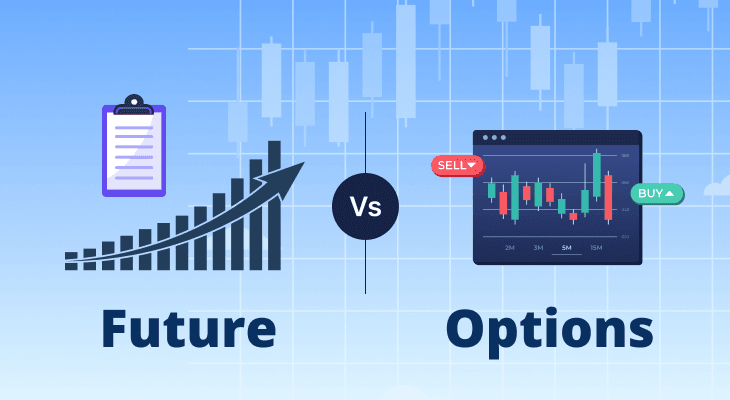
Future & Options: Quick Overview & Difference
Understanding tools like options and futures is critical to succeed as a trader. Options and futures, which are traded on exchanges such as the Bombay Stock Exchange (BSE) and the National Stock Exchange (NSE), provide an avenue for both risk management and profit generation in the stock markets. In this blog, we'll look at the differences between options and futures, including their unique features, benefits, and how investors utilise them.
Understanding Options and Futures
Options and futures are critical components of the stock market, providing investors with an array of trading and risk management options. Before getting into the details that distinguish them, let's review the key concepts that constitute options and futures contracts.
Both options and futures are standardised agreements traded on exchanges such as the BSE and NSE. A futures contract requires the buyer or seller to buy or sell the underlying asset at a defined price on a specific future date. In contrast, an options contract gives the holder the right (but not the responsibility) to buy (call option) or sell (put option) the underlying asset at a fixed price before the contract ends.
To show the difference between futures and options, consider this example: Assume you're interested in buying gold. A futures contract involves purchasing a particular amount of gold at ₹50,000 per ounce over a three-month period. An options deal involves paying a premium upfront to buy gold at ₹50,000 per ounce within three months. The fundamental contrast is the obligation: with futures, you must complete the contract, but in options, you have a choice.
Let's examine the workings of options and futures trading. Both products require a margin account with a broker, which allows traders to leverage their positions. They are frequently used to hedge against price swings or speculate on market trends. For example, a farmer may utilise futures contracts to lock in a price for their crop, protecting against adverse price swings. Similarly, an investor may buy put options to safeguard their stock portfolio against a future decline.
Options vs Futures - Which is Better?
When considering the choice between options and futures, you might be confused about which road to take. Here are the differences between these financial products, allowing you to make an informed decision based on your financial goals and risk tolerance.
Meaning
Let us begin our research by examining the basic difference between options and futures. Futures contracts are contractual agreements to exchange an underlying asset at a defined price on a specific future date. On the other hand, options provide you the freedom to decide whether or not to execute the contract, providing flexibility that futures do not.
Risk
As we explore further, we come across the problem of risk, which is an important factor for any smart investor. Futures, with the possibility for endless gains or losses, might be compared to a high-risk bet. Options, on the other hand, limit your downside risk and provide some stability in the face of market volatility.
Profit Or Loss
In futures, the potential profits or losses are essentially limitless. However, the risk is reduced in the case of options, where possible losses are limited, although at the expense of limited potential gains.
Obligation
One of the major differences is in the area of responsibility. When you trade futures, you are contractually obligated to complete the deal. Options, on the other hand, provide you the ability to decide whether or not to proceed with the contract, giving you power of choice.
Contract Execution
Another important factor to consider is the timing of contract execution. Futures contracts require execution on a specific date, providing limited possibility for improvisation. Options, on the other hand, provide you the flexibility to execute the contract before it expires.
Advance Payment
Futures have no upfront costs, making them appealing to risk-tolerant investors. Options, on the other hand, require you to pay a premium up front as a safety against future losses and the ability to opt out if conditions change.
Both options and futures provide different possibilities and risks appealing to a wide range of investors. Whether you're a risk-taker looking for unlimited profit opportunities or a careful strategist trying to hedge against market volatility, there's a financial instrument for you.
What is the Difference Between Futures and Options Trading Based on Liquidity?
Futures contracts have a greater trading volume and market depth than options, hence they are more liquid. Futures have narrower bid-ask spreads and reduced transaction costs, making them more appropriate to active trading. In contrast, options contracts, with their lower trading volumes and possibly wider spreads, may make it difficult to execute complicated trading strategies efficiently. Liquidity is critical in determining the ease and cost-effectiveness of trading, with futures contracts outperforming options in this regard.
Options vs Futures Difference Based on Capital
Futures trading requires a smaller initial investment because there is no upfront premium. However, risks are higher, with the possibility for unlimited losses. Options trading requires a premium payment up advance, limiting risk to the premium amount. Futures do not suffer from time decay, however options do, affecting their value over time. Futures margin requirements change with market circumstances, although options margin needs are often smaller. Both provide leverage, although futures provide greater leverage than options. Understanding these distinctions is critical for effective capital management, as it allows you to make informed trading decisions that are consistent with your risk tolerance and financial objectives.
Conclusion
Knowledge is power when it comes to trading in the stock market. Understanding the differences between options and futures allows you to identify strategic opportunities to protect your investments and maximise returns. Futures provide liquidity and potential returns, while options provide flexibility and risk mitigation. Whether one chooses futures or options, comprehending these products allows you to operate in the markets with confidence, enhancing the chances of success in your trading pursuits.
More Related Articles
Understanding the meaning and benefits of the systematic trading system
 October 23, 2026 | 0 mins read
A systematic trader is an individual who uses a predesigned and backtested trading strategy to buy and sell financial instruments such as stocks, futures, currencies, or commodities. Instead of relying on gut feelings or emotions, they use a systematic trading system built on predefined rules, quantitative analysis, and technology to make trading decisions.

Muhurat Trading 2026: Will stock market be open on 8th November Sunday?
October 23, 2026 | 0 mins read
Muhurat Trading 2026 will be held on Sunday, 8 November 2026, on Diwali Laxmi Puja. NSE and BSE will open their equity markets for a special afternoon session, with continuous trading beginning at 2:20 pm IST. Trading in securities not covered by the Closing Auction Session (CAS) will continue until 3:30 pm, while continuous trading in CAS-eligible securities will end at 3:15 pm. For investors, Muhurat Trading combines a long-standing Diwali tradition with an opportunity to participate in the stock market. Here is a guide to the date, timings and session structure for 2026.

How stock market psychology influences investment decision-making
October 23, 2026 | 0 mins read
Stock market psychology refers to the collective emotions, sentiment, and behavioural biases that influence the buying and selling decisions of investors. Rather than relying on fundamental and technical analysis, investors may sometimes react based on emotions, which can influence market movements.
FAQ
While options provide the holder the option to execute the contract or not, futures contracts require the transaction to be completed at a defined price and date. Each financial instrument's risk exposure and flexibility are shaped by these differences in commitments.