
January 13, 2026 | 5 min read
Liquid Funds vs Liquid ETFs: Understand the Difference
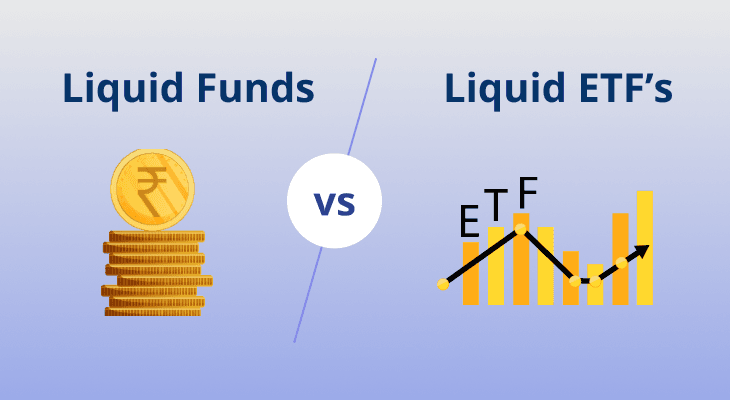
When you need a place to park your money for a few days or weeks instead of letting it sit idle in a savings account, liquid funds and liquid ETFs are among the most popular options. Both are designed for short-term investments, preserve capital, and generate slightly better returns than traditional bank accounts; but they work differently.
Understanding the difference between liquid funds and liquid ETFs can help you choose the right instrument for your goals. Let’s explore both options in depth, compare them, and see how you can invest wisely.
Introduction to Liquid Funds and Liquid ETFs
Before comparing the two, it’s important to understand what each product means and how it works.
Liquid Funds:
Liquid funds are a type of debt mutual fund that invests in short-term debt instruments such as Treasury bills, commercial paper, and certificates of deposit. Their maturity is usually less than 91 days, making them low-risk and highly liquid.
- Key Features:
- High liquidity – redemption processed within 24 hours (T+1).
- Low-risk exposure compared to equity or long-term debt.
- Suitable for parking idle money or building an emergency corpus.
- Applicability: Best for investors who prefer fund manager oversight and simple redemption.
- Return Expectation: Slightly higher than savings account interest rates.
- Risk Level: Low, but not entirely risk-free as NAV can fluctuate slightly.
- Redemption: T+1 (money credited the next business day) or instant redemption up to ₹ 50,000/day for eligible investors.
Liquid ETFs:
Liquid ETFs (Exchange Traded Funds) are also designed to park money for the short term, but they are traded on the stock exchange like shares. They mirror the performance of a liquid index that tracks money market instruments.
- Key Features:
- Can be bought and sold on NSE/BSE in real time.
- Requires a Demat and trading account (like m.Stock).
- Costs are transparent, with low expense ratios.
- Applicability: Ideal for investors comfortable with stock market trading platforms who want real-time liquidity and low cost.
- Return Expectation: Similar to liquid funds but slightly more transparent due to real-time market pricing.
- Risk Level: Low, but you may see minor price variations intra-day.
- Liquidity: Can be sold anytime during market hours via a demat account.
Liquid Funds vs Liquid ETFs
Both liquid funds and liquid ETFs serve the same broad purpose, short-term parking of money, but their mechanism and access are different.
- When Liquid Funds Make Sense: Ideal for investors without a demat account, looking for easy redemption and overnight access. Good for those who prefer automated SIP/STP options and want to use liquid funds as a parking spot before switching to equity funds. For example, if you invest ₹50,000 today, you can redeem it tomorrow morning and have the funds credited to your bank account in 1-2 business days.
- When Liquid ETFs Make Sense: Suitable for investors who already have a demat account and want to buy/sell on the exchange at live prices. Best for corporates, HNIs, and active investors who want to park large sums intraday and enjoy real-time transparency. If you hold a liquid ETF in your Demat, you can sell it on the exchange anytime and get the cash by T+0 (or T+1) settlement, just like selling shares.
Liquid Funds Vs Liquid ETFs
Feature | Liquid Funds | Liquid ETFs |
|---|---|---|
Structure | Mutual fund (pooled) product investing in debt instruments | Exchange-traded product tracking a liquid index |
Access | Invest via AMC, broker, or MF platform (no demat required) | Requires demat and trading account |
Liquidity | Redeemable at end-of-day NAV (T+1 settlement or instant up to limit) | Can be bought/sold in real-time during market hours |
Pricing | Based on daily NAV (once a day) | Based on live market price (may have small premium/discount) |
Transparency | NAV published once per day | Portfolio and price visible real-time |
Minimum Investment | Typically ₹100 – ₹500 | Usually 1 unit (approx. ₹1,000 depending on ETF price) |
Expense Ratio | Slightly higher due to mutual fund management | Usually lower than liquid funds |
Best For | Investors seeking simple, no-hassle liquidity | Market-savvy investors comfortable with trading |
Pros and Cons of Liquid Funds and Liquid ETFs
Pros of Liquid Funds
- Easy redemption process without market participation.
- Suitable for new investors who don’t use trading platforms.
- Auto-sweep facilities available in some AMCs.
Cons of Liquid Funds
- Slightly higher expense ratios compared to ETFs.
- NAV is fixed once daily, no intra-day tradability.
Pros of Liquid ETFs
- Lower cost due to reduced fund management overheads.
- Real-time buy/sell flexibility on stock exchanges.
- Transparent pricing close to actual NAV.
Cons of Liquid ETFs
- Requires Demat and trading account.
- Only tradable during market hours.
- Liquidity depends on market volumes; sometimes spreads can be wide.
How to Invest in Liquid Funds and Liquid ETFs
Investing in Liquid Funds
- Directly through AMC websites or apps.
- Through distributors or mutual fund platforms.
- Minimum investment is generally ₹100 to ₹500 00.
Investing in Liquid ETFs
- You need a Demat and trading account, such as with m.Stock.
- Simply search for the liquid ETF ticker (e.g., Nippon India ETF Liquid BeES), enter units, and buy like a stock.
- Minimum investment is typically one unit (around ₹1,000).
With a digital investment platform like m.Stock, you can open an account online in minutes and invest in both mutual funds and ETFs from one platform, ensuring flexibility and ease of management.
Things to Note Before Investing
- Taxation: Both liquid funds and liquid ETFs are taxed as debt investments. As per the current taxation rules, all gains are taxed as per your income slab, irrespective of the holding period.
- Emergency Fund Strategy: If you want money available 24/7, liquid ETFs may be better (since you can sell during trading hours instantly). If you prefer simple withdrawal without worrying about market orders, liquid funds work better.
- Expense Ratios: Liquid ETFs are usually cheaper than liquid funds. For investors parking large sums, cost efficiency can make a difference.
- Use Case Balance: Some investors use both liquid funds for convenience and liquid ETFs for real-time access when markets are open.
Conclusion
Both liquid funds and liquid ETFs are excellent tools for short-term investing and parking idle funds safely. While liquid funds offer simplicity and ease of redemption, liquid ETFs provide real-time flexibility and lower costs for market-savvy investors.
The smarter choice depends on your preferences:
- If you value ease and no Demat requirement, go for liquid funds.
- If you already trade and want real-time control with lower costs, liquid ETFs are ideal.
For most investors, a combination of both may provide the perfect balance between convenience and flexibility.
More Related Articles

How to Pledge Mutual Funds for Margin?
 August 11, 2026 | 0 mins read
Many investors today hold sizable investments in mutual funds while also actively participating in stock market trading, derivatives, or margin-based strategies. In such situations, investors often face a practical challenge: they may want additional trading margin without liquidating their long-term investments.
Is Gold ETF better than Gold Mutual Fund?
August 7, 2026 | 0 mins read
Gold has once again become a major talking point among Indian investors. Rising geopolitical tensions, global inflation concerns, central bank buying, and economic uncertainty have pushed gold prices sharply higher in recent years. In 2025 and early 2026, international gold prices repeatedly touched record highs, while domestic gold rates in India also surged due to both global prices and rupee movement.

How to Build a Retirement Plan Using SWP vs Annuity
August 6, 2026 | 0 mins read
Retirement is one of those milestones that seem far away until suddenly they are not. After two decades of advising individuals on their financial futures, one truth keeps surfacing: a retirement plan built on hope rather than structure is a plan waiting to fail.
FAQ
Yes, liquid ETFs can be sold anytime during stock market hours through your trading platform. Once sold, the funds are credited to your account on a T+1 basis, similar to selling shares. However, unlike liquid funds, you cannot redeem them outside market hours.