
May 15, 2025 | 6 min read
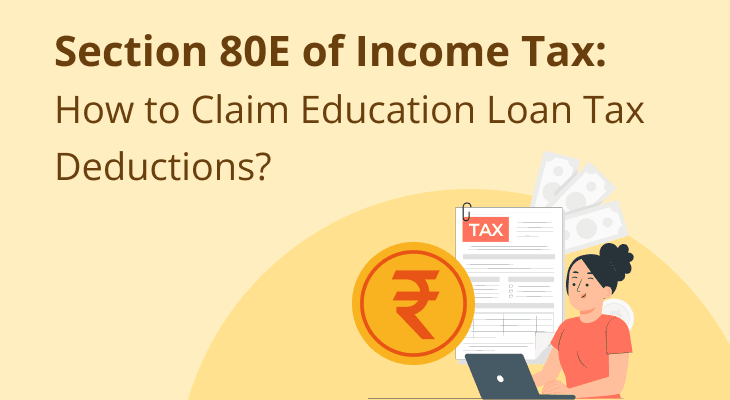
Section 80E of Income Tax: How to Claim Education Loan Tax Deductions?
Higher education can be expensive, and many students rely on education loans to pay for their studies. To give financial relief, the government allows tax deductions on the interest paid on such loans under Section 80E of the Income Tax Act, 1961. This provision reduces the overall tax burden for individuals repaying an education loan.
Unlike Section 80C, which has a capped deduction, Section 80E has no upper limit on the amount you can claim. However, only the interest portion of the loan repayment is eligible for this deduction. Whether you took out a loan for yourself, your spouse, your children, or a legally dependent student, understanding the 80E loan deduction can help you save on taxes.
Eligibility to Claim Deduction
To qualify for an education loan tax deduction under Section 80E, you must meet the following criteria:
- This benefit is available only to individuals, not Hindu Undivided Families (HUFs) or companies.
- The education loan should be taken from a reputed financial institution or a registered charitable organisation. Loans from family or friends do not qualify.
- The deduction is only applicable if the loan is taken for higher education, whether in India or overseas.
- The deduction can be claimed by either the parent or the student, depending on who repays the loan.
- The person claiming the deduction should be the one who repays the loan.
These eligibility conditions ensure that the deduction is used for genuine education expenses and not misused.
Amount of Deduction and Duration
The deduction under Section 80E applies only to the interest component of the loan, not the principal amount. One of the primary benefits is that there is no maximum limit on the amount you can claim. If you pay a high interest amount, you can deduct the entire sum from your taxable income.
However, there is a time limit on claiming the deduction:
- You can take advantage of this benefit for a maximum period of 8 years.
- If you repay the loan before 8 years, you can only claim the deduction for the years in which repayment occurred.
- If the repayment period goes beyond 8 years, the deduction is no longer applicable after the eighth year.
For example, if you start paying the loan in 2023 and pay it back by 2027, you can claim deductions for only 5 years. But if your repayment continues until 2032, you can claim it only for 8 years, and not after that.
Important Documents Required to Claim the Deduction
To claim the 80E education loan tax deduction, you need to provide certain documents as proof:
- Loan sanction letter: Issued by the financial institution to confirm that the loan is for higher education.
- Repayment certificate: A document from the lender detailing the breakup of principal and interest amounts paid in the financial year.
- Bank statements: If needed, Bank statements showing the EMI deductions for the education loan.
- Income tax return (ITR) details: Where the deduction is claimed.
Without proper documentation, your claim can get rejected in case your income tax return is taken up for scrutiny by the Income Tax Department, so it is important to keep these records updated and ready for verification.
Step-by-Step Guide to Claim the Benefits
Claiming the education loan tax deduction under Section 80E is a simple process, but ensuring accuracy is crucial to avoid issues during tax filing. Here is a detailed step-by-step guide to help you claim the deduction correctly:
Step 1: Verify Eligibility
Before applying, make sure that you meet all the eligibility criteria:
- Taking an education loan from a reputed financial institution or charitable organisation.
- Loan is for higher education, whether in India or abroad.
- Deduction applies only to the interest part of the repayment, not the principal amount.
- Only the person repaying the loan can claim the deduction, whether it is the student or their parent.
Step 2: Obtain the Loan Repayment Certificate
A loan repayment certificate is required to claim the Section 80E deduction. This document, provided by the lending institution entails:
- The total amount paid during the financial year.
- A breakdown of principal and interest payments.
Since only the interest amount is applicable for the deduction, this document helps ensure accurate reporting.
Step 3: Collect Additional Supporting Documents
While filing your income tax return (ITR), you might need to provide additional documentation for verification:
- Bank statements showing EMI payments.
- Loan sanction letter to confirm that the loan was taken for educational purposes.
- Interest payment receipts if asked for by the tax department.
Although you do not need to submit these documents while filing your ITR, it is advisable to keep them ready.
Step 4: Fill in Your Income Tax Return (ITR) Accurately
When filing your ITR, go to the deductions section under Chapter VI-A and enter the total interest paid under Section 80E.
Ensure you:
- Accurately input the interest paid amount as mentioned on your loan repayment certificate.
- Do not include the principal repayment, as it is not eligible for deduction.
- Double-check all details to avoid errors.
Step 5: Verify Your Tax Return Before Submission
After entering the education loan tax deduction details, verify your ITR using:
- Aadhaar-based OTP authentication (online).
- Net banking verification (if applicable).
- Physical ITR-V submission (if filing manually).
Verification is required to ensure that your claim is successfully processed.
Step 6: Keep Track of Future Repayments
Keep track of your payment schedule because the Section 80E deduction is only valid for 8 years. If you complete the repayment earlier, you can only receive the benefit for the years in which you paid interest.
By following these steps, you may maximise your tax benefits while avoiding common mistakes.
Common Mistakes to Avoid When Applying for Deductions
While claiming the Section 80E deduction, avoid these common mistakes:
- Claiming the principal amount: Only the interest part is applicable for a tax deduction.
- Taking a loan from an unrecognised source: If your loan is from friends or relatives, you cannot claim the tax benefit.
- Not checking the repayment period: The deduction is valid for 8 years only. Make sure you plan your repayment accordingly.
- Missing documentation: Without the necessary documents, your claim can be rejected. Always get a repayment certificate from your lender.
- Incorrectly filling the tax return: Incorrect details entered while filing ITR can cause delays or rejection of the claim.
Avoiding these mistakes allows you to maximise your tax savings and ensure a smooth filing process.
Conclusion
Education loans provide financial resources for students pursuing higher education. The education loan tax deduction under Section 80E reduces taxable income, resulting in significant savings. Since there is no limit to the deduction amount, this provision benefits those who pay a high interest on education loans.
However, it is important to keep track of repayment schedules, maintain proper documentation, and avoid common mistakes to claim the deduction successfully. This allows you to lower your tax burden while also focusing on your academic and professional goals.
More Related Articles
Why Early Tax Planning Matters in Financial Year FY2026-27
 July 8, 2026 | 0 mins read
Amid the sea of financial obligations, tax planning often takes a back seat. Yet it should be one of the most important considerations when managing finances, as it offers several advantages. Early tax planning becomes even more important in 2026, given the evolving global environment, changing tax regulations, and shifting financial priorities. This article explains why early tax planning matters, practical ways to approach it, and common mistakes to avoid.
What Happens If You Don’t File ITR?
July 3, 2026 | 0 mins read
Filing your Income Tax Return (ITR) is not just a yearly formality. It is a legal responsibility if your income crosses certain limits or falls under specific conditions. Many taxpayers assume that skipping the process will not have serious consequences, especially if they believe they do not owe any tax. However, if you ignore income tax return filing, the consequences can go beyond a simple fine.
Income Tax Act 2025 Explained: Key Changes Effective from 1 April 2026
July 1, 2026 | 0 mins read
The Income Tax Act 2025 feels like a long-overdue reset button. From 1 April 2026, the familiar but exhausted 1961 law finally retires. In its place comes a reorganized statute that is structured and drafted with today’s digital-first economy in mind. To be clear, this isn't a sudden announcement about any major tax change. Your rates under the new income tax regime do not automatically jump or drop just because of this shift. What changes is the structure of the law, how it is arranged, defined, and read. We are looking at fewer sections, clearer grouping, and a lot less scattered drafting.
FAQ
You can claim a deduction under Section 80E if the diploma course qualifies as higher education and is pursued after Class 12 from a recognised institution. Loans for vocational or unrecognised courses are not eligible for this deduction.