
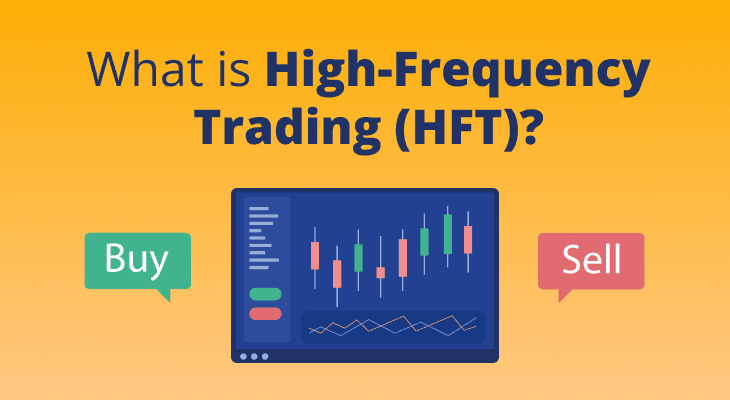
December 24, 2024 | 6 min read
What is High-Frequency Trading (HFT)?
High-frequency trading (HFT) is a relatively new method of trading, aligned with developments of the digital age in which we live. HFT trading, as it is called, refers to algorithmic trading that features trades being executed rapidly, not to mention a large number of trading transactions operating. Additionally, traders who engage in this kind of trading have a short-term investment horizon. The key to the effective use of HFT is the leveraging of special software housed in unique computers to achieve the execution of trades at the highest speeds possible.
The trading strategy may appear complex to some investors, and consequently, it is typically used by large and competent institutional investors like hedge funds and investment banks. The method of high-frequency trading employs complex algorithms to analyse individual stocks with a view to spotting evolving trends within a millisecond time frame. Such a strategy results in a substantial amount of purchase orders that may be conveyed in a few seconds if the analysis detects a trigger.
What is high-frequency trading (HFT)?
High-frequency trading may be described as a method of trading that employs cutting-edge technology coupled with algorithms to operate quick transactions on the trading floor. The process mainly has its basis in automation and speed to capitalise on slight price differences occurring in the financial markets. HFT trading aims to achieve profits from such momentary opportunities by conducting trades at a brisk pace.
How does high-frequency trading work?
The principle of HFT or high-speed trading is essentially a combination of efficiency and speed to conduct trades using algorithms that match certain criteria for trading. HFT companies use sophisticated and advanced technology and powerful computerised devices to analyse extensive market data in a real-time scenario. The systems of HFT are responsible for the identification of patterns, price discrepancies, and trends that allow traders to take advantage of the most minor differentials in price.
What is algorithmic trading?
Now that you know the answer to the question, “What is high-frequency trading?”, you may find it easy to grasp the concept of algorithmic trading. Basically, algorithmic trading forms a subset of high-speed trading or high-frequency trading. It involves algorithms or instructions that are pre-programmed and work to conduct trades in an automatic manner. The algorithms that are embedded into such systems are designed to work according to predetermined rules and prefixed criteria to make decisions in trading.
As you may have understood by now, algorithmic trading is a complex way to trade because it is engaged in complex systems. However, it proves to be a boon to institutional trading firms as they deal in bulk trades that can be executed with great speed, not to mention the elimination of human bias and emotions, and human error in general. HTF trading using algorithms is solely dependent on an analysis that is driven by data, and this makes it an objective way to trade.
Advantages of High-Frequency Trading
As high-frequency trading eliminates any kind of human error and works quickly enough to make the most of lucrative trading opportunities, it is a much sought-after method of making trading transactions work. The method has key advantages and these are highlighted below:
- Boosted Market Efficiency: High-frequency trading promotes and enhances market efficiency. Consequently, the overall market gets a boost when this facilitates the identification and correction of any anomalies in the market.
- Provision of Liquidity in Markets: HFT gives rise to liquidity in the market as several trades are conducted rapidly. This ensures that there are buyers and sellers available for a range of securities.
- Efficient Discovery of Price: HFT improves price discovery and makes it more efficient as new information about asset prices is incorporated very quickly.
- Reduction in Bid-Ask Spreads: HFT trading involves huge trading volumes that permit HFT companies to narrow down bid-ask spreads. This benefits individual investors.
Strategies of High-Frequency Trading
Within the broad category of high-frequency trading, various strategies are employed depending on the trades to be executed. Here are the strategies employed in high-frequency trading:
- Statistical Arbitrage
HFT firms use statistical arbitrage as a strategy to identify pricing and exploit inefficiencies in price between financial instruments that are related to each other. In this strategy, the analysis of statistical models and historical data is used to identify correlations and patterns to execute trades when the said patterns show shifts from their predicted values.
- Market-Making
HF trading can engage market-making strategies by providing liquidity through the continuous quoting of buy and sell prices related to certain securities. A liquid market is ensured and profit from the bid-ask spread may be maintained by constantly being ready to buy or sell securities.
- Tick Trading
This is a strategy in which HFT companies make the most of minor price shifts or “ticks” in the price of a specific security. HFT firms aim to make profits from such small differentials in price by the execution of several trades quickly.
- Quote Stuffing
In HFT trading, quote stuffing is used as a technique to swamp a trading venue by executing several buying and selling orders rapidly. Due to many trades being engaged in quickly and a general rush of activity, confusion is often created in the market. In turn, this disrupts the process of decision-making of other market participants and gives an edge to HFT firms.
Risks of HIgh-Frequency Trading
High-frequency trading may be a complicated way to trade for individual traders and investors, but for large firms, it is easy as they have the personnel to execute these trades in a proficient and professional manner. Still, the strategy is linked with many risks, mentioned below:
- Regulatory Risks: HF trading is governed by certain regulations and ethical standards while trading activities are conducted. This is done to curb market manipulation and unethical market activities. Any non-compliance with regulations and ethical practice standards can result in negative legal consequences and damage to any HFT firm’s reputation.
- Operational Risks: Since high-frequency trading relies on technology and automation, system failures, technical issues, or connectivity glitches can lead to crucial financial losses.
- Model Risks: Strategies that use HFT depend heavily on intricate algorithms and complex models. Flawed and inaccurate models and systems can cause significant losses.
Conclusion
HFT trading may be the answer to a trader’s dreams of trading in a quick, smooth, and efficient way, but there are certain risks to be aware of while using the strategy. High-frequency trading utilises the latest technology, rapid execution, and complex algorithms to take advantage of small discrepancies in the prices of securities in the markets. Traders and firms using such strategies must be savvy with technology, not to mention be cautious of the risks involved. The key to efficient and productive trading is to strike the right balance between integrity in the market and the use of advanced technology to achieve profits.
More Related Articles
A Complete Guide on How to Open Trading Account
 May 26, 2026 | 0 mins read
You cannot trade in the stock market with a Demat account. Yes, a Demat account merely stores your assets. The actual buying and selling of assets (shares in this case) takes place in a trading account. In essence, Demat, trading, and bank account are all interlinked and crucial for you to execute a successful trade. When you buy shares, money is first transferred from your bank account to your trading account. Once the transaction goes through, the shares are credited to your Demat account. This is why opening a trading account is a must if you want to trade in the stock market.

7 factors to consider while opening Trading account online
May 22, 2026 | 0 mins read
Want to open a trading account and invest in the financial markets? For a first-time investor, the process of opening a trading account seems like a daunting task. There are many factors involved that determine which trading account will be best suited to your needs. So it’s natural to be filled with doubts and questions. To help you make an informed decision, we’ve compiled a list of 6 factors to consider while opening a trading account online.
How to trade online using a Trading account?
May 22, 2026 | 0 mins read
There were times when share markets were crowded with traders and investors gesturing and crying out to buy and sell shares. However, online trading has changed the game. Online trading was first implemented in India by the Securities and Exchange Board of India (SEBI) in January 2000. This digital mode took over the functioning of the market when the Indian regulations mandated every investor to get their online trading and demat account. The use of online trading and demat accounts has facilitated the reduction of paperwork and minimised the risk of fraud and theft associated with physical securities.
FAQ
Yes, HFT trading is entirely legal in India but is governed by regulations issued by the Securities and Exchange Board of India (SEBI). The regulations related to HFT and algo (algorithmic) trading can be found on the SEBI website and rules must be strictly adhered to in order to trade in this manner.