
How to Use Various Techniques to Value a Stock
- What is valuation?
- Why are valuation methods essential in the stock market?
- Different types of stock valuation techniques
- How to understand valuation methods with real-world examples
Understanding a stock's value is crucial for making informed investment decisions. In the previous chapter, we distinguished between the price and value of a stock. Now, let’s explore what valuation really means and how it helps bridge the gap between those two concepts.
While value refers to the intrinsic worth of an asset, valuation is the structured process of estimating that worth. This estimation is especially important in equity markets where the quoted price of a stock may not always reflect its real value.
Whether it's equities, bonds, or real estate, the goal of valuation is to assess whether an asset is undervalued, overvalued, or fairly priced — helping investors decide if it's worth pursuing.
Why is Valuation Necessary?
Valuation serves as a foundation for price negotiations and decision-making in the financial ecosystem. Here’s how different stakeholders apply valuation techniques:
Long-term investors evaluate whether a stock aligns with their financial goals.
Corporates use valuation during mergers, acquisitions, or divestitures.
Peer comparisons rely on valuation to gauge relative performance.
Legal and regulatory frameworks often require accurate asset valuation.
ESOP valuations determine fair employee compensation packages.
No matter the objective, choosing the appropriate valuation method is key to making sound financial decisions.
Common Stock Valuation Methods
Here’s a breakdown of the three most widely used valuation techniques and how they work:
1. Discounted Cash Flow (DCF) Method
This method estimates the intrinsic value of a business by forecasting its future free cash flows and discounting them back to the present using an appropriate discount rate.
Key Concepts to Know:
Time Value of Money (TVM): A rupee today is worth more than a rupee tomorrow due to its potential earning capacity.
Future Value (FV): The projected value of today’s money, compounded over time.
Weighted Average Cost of Capital (WACC): A composite discount rate combining cost of debt and equity, weighted by their proportions.
Terminal Value (TV): Assumes perpetual growth beyond the forecast period and plays a critical role in final valuation.
Formula to Estimate Terminal Year Cash Flow:
PV of Terminal Year Cash Flow = [Terminal Cash Flow × (1 + Terminal Growth Rate)] / (WACC - Terminal Growth Rate)
Example:
Year 1 Free Cash Flow: ₹1,000 crore
Growth Rate: 10% annually
WACC: 12%
Terminal Growth: 3%
Forecast Horizon: 5 years
Net Debt = ₹10,570 crore - ₹1,750 crore
Shares Outstanding: 75 crore
This calculation helps determine the enterprise value, and ultimately, the per-share value using DCF principles.
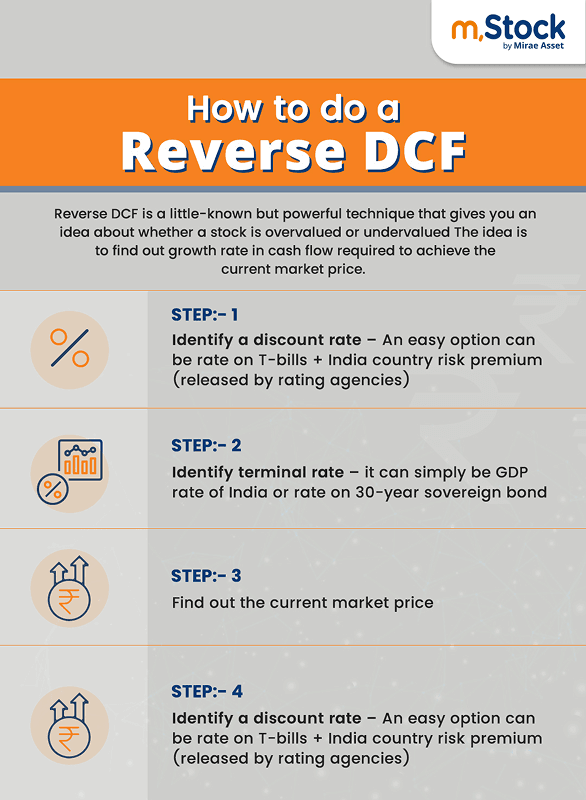
2. Multiplier Method
Also known as the market-based valuation, this method compares a company’s financial ratios (like P/E, EV/EBITDA, or P/Sales) to those of similar firms in the industry.
How It Works:
Identify a peer group within the same sector.
Calculate key multiples like Market Price/EBITDA, EV/Revenue, or P/E Ratio.
Use industry average to estimate your target company’s value.
This method is most effective for businesses with similar growth rates, risk profiles, and operating models.
3. Asset-Based Valuation
This straightforward approach calculates a company’s value based on the net value of its assets (i.e., assets minus liabilities).
When to Use:
Suitable for asset-heavy sectors such as infrastructure or aviation.
Not ideal for tech or service-based firms with significant intangible assets.
Variants:
Liquidation Value: Assumes all tangible assets are sold off, excluding intangibles.
Going Concern Value: Includes intangibles like goodwill and brand value in the asset pool.
This technique provides a conservative floor value of the business.
Points to Remember
Valuation is the first step toward making strategic investment or divestment decisions.
Different stakeholders—investors, acquirers, regulators—rely on tailored valuation techniques.
Knowing which valuation method to apply is essential for smart trading and investing.