
Know the Difference Between Price and Value
- The definitions of value and price
- How price and value differ
- What is intrinsic value in the stock market
- What should not be considered intrinsic value
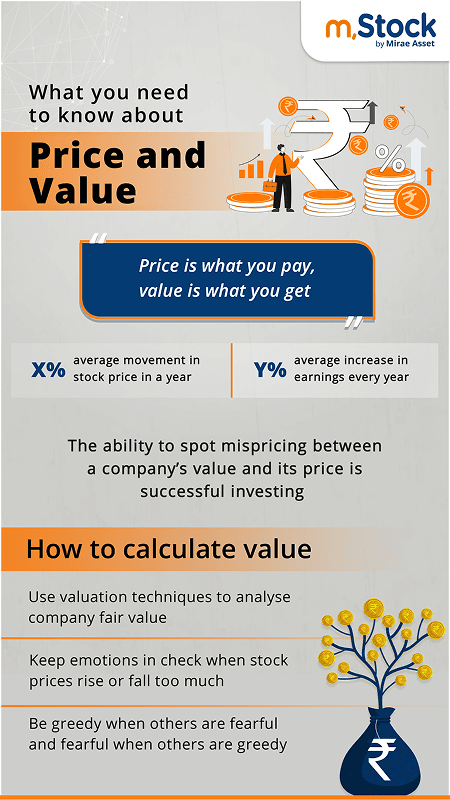
In everyday conversations, we often use cost, price, and value as if they mean the same thing. But in the world of investing, each term serves a distinct purpose. Let's unpack their meanings and understand their significance in stock market investing.
Difference Between Price and Value
To truly grasp the difference between price and value, we must first understand cost.
Cost:
This refers to the total expenditure incurred to make a product usable and market-ready. It includes raw materials, labor, utilities, overheads, and more. It’s a measurable monetary outlay, typically viewed from the perspective of the manufacturer.
Price:
Price is what a buyer pays to acquire a product. It’s essentially cost plus profit. In competitive markets, buyers can influence price through negotiation. Occasionally, products are sold at or below cost due to strategic reasons, but this isn’t common.
Value:
Value is the worth or benefit derived by the buyer. It is subjective and unquantifiable. For instance, a dishwasher might be worth its price to someone because it saves time and effort—this utility becomes its value. Value is personal and often revealed over time.
Quantifiability of the Three
Cost: Quantifiable and viewed from the producer’s angle.
Price: Also quantifiable; considered from the seller’s perspective.
Value: Not directly quantifiable; it's perceived by the buyer and influenced by experience, features, design, and usability.
Price vs. Value of Equity Shares
In the stock market, the difference between price and value is critical to sound investing.
Stock Price:
This is the current market rate at which a share trades. It moves constantly due to demand and supply dynamics. Factors like investor sentiment, trading volumes, and market speculation contribute to fluctuations.
Players such as speculators, arbitrageurs, hedgers, and long-term investors all influence price movement through buying and selling. But while price responds instantly to market forces, understanding why a stock is priced the way it is requires deeper insight into the company’s fundamentals.
Stock Value:
Unlike price, stock value is intrinsic. It is the true worth of a company based on its financial health, growth prospects, business model, risk profile, and industry standing.
What’s important is that intrinsic value is subjective. Analysts may interpret the same data differently and arrive at varying intrinsic values for the same company. This reinforces the idea that valuation requires both data and informed judgment.
Common Methods to Estimate Intrinsic Value
1. Discounted Cash Flow (DCF):
This method estimates future cash flows and discounts them back to the present using an appropriate rate. It gives a fair value based on future profitability.
2. Dividend Discount Model (DDM):
Based on the premise that stocks are bought for future dividends, this method discounts expected dividends to determine the stock’s value.
3. Net Asset Value (NAV) Method:
This is particularly useful for asset-rich companies like those in real estate or aviation. Net assets (total assets minus liabilities) are divided by the number of outstanding equity shares to get the NAV per share.
What Is Not Intrinsic Value?
It’s equally important to know what doesn’t count as intrinsic value:
Price: Market price is reactive and doesn’t reflect inherent value.
Enterprise Value (EV): Though used in valuation, EV fluctuates with price and includes market cap, debt, and cash.
Book Value: While it provides a static picture based on the balance sheet, it doesn't account for market dynamics or future potential.
Final Thought:
Warren Buffett once said:
“Price is what you pay. Value is what you get.”
Understanding this distinction is foundational for any investor.
Points to Remember:
Price and value are not the same—especially in the context of investing.
Stock price reacts to demand and supply, while stock value is rooted in business fundamentals.
Knowing how to assess a stock’s intrinsic value can help investors make informed decisions.
Multiple models, including DCF, DDM, and NAV, can be used depending on the company type and investor outlook.