
Adjusting Options Trades – A Practical Guide
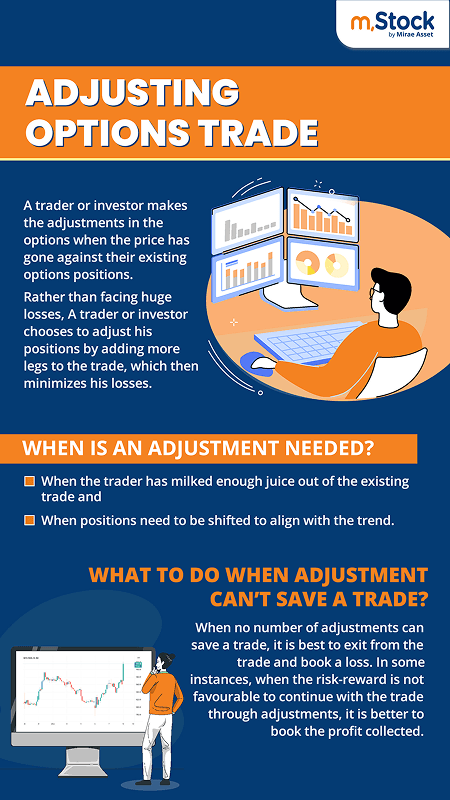
- When is an adjustment necessary?
- How to tweak a profitable trade for more gains
- Tactics to manage a losing trade
- Scenarios where no adjustment is the best adjustment
When trading in the cash or futures markets, your options post-entry are quite restricted. For instance, if you’ve purchased shares at ₹150 and the price rises to ₹170, you typically have two routes: book full or partial profits, or add more quantity if you expect the momentum to continue. This approach involves committing additional capital to chase further gains.
On the downside, if the price drops, the usual recourse is either booking a loss or averaging down by buying more. This averaging method, often referred to as the martingale strategy, relies on the hope of a price recovery. However, both approaches require more capital without offering strategic flexibility.
In contrast, options trading with m.Stock gives you a strategic edge. It allows for dynamic trade adjustments—whether to protect a faltering position or to maximize profits in a favorable one. With smart adjustments, you can reshape the risk-reward profile of a position, often without major additional costs.
But remember adjusting a trade doesn't guarantee success. Just like designing a strategy requires expertise, making timely and effective adjustments demands solid knowledge of options.
When Should You Adjust an Options Trade?
There are generally two prime moments when an adjustment is warranted:
To lock in profits and shift your strategy in line with the market trend
To limit risk or repair a trade that’s moving against you
Adjustments to Manage a Profitable Trade
Consider a trader who builds a Bull Put Credit Spread by selling the 17,500 Put and buying the 17,550 Put with the same expiry, capturing a net credit of 23 points.
If the market moves upward beyond 17,550, the maximum profit—equal to the net credit has been realized. At this stage, there's minimal reward left, and the risk-reward ratio becomes unbalanced.
If the trader expects the market to continue its uptrend, they might close the existing spread, now near worthless, and roll up to a new spread—say, selling the 17,550 PE and buying the 17,600 PE.
This process of rolling up enables the trader to stay in the trade while aligning the strategy with the ongoing trend. If the bullish momentum is expected to continue beyond the current expiry, the trader might also roll out the position to a future expiry. Doing both shifting to a higher strike and a later expiry—is known as rolling up and out.
Adjustments to Manage a Losing Trade
Even seasoned traders using option-selling strategies will encounter losing trades. Fortunately, multi-strike strategies like Strangles and Iron Condors offer flexibility for adjustment.
A common tactic is to book profits on the winning leg and move it closer to the current market level. One method for timing these adjustments is by monitoring net delta exposure. These strategies are generally delta-neutral at initiation, meaning their total delta hovers around zero.
Take a Strangle where the trader sells the 17,300 Put and the 17,800 Call while the market trades around 17,500. If the market drifts downward toward 17,400, the Put gains delta while the Call’s delta declines, shifting the net delta to around +20.
Traders typically adjust the position when the net delta reaches ±15. In this case, the 17,800 Call could be booked for a profit, and a new, closer strike like the 17,700 Call could be sold. This adjustment helps bring the net delta back to neutral.
If this process continues and the trader ends up with both 17,300 Call and Put positions, they’re now holding a Straddle, a strategy that could yield profits as theta decay works in their favor.
However, if the market continues to fall even after the straddle is in place, the trader must decide whether to cut the loss or roll out the position to the next expiry to buy time.
When Adjustments Are Not Needed
There are situations where any attempt to adjust may only worsen the trade. In such cases, the prudent move is to exit the position and accept the loss.
For instance, if a stock has made a strong move and is nearing a major resistance level, holding on or adjusting may expose you to greater risk than reward.
In options trading, it’s always wise to evaluate adjustments through a risk-reward lens. If the adjustment improves your odds without taking on disproportionate risk, it’s worth considering. Otherwise, it’s better to step aside and regroup.
Conclusion
Being successful in options trading with m.Stock isn’t just about entering trades smartly it’s about managing them skillfully. The ability to adjust trades at the right time separates good traders from great ones.
Strategic adjustments can rescue a losing trade, or extend the profitability of a winning one. While adjustments are not a magic fix, they are a vital part of the options trader’s toolkit helping limit losses, enhance profits, and navigate changing market conditions with confidence.