October 27, 2026 | 5 min read
BLS Polymers IPO: Issue Date, Price, Lot Size, Issue Structure and Key Details
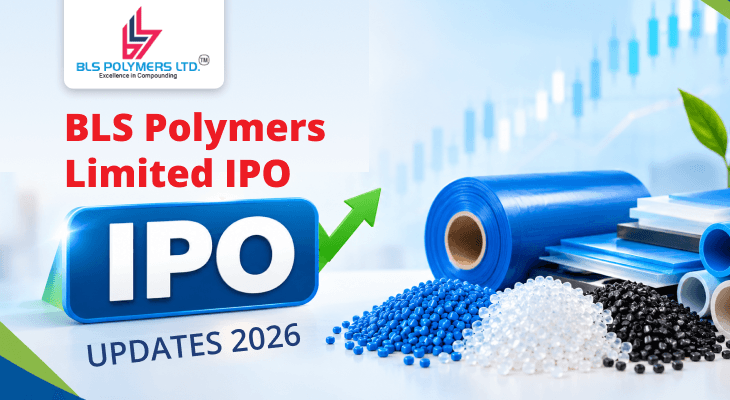
BLS Polymers IPO is a fresh issue of 1.70 crore shares, worth up to ₹255 crore at the ₹150 cap price. There is no offer for sale. Bidding opens on 27 October 2026 and closes on 29 October 2026, the shares are proposed to list on BSE and NSE.
BLS offers a credible combination of revenue growth, sharp profit expansion and falling debt. The harder question is whether FY2026 margins are repeatable when polymer-resin prices move, trading remains material and new capacity comes on stream.
What the company actually does
The company makes more than 127 grades of customised polymer compounds at its Goa facility for telecom, power, railways, water and oil-and-gas applications. It also trades HDPE and LLDPE resins, which contributed 31.86% of FY2026 revenue.
Its facility is close to Mormugao Port, and products are supplied across 23 Indian states and union territories with exports to markets including Bangladesh, Egypt and Saudi Arabia. Qualification with public-sector customers creates entry barriers, but also lengthens approval and collection cycles.
Operating picture
Overall capacity utilisation was 66.00% in FY2026, leaving headroom before the IPO-funded expansion.
Wire and cable compounds contributed 80.93% of FY2026 revenue; pipeline products are growing but diversification is still incomplete.
The top customer contributed 31.74% of FY2026 revenue and the top 10 contributed 66.81%.
Trading revenue lifts throughput but usually carries less differentiation than formulated compounds. Investors should track manufacturing mix, not just reported sales.
Financial performance
Profit grew much faster than revenue over FY2024-FY2026, helped by better margins and lower finance costs. Q1 FY2027 remained profitable, though operating cash flow turned negative.
₹ crore | FY2024 | FY2025 | FY2026 | Q1 FY2027 |
|---|---|---|---|---|
Revenue from operations | 296.36 | 328.44 | 349.43 | 107.03 |
Total income | 301.50 | 336.70 | 354.41 | 107.81 |
PAT | 7.52 | 21.14 | 27.01 | 10.23 |
Net worth | 46.83 | 67.94 | 94.93 | 105.17 |
Borrowings | 93.77 | 73.92 | 51.72 | 62.91 |
Operating cash flow (Rs in crore) | 2.65 | 25.13 | 38.06 | (6.64) |
Free Cash Flow (Rs in crore) | -0.20 | 22.60 | 33.30 | -11.10 |
Growth. Revenue from operations rose at an 8.6% CAGR over FY2024-FY2026, while PAT increased more than threefold. The earnings step-up is mainly a margin story rather than explosive sales growth.
Margins. FY2026 EBITDA margin was 13.33% and PAT margin 7.73%, versus listed-peer ranges that vary materially with product mix. Resin spreads and the share of traded goods matter.
Cash conversion. FY2026 operating cash flow of ₹38.06 crore exceeded PAT, but Q1 FY2027 used ₹6.64 crore as receivables increased. A strict FCF value is withheld because the indexed cash-flow recovery did not separate all qualifying capex and disposal lines.
Balance sheet. Borrowings fell through FY2026, then rose to ₹62.91 crore in June 2026. Inventory plus receivables remained substantial at ₹167.63 crore in Q1 FY2027.
How the IPO money will be used
Object | Amount / structure | Investor read-through |
|---|---|---|
Expand Goa facility for PE and XLPE compounds | ₹77.56 crore | Adds capacity in the core manufacturing business; utilisation and commissioning discipline matter. |
Fund working capital | ₹89.50 crore | Supports inventory and receivables, but does not itself improve margins. |
General corporate purposes and issue expenses | ₹87.94 crore | Large residual bucket limits project-level visibility. |
The all-fresh structure is positive because the full gross proceeds are raised for the company. Investors should still separate productive capex from the sizeable working-capital and general-purpose allocation.
Strengths
Specialised portfolio: More than 127 grades and customer qualifications create technical stickiness.
Improving profitability: PAT rose from ₹7.52 crore in FY2024 to ₹27.01 crore in FY2026.
Deleveraging: Borrowings declined by roughly ₹42 crore over FY2024-FY2026.
Export and end-market spread: Sales span critical infrastructure sectors and multiple geographies.
Risks that deserve attention
Customer concentration: The largest customer supplied nearly one-third of FY2026 revenue.
End-market concentration: Wire and cable compounds still account for about four-fifths of revenue.
Commodity exposure: Polymer-resin prices and pass-through timing can compress spreads.
Working-capital intensity: Inventory and receivables absorb substantial capital; Q1 FY2027 operating cash flow was negative.
Execution risk: New capacity can depress returns if demand or utilisation falls short.
Compliance history: Past corporate-law lapses and pending regularisation applications could lead to penalties.
Peer comparison
The RHP compares BLS with polymer compounders. Scale differs widely, so margin, leverage and return ratios are more useful than revenue alone.
Company | Revenue ₹cr | PAT margin | RoNW | P/E |
|---|---|---|---|---|
349.43 | 7.73% | 28.45% | 25.04x | |
1,995.55 | 9.28% | 13.24% | 46.25x | |
2,947.87 | 6.85% | 19.92% | 12.97x | |
788.66 | 4.65% | 8.17% | 14.53x |
At the cap, BLS sits above DDev and Plastiblends on P/E but below Kingfa. Its superior RoNW helps the case, though post-issue equity and unutilised capacity will mechanically dilute returns until proceeds are deployed.
Valuation and the practical decision
At the cap price. The indicated market capitalisation is about ₹930.5 crore and the FY2026 P/E is about 25.0 times. Price-to-book is about 7.1 times on pre-issue FY2026 NAV.
What must go right. Manufacturing mix must improve, customer concentration must decline, and the new plant must earn acceptable utilisation without a working-capital blowout.
What to track next
Commissioning timetable and cost for the Goa expansion.
Manufactured versus traded revenue mix and resin spread.
Top-customer share and new product qualifications.
Receivable days, inventory turns and quarterly operating cash flow.
Post-issue RoCE as fresh equity is deployed.
The offer deserves attention for its clean fresh-issue structure and earnings momentum, but the cap-price valuation already credits some future execution. Track utilisation and cash conversion before treating FY2026 margins as the new normal.
Primary filing and recovery note
Governing filing: BLS Polymers Limited RHP dated 17 October 2026, listed by SEBI on 19 October 2026: https://www.sebi.gov.in/filings/public-issues/oct-2026/bls-polymers-limited-rhp_105327.html
Official RHP mirror: https://unistonecapital.com/wp-content/uploads/2026/10/BLS-Polymers-Limited.pdf
Recovery route: SEBI, issuer, sole BRLM Unistone Capital, BSE and NSE routes were checked. Raw and range requests were proxy-blocked; complete page-specific indexed extraction was reconciled to the current RHP. The August 2025 DRHP and abridged prospectus were rejected.
Disclaimer: This blog is only for educational and informational purposes and does not constitute investment advice. Please consult your financial advisor before taking any investment decisions.
More Related Articles

EAAA India Alternatives Ltd IPO Day 2 Subscription Status
 October 27, 2026 | 0 mins read
EAAA India Alternatives Ltd is launching its IPO on 26 Oct 26. Check here the Day 2 IPO subscription status on m.Stock.
SFC Environmental Technologies Ltd IPO Day 1 Subscription Status
October 27, 2026 | 0 mins read
SFC Environmental Technologies Ltd is launching its IPO on 27 Oct 26. Check here the Day 1 IPO subscription status on m.Stock.
BLS Polymers Ltd IPO Day 1 Subscription Status
October 27, 2026 | 0 mins read
BLS Polymers Ltd is launching its IPO on 27 Oct 26. Check here the Day 1 IPO subscription status on m.Stock.