
May 22, 2026 | 7 min read
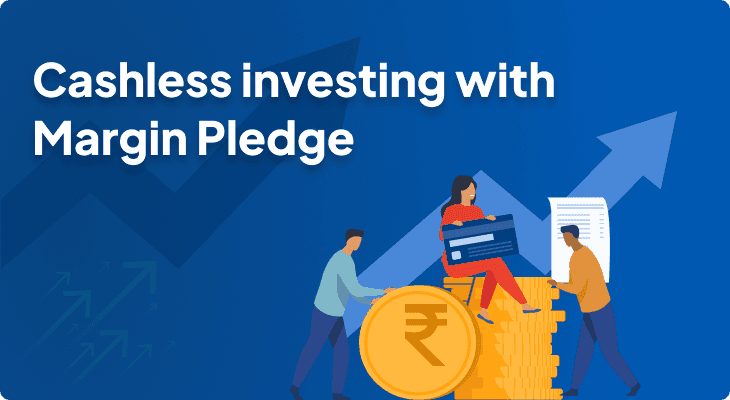
Cashless investing with Margin Pledge
Opportunities in the stock market are endless. However, margin available with investors and traders is limited. This means investors sometimes end up missing out on investment opportunities due to lack of capital. This is where Pay Later (MTF) facility comes to the rescue as investors can get up to 80% funding against 20% capital of their own.
But even with Pay Later (MTF), the investor is required to maintain 20% or more capital with them. This might not always be possible. So, what happens when investors run out of cash? Is there an option to trade with zero cash? Yes, there is.
Investors can use funding received under Margin Pledge to take delivery positions under Pay Later(MTF).
Let us understand how this works -
Say you are bullish on the Banking sector and anticipate a good earnings quarter. You already own 1,000 shares of HDFC Bank Ltd. trading at ₹1,600. The total value of your holdings is ₹16,00,000. To diversify your portfolio, you decide to buy 1,000 shares of IndusInd Bank Ltd. trading at ₹1,500. The total value of this buy transaction is ₹15,00,000.
There are three ways in which you can take this opportunity:
Intraday
You can place an intraday order in IndusInd Bank Ltd. with a margin of ₹6,04,500. The capital required is low, but you will have to square-off your position on the same day, which isn’t ideal as it might take weeks and months for your strategy (bullish view in banks) to play out.
Options
Being bullish, you can buy call option (CE). 1 lot of IndusInd Bank CE contains 500 shares. You can buy 2 lots (1000 shares) of 1,500 CE option trading at a premium ₹34. You will need margin of ₹34,000. But again, you will have to square-off your position on expiry. Also, Options are risky.
Delivery
You can place a delivery order and get the stocks in your portfolio. However, even with Pay Later (MTF) you will need a minimum capital of ₹4,54,500. And in case you do not have the minimum capital, you might lose out on this opportunity.
This is how this Pay Later (MTF)– Margin Pledge set up will work
-

Pledge your existing stock portfolio, HDFC Bank Ltd. worth ₹16 lakh with your broker
-

-
Your broker will give 12.80 lakh against 16 lakh after deducting haircut of 20% Now, you can use ₹4,54,500 out of the available ₹12.80 lakh margin in your account to buy 1,000 shares of IndusInd Bank Ltd under Pay Later (MTF)
Wait, there’s more. You still have a balance available margin of ₹8,25,500 which you can use to invest in other stocks under Pay Later (MTF).
So, by optimally using both Margin Pledge and Pay Later(MTF), you get the following benefits:
Ability to buy stocks with zero cash balance
One of the lowest interest rates, starting from 8.99% p.a. for Pay Later (MTF) and just 9.99% for Margin Pledge
Unlimited holding period on Pay Later (MTF) position
In addition to these, other benefits of Margin Pledge includes:
No interest on intraday trades
Interest charged from the day you start utilising the margin, not from the day margin is credited to your account
It is important to understand how interest will be charged in this scenario.
Let’s assume,
Position value: ₹1,00,000
Funding by m.Stock Pay Later (MTF): ₹70,000
Interest charged on ₹70,000 MTF as per MTF debit slab: 14.99% p.a.
Available cash margin: ₹1,00,000
Available margin against pledged shares: ₹80,000
Interest charged on ₹30,000 margin utilised by pledging stocks out of the stock balance: 9.99% p.a.
Now, if the value of the stocks decreases from ₹1,00,000 to ₹95,000, an additional margin of ₹5,000 will be needed. The margin call will be fulfilled from the remaining available margin against pledged shares.
Interest charged on ₹30,000 + extra ₹5,000 margin utilised by pledging stocks out of the stock balance: 9.99% p.a.
Now, if the margin against pledged stocks is ₹32,000 instead of ₹80,000 in the above-mentioned example, an additional margin requirement of ₹2,000 will be fulfilled from the margin against pledged stocks, on which Pledge Shares interest of 9.99% p.a. would be levied, and ₹3,000 will be fulfilled from the available cash margin, on which no interest would be charged.
Similarly, if the available margin against pledged stocks is only ₹32,000 instead of ₹80,000 and the available cash margin is ₹1,000 instead of ₹1,00,000 in our above example, there would be a margin call for ₹2,000 [₹30,000 initial margin + ₹5,000 additional margin – (₹32,000 Pledge Shares stocks + ₹1,000 cash margin)].
In case the margin call is not fulfilled, the MTF position will be squared off. Till the position is squared off, the additional ₹2,000 margin requirement will be fulfilled from available margin against pledged stocks on which Pledge Shares interest of 9.99% p.a. will be levied; ₹1,000, will be fulfilled from cash margin on which no interest would be charged, and on the shortfall of ₹2,000, MTF interest will be charged as per the MTF interest slab, which is 14.99% in this case.
This means on subsequent margin calls, if your margin against pledged shares is exhausted and you have available cash margin, then the margin call request will be fulfilled from the cash margin.
The available margin will be first adjusted from the Derivatives and Cash Segment and then MTF.
Pay Later(MTF) and Margin Pledge when used together, can potentially transform your trading and investment game. So, go ahead, trade with zero cash now!
More Related Articles

How Long Can Beginners Hold Shares Using MTF?
 August 11, 2026 | 0 mins read
Many investors enter the stock market with strong conviction about certain stocks, but may not always have enough capital to buy the desired quantity outright. This is where Margin Trading Facility (MTF) has become increasingly popular in India.

How to Add Funds to Your MTF Position Easily?
August 11, 2026 | 0 mins read
Margin Trading Facility (MTF) has become a widely used trading feature among investors who want greater buying power in the stock market without paying the full transaction amount upfront. Instead of funding the entire purchase independently, you contribute an initial margin while the broker finances the remaining portion.
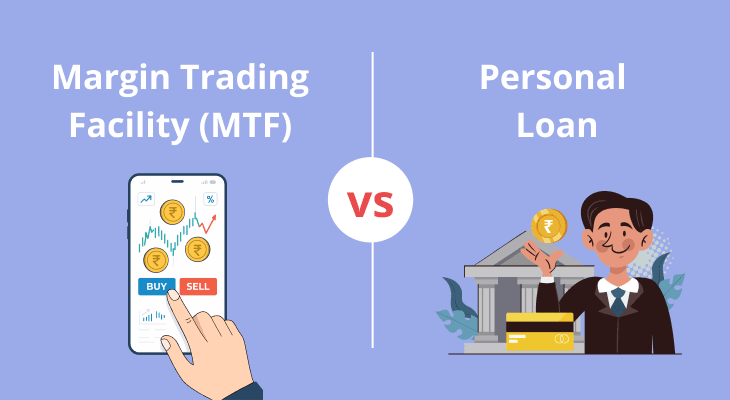
Margin Trading Facility (MTF) vs Personal Loan: Which is Smarter for Leveraged Investing?
July 3, 2026 | 0 mins read
Many investors reach a point where they want to invest more than their available capital. At that stage, you may consider borrowing to invest. Two common ways to do this are using a Margin Trading Facility (MTF) through your broker or taking a personal loan from a bank.
FAQ
No, you can not use the already pledged shares as collateral for another loan. The pledge facility is available only to unlock trading margin. When you pledge your stocks, the value is credited instantly into your margin account. You can use this margin for intraday trading along with F&O and ETF segments.