

May 8, 2025 | 5 min read
Credit Score vs. Credit Rating: What's the Difference?
Introduction
Whether you're applying for a loan, seeking business financing, getting a credit card, or simply trying to understand your financial standing, you are likely to come across terms like credit score and credit rating. Before you start trying to make sense of your credit score or dive into your credit rating, it helps to understand what each one represents, what they involve, and why they matter.
This article will explore both these terms in detail and highlight the differences between the two so you get a clearer picture of your overall financial health.
What is a credit score?
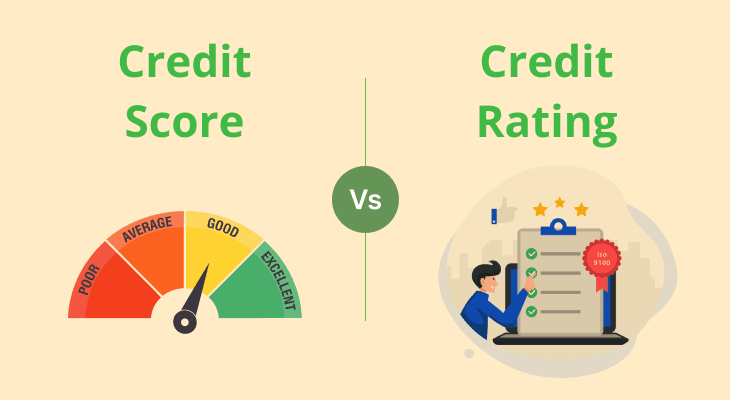
A credit score is a numerical figure made up of three digits that reflects your financial creditworthiness. It typically falls within a range of 300 to 900. The closer your score is to 900, the more financially reliable you are considered by loan providers as well as other entities, including landlords, insurance companies, etc.
Your credit score plays a particularly crucial role when it comes to borrowing money. A higher credit score suggests you are a low-risk borrower, which can help you access loans on better terms, such as lower interest rates and higher loan amounts. Many factors can influence your credit score, including your repayment history, the total amount of debt you owe, the types of credit you use, etc.
The credit score is calculated by the following agencies in India:
- Credit Information Bureau (India) Limited (CIBIL)
- CRIF High Mark
- Experian
- Equifax
Here’s a breakdown of what your credit score typically signifies:
- 300 - 549: Poor
- 550 - 649: Fair
- 650 - 749: Good
- 750 - 799: Very good
- 800 - 900: Excellent
What is a credit rating?
Unlike personal credit scores, credit ratings are specific to entities and not individuals. A credit rating can evaluate the financial creditworthiness of governments, financial institutions, large business entities such as partnership firms and limited companies, and in some cases, Non-Governmental Organisations (NGOs). It helps determine how likely these organisations are to repay their debts on time.
In India, credit rating agencies are regulated by the Securities and Exchange Board of India (SEBI). Some notable credit rating agencies include:
- Credit Rating Information Services of India Limited (CRISIL)
- Credit Analysis and Research Limited (CARE)
- Investment Information and Credit Rating Agency (ICRA)
- India Ratings and Research
These agencies assign ratings that generally range from AAA to D, based on various factors like an organisation’s financial strength, repayment history, etc.
Here’s a breakdown of what each credit rating typically signifies:
- AAA: An excellent rating, indicating the lowest credit risk
- AA: A very good rating, suggesting a very low credit risk
- A: Considered good, with a low credit risk
- BBB: Represents average credit quality, with moderate risk
- B: Indicates a lower credit quality and higher risk
- C: Signifies a poor rating and reflects very high credit risk
- D: Assigned when the entity has already defaulted on its obligations
Credit rating vs credit score - Key differences
Here are the key differences between a credit rating and a credit score:
Points of difference | Credit rating | Credit score |
Applicability | A credit rating is used for organisations such as government bodies and private businesses. | A credit score, on the other hand, is used for individuals.
|
Representation | Credit ratings are shown in alphabets, with AAA being the highest and D the lowest. | Credit scores are numerical and range from 300 to 900, with higher scores indicating better creditworthiness. |
Purpose | Credit ratings are usually used when organisations seek investments or funding. | Credit scores can come into play when individuals apply for loans, credit cards, jobs, or even insurance plans. |
Basis of evaluation | Credit ratings are based on business financials, repayment history, etc. | Credit scores are based on an individual's debt management, repayment track record, and the number of active loans. |
Importance | A credit rating can help organisations understand their standing in the financial market. It plays an essential role in securing funding and investments. Moreover, a credit rating is easy to monitor, as it is presented in a simple alphabetical format. | A credit score gives loan providers, insurance companies, employers, landlords, etc., a quick snapshot of your financial reliability and borrowing habits. It is easy to interpret, highlights areas for improvement, and is crucial for financial transactions such as securing a personal loan or credit card. |
Importance for financial stability
Financial stability is essential for both individuals and entities to ensure their financial goals are met. Credit ratings and credit scores play a key role in maintaining this stability.
- For organisations, maintaining a favourable credit rating ensures quicker access to funding. It also builds a solid reputation for the entity and helps it secure better terms from lenders and investors.
- Similarly, a high credit score allows individuals to access loans on better terms, enjoy lower premium rates on insurance plans, and even improve chances during job applications by highlighting a person’s reliability and financial responsibility.
Maintaining a good credit rating and score can support both your professional and personal financial goals, and contribute significantly to your long-term financial stability.
Conclusion
Although often used interchangeably, credit ratings and credit scores have different uses and apply to different entities. A credit score reflects an individual's financial reliability, while a credit rating assesses the creditworthiness of businesses and organisations. They are also presented differently — one in numbers, the other in letters. Understanding the distinction between the two is important, as it helps you focus on the one most relevant to your financial situation. If you run a business, it is wise to monitor both your credit rating and personal credit score. If not, tracking your credit score alone is enough to stay informed and financially prepared.
More Related Articles
What is the FIRE concept in finance & early retirement?
 October 28, 2026 | 0 mins read
The FIRE concept in finance is based on a simple idea: achieve financial independence early so early retirement is possible. To pursue this goal, individuals typically live frugally during their earning years, save diligently, and invest regularly to build a comfortable retirement corpus – one that is capable of supporting their lifestyle after retirement.

Wealth Creation Strategies for Beginners in India
October 23, 2026 | 0 mins read
Wealth creation is the process of building financial assets over time in order to achieve financial security and long-term financial independence. It helps individuals prepare for emergencies, achieve life goals such as buying a home or funding higher education, and enjoy a comfortable retirement. Wealth creation is not just about earning money. It involves careful financial planning, disciplined saving, strategic investing, and effective risk management to grow wealth sustainably over time.

Financial Planning Strategies for Economic Uncertainty
October 23, 2026 | 0 mins read
Financial planning is the systematic process of setting short- and long-term financial goals and creating a structured roadmap to achieve them. It helps you manage your finances effectively while preparing for planned milestones and unexpected events.