
November 17, 2026 | 9 min read
Crystal Crop Protection IPO Details, Dates, Price, and Issue Analysis
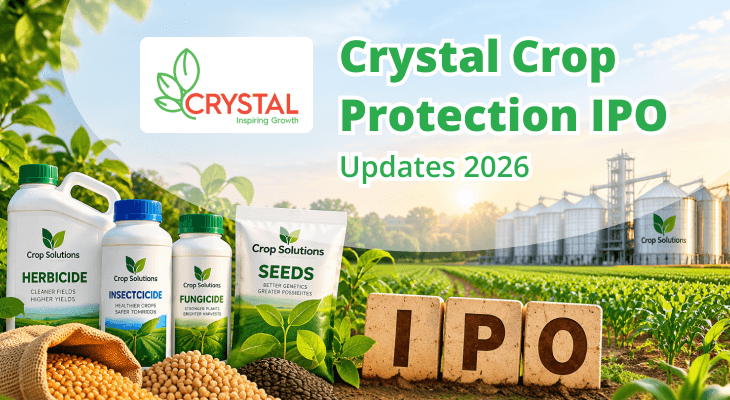
Crystal Crop Protection Limited is a crop-solutions company built around agrochemicals, natural crop solutions and seeds. The Crystal Crop Protection IPO opens on 18 November 2026 and closes on 20 November 2026 at a price band of ₹259 to ₹272 per share.
At the upper band, the total issue for Crystal Crop Protection Limited IPO is about ₹455.48 crore, comprising a fresh issue of about ₹354.77 crore and an offer for sale of about ₹100.71 crore by promoter Ankur Aggarwal. The fresh proceeds are aimed mainly at debt repayment, with the balance supporting acquisitions, strategic initiatives and general corporate purposes.
What matters most FY26 revenue reached ₹3,151.97 crore and EBITDA margin improved to 14.47%, but the business still carried ₹962.67 crore of fund-based borrowings at August 2026. The price asks investors to pay a premium to the disclosed peer-average P/E while accepting an audit qualification and a regulatory-litigation overhang.
Crystal Crop Protection IPO details
Item | Current offer detail |
|---|---|
Total issue size | About ₹455.48 crore at the upper band |
Fresh issue | About ₹354.77 crore at the upper band |
Offer for sale | 3,702,694 shares about ₹100.71 crore at the upper band |
Price band | ₹259 to ₹272 per share |
IPO opening date | 18 November 2026 |
IPO closing date | 20 November 2026 |
Minimum bid lot | 55 shares, ₹14,960 at the upper band |
Face value and listing |
The RHP sets a fresh-issue ceiling of ₹355.003 crore after a ₹84.287 crore pre-IPO placement. The live share-count calculation at the upper band produces the slightly lower ₹354.77 crore figure used in the issue details above.
How the fresh issue will be used
- ₹247.94 crore for repayment or prepayment of selected company borrowings.
- ₹22.06 crore for investment in Saffire Crop Science Private Limited so it can repay borrowings.
- The remaining net proceeds for unidentified acquisitions, strategic initiatives and general corporate purposes, within the stated regulatory caps.
Debt repayment is the clearest near-term benefit because it can reduce finance cost and balance-sheet risk. The acquisition bucket is less precise, so investors will need to judge later targets, purchase prices and post-deal returns rather than crediting the proceeds with automatic value creation.
About Crystal Crop Protection
Crystal develops, manufactures and distributes crop-protection products, natural crop solutions and seeds for field, vegetable and flower crops. The model combines research, registrations, manufacturing, brand building and a broad distributor network serving Indian farmers.
Crop-protection products and natural solutions produced ₹2,476.57 crore of FY26 product revenue, while seeds produced ₹585.19 crore. The company had 13,952 active distributors in FY26, up from 8,992 in FY24, and its branded-formulation innovation rate improved from 16.02% to 19.56%.
Operations and sector economics
The company operates formulation, technical and seed-processing facilities. Its Dahej and Nagpur technical units had combined installed capacity of 4,717 MT at June 2026, and the seeds business operates three processing units.
Agrochemical demand is seasonal and tied to monsoons, crop prices, pest pressure and farmer purchasing power. Registrations, product efficacy, raw-material sourcing and channel inventory matter as much as headline sales growth, which is why cash conversion and returns on capital deserve close attention.
Crystal Crop Protection Financial performance
₹ crore | FY24 | FY25 | FY26 |
|---|---|---|---|
Revenue from operations | 2,229.93 | 2,690.51 | 3,151.97 |
EBITDA | 209.06 | 315.28 | 456.23 |
EBITDA margin | 9.38% | 11.72% | 14.47% |
Profit after tax | 87.24 | 118.39 | 144.91 |
Operating cash flow | 337.79 | 383.03 | 256.42 |
Free cash flow | 243.32 | 285.77 | 179.60 |
Net working capital days | 174 | 141 | 139 |
Revenue grew at about 18.9% a year from FY24 to FY26 and PAT at about 28.9%. Gross margin improved from 31.10% to 38.49%, while EBITDA margin rose by more than five percentage points, showing better mix and operating leverage.
Cash generation is real but softened in FY26. Operating cash flow fell 33% even as PAT rose 22%, and FY26 free cash flow dropped after ₹154.95 crore of PPE and intangible/right-to-use purchases before asset-sale proceeds.
Working-capital days improved from 174 to 139, yet ₹755.31 crore remained tied up in net working capital at March 2026 and trade receivables were ₹810.66 crore by June. The IPO-funded debt reduction should be evaluated alongside the seasonal need to carry inventory and finance the channel.
Peer comparison and valuation
FY26 metric | Crystal | Kaveri Seeds | Sumitomo | Bayer CropScience | Rallis | Dhanuka |
|---|---|---|---|---|---|---|
Revenue ₹ crore | 3,151.97 | 1,394.76 | 3,238.32 | 5,675.00 | 2,896.65 | 2,019.79 |
P/E | 23.42-24.59x | 12.13x | 31.20x | 22.73x | 19.93x | 14.38x |
ROE | 7.94% | 16.07% | 14.95% | 19.15% | 6.16% | 17.67% |
The peers cover seeds, agrochemicals and diversified crop science, so their product mixes and seasonality differ. Crystal is comparable on scale, but its FY26 ROE trails four of the five disclosed peers and its return profile does not yet match the premium end of the group.
Using FY26 diluted EPS of ₹11.06, the price band implies roughly 23.42 to 24.59 times earnings. That is above the RHP peer average of 20.07 times, close to Bayer CropScience and below Sumitomo, so the valuation already assumes that margin gains and debt reduction will hold.
Strengths
- Diversified portfolio across crop protection, natural crop solutions and seeds.
- Revenue, gross margin and EBITDA margin improved consistently across FY24-FY26.
- The active distributor network expanded from 8,992 in FY24 to 13,952 in FY26.
- Positive operating and free cash flow in each of the three reported years.
- The fresh issue is largely directed to debt repayment, creating a visible balance-sheet use.
Risks
- Fund-based borrowings were ₹962.67 crore at August 2026, exposing earnings to interest rates and refinancing conditions.
- The FY26 audit report carried a qualification involving a ₹16.30 crore insurance-claim receivable and an emphasis of matter tied to a ₹109.42 crore DGFT demand, CBI proceedings and an ED investigation.
- The top ten raw-material suppliers represented 38.18% of FY26 purchases and 51.33% in the June 2026 quarter.
- Weather, pest incidence, crop prices and sowing cycles can change demand quickly and stretch working capital.
- Product efficacy or quality complaints can cause crop-damage claims, regulatory action and brand erosion.
- Acquisition-led growth can dilute returns if assets are bought at high prices or integrated poorly.
What investors should track next
Track the exact debt retired after allotment, FY27 finance-cost savings, cash conversion through the next crop cycle and whether ROE moves closer to the stronger peers. The audit qualification, DGFT matter and related enforcement proceedings also need clean, periodic updates rather than being treated as one-off footnotes.
More Related Articles

IFL Finance IPO
 November 13, 2026 | 0 mins read
IFL Finance Limited has moved from its earlier housing-finance identity towards a focused secured-lending model, with gold loans becoming the centre of its loan book. Its proposed IPO is therefore less about funding a new physical asset and more about adding capital to a balance sheet that is already scaling. The key questions are how durable the gold-loan growth can be, whether asset quality remains controlled as the book expands, and how efficiently the company can convert fresh Tier-I capital into profitable lending.

Bvishal Oil and Energy IPO
November 13, 2026 | 0 mins read
Bvishal Oil and Energy Limited is a technology-driven onshore oilfield services provider serving the exploration, production and maintenance requirements of oil and gas wells. Its portfolio spans Well Intervention and Well Stimulation, Surface Production Testing and Gas Processing, Operations and Maintenance (O&M), Production Enhancement Services (PES) and Enhanced Oil Recovery (EOR). The company operates primarily in upstream and selected midstream activities rather than owning oil or gas reserves itself.

Master Chains N Jewels IPO
November 13, 2026 | 0 mins read
Master Chains N Jewels is a Mumbai-based B2B gold jewellery manufacturer and wholesaler. It designs and manufactures gold chains and a wider range of lightweight jewellery, while also undertaking job-work and customised manufacturing for wholesalers, single-store retailers and multi-store jewellery chains.
FAQ
Bidding is scheduled from 18 November to 20 November 2026.