
July 24, 2026 | 7 min read
How Much Risk Should You Take in Your 20s, 30s, 40s & 50s?
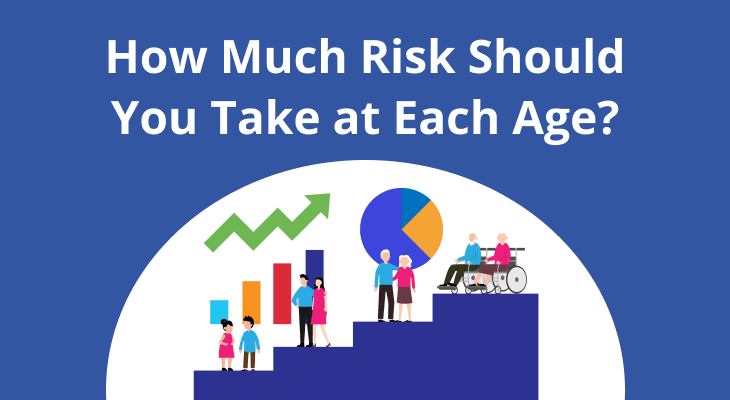
Risk is the price one has to pay for return. The higher the potential gain, the more uncertainty you take on to get it. Every investment carries some degree of that uncertainty the question is how much makes sense for where you are in life. A 25-year-old and a 55-year-old looking at the same stock market are in fundamentally different situations. At 25, putting most of your savings into equity mutual funds is a reasonable decision. At 55, the same decision could leave you in a difficult position if markets fall sharply in the years leading up to retirement.
What changes with age is how much risk your financial life can absorb, and that is what risk appetite measures. Risk appetite is the amount of risk you are willing to take to achieve your financial goals. It shifts as your income grows, your responsibilities deepen, and your timeline shortens. This is why financial planning by age requires a recalibration of your investment portfolio from time to time.
5 Factors That Determine Your Age‑wise Risk Tolerance
As important as age is for planning your investments, it is still one input, not the whole picture. Your risk tolerance at any stage is shaped by several factors, including:
1. Income stability: A salaried professional with predictable income can take more risk than a freelancer with variable earnings.
2. Dependants: A single 35-year-old and a 35-year-old with two children and ageing parents are in very different financial positions, even on the same income.
3. Existing liabilities: An active home loan changes what you can afford to put at risk.
4. Emergency fund: Without 3-6 months of expenses set aside, even a modest market correction can force you to sell investments at the wrong time.
5. Emotional tolerance: Some investors can hold through a 30% drawdown without flinching. Others cannot sleep when their portfolio drops 10%. Both are valid, but only one of them should be in a high-equity portfolio.
How Much Risk Should You Take at Your Age?
In your 20s take some risk and set up a base that can compound over time
This is the decade where time works hardest in your favour, and investing in equities is a great idea. A ₹10,000 monthly SIP started at 22 will grow significantly more than the same SIP started at 32 not because of a larger amount, but because of a decade of additional compounding. Indians under 35 opened 40% of all new SIP accounts in 2025, and 84% of Gen Z investors choose equity mutual funds. This is a sign that younger investors are increasingly getting this right.
A suggested allocation in your 20s
- 75%–80% equity, 15–20% debt and cash.
In your 30s, balance growth with growing responsibilities
Your income is likely higher, but so are your obligations like EMIs, children, possibly ageing parents. Keep equity heavy, but this is the decade to build a parallel layer of stability alongside it. Start your PPF contributions, begin NPS, and ensure you have adequate term insurance in place. Hybrid funds work well here for investors who want equity exposure with a built-in debt cushion.
A small allocation to gold 5% in SGBs or gold ETFs—is worth adding in your 30s. It diversifies away from both equity and debt, and SGBs pay 2.5% annual interest on top of gold price appreciation, with capital gains fully tax-exempt at maturity.
Suggested allocation in your 30s:
70% equity (flexi-cap, hybrid, ELSS), 25% debt (PPF, NPS, hybrid funds), 5% gold (SGBs or gold ETFs).
In your 40s, you could consider shifting toward a more stable, lower-risk portfolio
Your 40s are typically your peak earning years, but retirement is now 15–20 years away. Keep equity in the portfolio, but shift away from small and mid-cap funds towards large-cap and flexi-cap funds that carry less volatility. This is also the decade to build a more meaningful debt base PPF if not already maxed, and NPS, which offers an additional ₹50,000 deduction under Section 80CCD(1B) and structured equity exposure up to 75%.
For anyone in the 30% tax bracket, debt mutual funds are worth considering over FDs. They offer better liquidity and can be more tax-efficient over longer holding periods. Increase your gold allocation slightly from your 30s, as it provides a more meaningful buffer against equity volatility as your corpus grows.
A suggested allocation in your 40s:
60% equity (large-cap, flexi-cap), 35% debt (NPS, PPF, debt mutual funds), 5% gold.
In your 50s, you should protect what you have built
With retirement likely a decade away, the priority shifts towards preservation. Equities still have a role as your corpus needs to keep growing in real terms through retirement. But this is the decade to move away from mid- and small-cap exposure entirely and consolidate into large-cap and conservative hybrid funds that prioritise stability over aggressive growth. On the debt side, move towards instruments that will generate predictable income in retirement. NPS remains valuable here for its tax efficiency and structured drawdown at retirement. PPF, if still active, should be extended. FDs and debt mutual funds round out the fixed income base for those in lower tax brackets. FDs work well, but for those in higher brackets, debt mutual funds remain more efficient.
A suggested allocation in your 50s:
40% equity (large-cap, conservative hybrid funds), 50% debt (NPS, PPF, debt mutual funds, FDs), 10% gold.
Age‑Wise Risk Appetite Comparison Table
Age Group | Risk Appetite | Equity Allocation | Focus |
|---|---|---|---|
20s | High | 75%–80% | Base creation |
30s | Medium-High | 65%–70% | Growth + stability |
40s | Medium | 45%–55% | Balance + protection |
50s | Low | 30%-40% | Preservation + income |
How to Assess Your Personal Risk Tolerance
Start with your timeline
When do you actually need this money? A 45-year-old saving for retirement at 60 has 15 years, which is enough to hold some equity. A 45-year-old saving for a child's education in three years has far less room to take on equity risk.
Use the 100-minus-age rule as a starting point
Subtract your age from 100 to get a rough equity percentage. 25 years old means roughly 75% equity. It is a blunt tool, but a useful first approximation before you adjust for your specific situation.
Look at your reaction to loss
Think back to the last time your portfolio dropped. Or, imagine it dropping 20%. Would you hold, add more, or sell? Your honest answer tells you more about your risk tolerance than any formula.
Reassess every two to three years
Income changes, responsibilities change, goals change. A risk appetite that was right at 32 may be too aggressive at 38. Hence, don’t forget to reassess the underlying risk that has built up in your portfolio.
Top 5 Common Mistakes People Make While Financial Planning by Age
1. Staying too aggressive for too long:
Carrying a 75% equity portfolio into your 50s means a bad market year could seriously damage a corpus you no longer have time to rebuild.
2. Going too conservative too early:
A 30-year-old keeping most of their savings in FDs is trading long-term growth for short-term comfort.
3. Treating age as the only variable:
Two people at 40 with different incomes, liabilities and goals should not have identical portfolios. Age is a guide and your actual situation determines the rest.
4. Ignoring inflation:
A portfolio can feel safe and still lose purchasing power in real terms. Safety and inflation-beating are different goals that need separate attention.
5. Delaying a reset:
Most people review their portfolio only when something goes wrong. Investment risk by age should be reviewed proactively at least once every 2-3 years.
Conclusion:
Risk deserves calibration, not avoidance. In your 20s, playing it too safe is itself a risk—the risk of not building enough. In your 50s, taking too many risks is a mistake. The goal at every stage is the same: match the risk you take to the time you have and the outcome you need.
Look at your portfolio today and ask whether it reflects where you actually are in life—your age, your income, your goals. If the answer is no, adjust gradually. Financial planning by age rewards consistency and intention far more than it rewards single large decisions.
More Related Articles

How to Choose the Right Investment Method for Short‑Term Goals
 July 24, 2026 | 0 mins read
A short-term goal is any financial target you need to meet within 1-3 years. This could be building an emergency fund, saving for a holiday, making a down payment on a house, or setting money aside for advance tax payments. Because the money has a fixed purpose and a financial need that is not too far into the future. The priority is simple: protect what you have and make sure you have easy access to it when you need it.

What is Rights Entitlement (RE) in the Stock Market?
July 23, 2026 | 0 mins read
At times, your demat account may reflect entries that fall outside the familiar pattern of buying and selling securities. Rights entitlement is one such instance. It appears quietly, and requires timely action on your part. You might notice an extra line item against a stock you already own, tagged differently, priced differently. It is not a bonus, not a split, and not exactly a new investment either. But it does carry value.
How Net Interest Margin Impacts Bank Stock Prices?
July 23, 2026 | 0 mins read
If you have ever tracked bank stocks in India, you probably hear analysts use one term repeatedly: Net interest margin (NIM). It shows up in earnings calls, quarterly results, and almost every banking report. At some point, you realise it is not just another ratio. It actually drives how banks make money. Most explanations around net interest margin feel overly simple. In reality, it is not always that straightforward when you look at actual bank performance. Two banks can report similar numbers, yet their stock prices behave very differently.
FAQ
Yes, but within reason. Your 20s are the best time to be equity-heavy because your investment horizon is the longest, giving your portfolio the most room to grow through market cycles. A 75%–80% equity allocation through diversified or index mutual funds is reasonable. Stick to disciplined, diversified equity exposure rather than concentrated, speculative bets.