
December 24, 2024 | 4 min read
How to Calculate F&O Turnover?
The Futures and Options (F&O) market in India has grown in popularity among retail investors over the past few years. Understanding how to calculate F&O turnover helps to effectively assess your tax obligations.
F&O turnover is the sum of absolute values of profits and losses of your all future and options trades. For tax reasons, income from F&O trading is considered as business income.
Furthermore, understanding how to calculate turnover for F&O trading will help you evaluate whether you need to undergo a tax audit. Beyond a specific turnover threshold, you might need to undergo a tax audit. That is why F&O turnover calculation is important.
Futures And Options
Futures contracts are agreements to buy or sell an underlying asset or security at a fixed price on a future date. Options, on the other hand, provide the holder of the option the right but not the obligation to buy or sell an underlying asset or security at a defined price on or before a specific date.
These financial products are critical for risk management and price speculation in the financial markets. Whether you are an experienced trader or just starting out, understanding the fundamentals of futures and options is critical.
What is F&O Turnover?
F&O turnover is the total income from futures and options trading after accounting for all profits and losses. Trading in futures and options is taxed as business income. Thus, understanding how to appropriately calculate F&O turnover will help you plan your taxes better.
Importance of Calculating F&O Turnover
Accurate calculation of F&O turnover is important as it helps in:
- Determining Tax Liability: Your taxable income from derivatives trading is calculated based on F&O turnover.
- Assessing Eligibility for Tax Audit: If your turnover exceeds certain levels, a tax audit is required.
How To Calculate F&O Turnover?
To calculate F&O turnover, you must first understand how different types of transactions are treated and then aggregate them correctly. Here's a step-by-step guide:
- Aggregate Favourable and Unfavourable Differences: Add all positive and negative trade differences. This implies you must add up all profits and losses made in your trades over the financial year.
- Account for Reversed Trades: If a trade is reversed, the resultant difference must be included in the turnover.
- Calculate Futures Turnover: In futures trading, turnover is the absolute profit, which is the total of all gains and losses across transactions.
- Calculate Options Turnover: For options, add the absolute profit and losses on your trades and the premium earned for selling the options.
Formulae for Calculation
- Futures Turnover: Absolute Profit (the total of all profits and losses for the year).
- Options Turnover: Absolute Profit + Premium from selling options (if not already included).
F&O Turnover Example
Let us understand the calculation with an example:
Transactions:
- X Futures: Purchased 600 shares at ₹ 1,800 and sold at ₹ 1,950.
- Y Futures: Purchased 800 shares at ₹ 2,800 and sold at ₹ 2,750.
- Z Call Option: Bought 400 shares at ₹ 90 and sold at ₹ 120.
- W Put Option: Sold 600 shares at ₹ 55 and later purchased at ₹ 60.
Calculation:
Name | Transaction Type | Lot Size | Purchase Value | Sale Value | Gain/(Loss) | Turnover |
X | Future | 600 | ₹1080,000 | ₹ 11,70,000 | ₹ 90,000 | ₹ 90,000 |
Y | Future | 800 | ₹22,40,000 | ₹22,00,000 | ₹ (40,000) | ₹ 40,000 |
Z | Call Option | 400 | ₹ 36,000 | ₹ 48,000 | ₹ 12,000 | ₹ 12,000 |
W | Put Option | 600 | ₹ 36,000 | ₹ 33,000 | ₹ (3,000) | ₹ 3,000 |
Total | ₹ 59,000 | ₹ 1,45,000 |
Total Turnover = ₹ 90,000 (X) + ₹ 40,000 (Y) + ₹ 12,000 (Z) + ₹ 3,000 (W) = ₹ 1,45,000.
In this example, the total turnover for all transactions amounts to ₹ 1,45,000, while the net gain is ₹ 59,000.
F&O Losses and Tax Audit
Reporting your F&O turnover is mandatory, whether you make a profit or a loss. This is because F&O trading turnover is regarded as business income for taxation purposes. Calculating F&O turnover accurately is important since it affects your tax liability.
When is a Tax Audit required?
A tax audit under section 44AB is needed if:
- Your trading turnover exceeds ₹1 crore.
- Your trading turnover exceeds ₹2 crore, and you opt for the presumptive taxation scheme.
- You report losses and wish to carry them forward to future years.
Steps for a Tax Audit
If a tax audit is necessary, you will need to:
- Hire a Chartered Accountant: They will assist in creating financial statements such as the profit and loss account and balance sheet.
- File Tax Audit Report (Form 3CD): This form includes extensive information regarding transactions and turnover.
- Prepare and File ITR: To avoid penalties, the Income Tax Return must be filed accurately.
Conclusion
Learning how to calculate F&O turnover is vital for F&O traders. It impacts your tax obligations and regulatory compliance. By following the steps indicated above, you can make sure that your turnover is calculated accurately. Consult a Chartered Accountant, while managing the complexity of F&O trading and taxation.
An Income Tax Calculator helps you estimate how much tax you need to pay based on your income, deductions, and exemptions. Use our Income Tax Calculator to understand your tax liability better and plan smarter to save more.
More Related Articles

How Rising Oil Prices Impact Stock Market Investments
 October 9, 2026 | 0 mins read
A petroleum price hike, driven by rising global crude oil prices, can have far-reaching consequences for the economy and financial markets worldwide. As India imports over 88% of its crude oil requirements, understanding the impact of rising oil prices on stock market investments is essential for investors.
Understanding the meaning and impact of a current account deficit on an economy
October 9, 2026 | 0 mins read
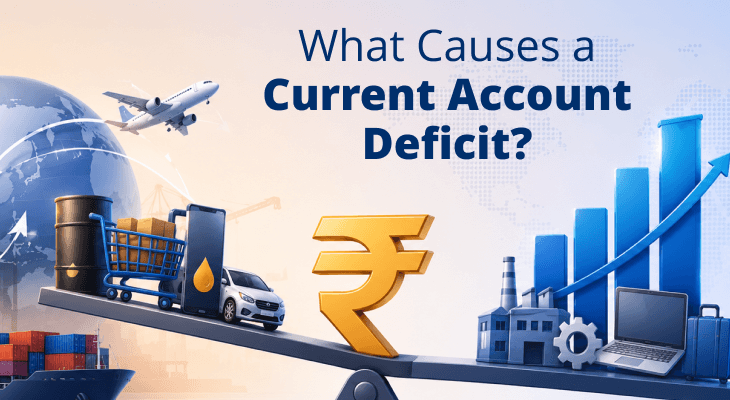
The current account is an important component of a country’s balance of payments. A current account deficit occurs when a country’s total payments to the rest of the world exceed its total earnings from abroad. These payments include imports of goods and services, investment income paid to foreign investors, and current transfers. These earnings include receipts from exports of goods and services, income earned from overseas investments, and current transfers such as remittances. A country’s current account deficit is generally expressed as a percentage of its gross domestic product (GDP).

Revenge trading meaning explained: Causes, impact, and how to avoid it
October 9, 2026 | 0 mins read
in revenge trade, they are often driven by emotions such as anger, frustration, fear, or disappointment rather than sound analysis. In the process, they overlook carefully planned trading strategies designed around their financial goals, investment horizon, and risk appetite. More often than not, revenge trading results in further losses, creating a vicious cycle that becomes increasingly difficult to escape.
FAQ
F&O turnover must be reported in your Income Tax Return (ITR) under the head Profits and Gains from Business or Profession. Depending on your income sources and the use of the presumptive taxation system, you must complete ITR-3 or ITR-4 with the necessary information. Ensure you record the turnover appropriately, including any profits and losses.