
August 19, 2026 | 8 min read
Iron Butterfly vs Iron Condor: Which Strategy Is Better?
Options trading is not always about predicting the next big market move. At times, the market trades within a narrow range, creating opportunities for strategies that benefit from stability rather than direction. Two of the most widely used neutral strategies are the iron butterfly strategy and the iron condor options strategy. While both strategies use four option contracts and defined risk, they do not behave in the same way. Differences in strike selection, profit range, and risk-reward dynamics can significantly affect trading outcomes. Understanding the difference between an iron condor and an iron butterfly can help you select a strategy that matches your market expectations and trading objectives.
What Is an Iron Butterfly?
An iron butterfly strategy is a neutral options strategy that combines a short call, a short put, a long call, and a long put with the same expiry date. The short call and short put share the same strike price, while the long options act as protective wings. Traders typically use this strategy when they expect the underlying asset to remain close to a specific price level until expiry.
What Is an Iron Condor?
An iron condor options strategy is a neutral options strategy that combines a bull put spread and a bear call spread using four option contracts with the same expiry date. Unlike an iron butterfly, the short call and short put are placed at different strike prices, creating a wider profit range. Traders generally use this strategy when they expect the underlying asset to remain within a broad trading range rather than at a single price level.
What Is the Difference Between Iron Condor and Iron Butterfly?
Both the iron butterfly strategy and the iron condor options strategy are neutral options strategies designed to benefit from limited market movement. Although both strategies aim to benefit from limited market movement, their design creates different trading experiences. The choice often depends on how much movement you expect from the underlying asset and how much flexibility you want within the trade.
1. Strategy Structure
The primary difference between an iron condor and an iron butterfly lies in the placement of the short options.
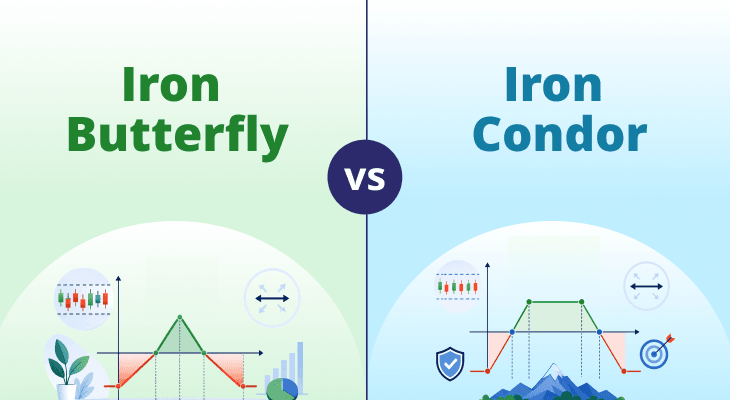
In an iron butterfly, the short call and short put have the same strike price, typically near the current market price. This creates a concentrated profit zone around a single level. An iron condor places the short call and short put at different strike prices. This creates a wider range within which the trade can remain profitable.
2. Profit Potential
An iron butterfly generally collects a larger premium because both short options are positioned at the same strike. This higher premium increases the maximum profit potential. However, achieving that profit often requires the underlying asset to remain very close to the central strike price until expiry.
An iron condor collects a smaller premium but compensates for this with a broader profit range.
3. Profit Range and Flexibility
The width of the profit zone is often one of the most important considerations when comparing the two strategies. With an iron butterfly, even a moderate price movement can reduce profitability.
An iron condor allows more room for the market to fluctuate while still remaining within the profitable range. For traders who expect some movement but not a breakout, this additional flexibility can be valuable.
4. Probability of Success
A wider profit range generally translates into a higher probability of profit. As an iron condor can tolerate greater price fluctuations, it may offer a better chance of remaining profitable compared with an iron butterfly. However, this comes at the cost of lower potential returns.
5. Risk and Reward Balance
Both strategies have limited risk because protective options cap potential losses. The difference lies in how risk and rewards are distributed.
- An iron butterfly seeks higher returns but requires greater precision.
- An iron condor prioritises flexibility and consistency over maximum profit.
Example Comparison
Assume a stock is trading at ₹1,000.
In an iron butterfly, both short options may be placed at ₹1,000. The position performs best if the stock remains very close to this level at expiry.
In an iron condor, the short put might be placed at ₹950 and the short call at ₹1,050. This gives the stock a wider trading range while still allowing the position to remain profitable.
When Should You Choose an Iron Butterfly or Iron Condor?
The decision between an iron butterfly vs an iron condor often depends on your market expectations.
1. Choose an Iron Butterfly When
- You expect very little price movement.
- The market is trading near a specific level.
- You want to collect a higher premium.
- You are comfortable with a narrower profit range.
2. Choose an Iron Condor When
- You expect prices to remain within a broad range.
- You want more flexibility.
- You prioritise probability over premium collection.
- You prefer a wider margin for error.
This distinction often plays a bigger role in strategy selection than the profit potential itself.
Key Advantages and Limitations of Both Strategies
Before choosing between an iron butterfly and an iron condor, it is important to understand the trade-offs each strategy presents. While both aim to benefit from neutral market conditions, they differ in terms of flexibility, profit potential, and the level of precision required.
Advantages of an Iron Butterfly
- Generates a higher premium at trade entry.
- Offers greater maximum profit potential.
- Can be effective when you expect the market to remain near a specific price level.
- Defines risk clearly through protective option positions.
Limitations of an Iron Butterfly
- Requires greater accuracy in forecasting price behaviour.
- A relatively small market move can reduce profitability.
- Provides a narrower profit range than an iron condor.
- May require closer monitoring as expiry approaches.
Advantages of an Iron Condor
- Allows more room for price fluctuations.
- Provides a broader profit zone.
- Can accommodate moderate market movement more effectively.
- Offers predefined risk and reward levels.
Limitations of an Iron Condor
- Generates a lower premium compared to an iron butterfly.
- Delivers lower maximum profit potential.
- May require wider strike selections, which can affect returns.
- Strong market trends can reduce the effectiveness of the position.
Neither strategy is inherently superior. The better choice depends on how much movement you expect from the underlying asset and whether you prioritise higher profit potential or a wider margin for error.
Risk Management Tips for Iron Butterfly and Iron Condor Trading
A well-structured trade can still produce losses if risk management is ignored. Regardless of whether you choose an iron butterfly or an iron condor, controlling risk should remain a priority.
1. Define Your Exit Rules Before Entering
Many traders focus heavily on entry points but give little thought to exits. Establishing profit targets and acceptable loss limits before placing the trade can help remove emotional decision-making later.
2. Avoid Oversized Positions
Even though both strategies have limited risk, placing too much capital into a single trade can create unnecessary exposure. Position sizing should align with your overall trading plan.
3. Monitor Changes in Volatility
Changes in implied volatility can affect option prices and alter the risk profile of a position. Keeping track of volatility conditions can help you assess whether the original trade thesis remains valid.
4. Review Market Events Before Entry
Economic announcements, earnings releases, and policy decisions can increase price uncertainty. Many traders evaluate the event calendar before opening neutral options positions.
5. Manage Winning Trades
Holding a position until expiry is not always necessary. Some traders choose to lock in profits once a significant portion of the potential gain has already been achieved.
Common Mistakes Beginners Should Avoid
Learning how these strategies work is important. Avoiding common mistakes is equally important.
1. Choosing Strikes Without a Market View
Strike selection should reflect expected price behaviour. Randomly choosing strike prices can lead to a poorly structured trade.
2. Focusing Only on Premium Collected
A larger premium may appear attractive, but it often comes with a narrower profit range and higher sensitivity to market movement.
3. Ignoring Volatility Conditions
Volatility can influence option pricing and strategy performance. Failing to consider volatility may result in positions that do not match current market conditions.
4. Holding Positions Too Long
Waiting until the final days before expiry can increase exposure to sudden price swings. Many traders actively manage positions rather than relying solely on expiry outcomes.
5. Trading Without a Risk Plan
Entering a trade without predefined risk limits can make it difficult to respond consistently when the market moves unexpectedly.
Conclusion
The debate around an iron butterfly vs an iron condor does not have a single winner. Both strategies serve different purposes and suit different market conditions. An iron butterfly offers higher premium potential but demands greater precision, while an iron condor provides a wider profit range and more flexibility. The better choice depends on your expectations for price movement, your risk tolerance, and your trading objectives.
By understanding the strengths and limitations of each approach, you can make more informed decisions and choose the strategy that best fits the market environment you are trading in.
More Related Articles

SEBI Proposes CAS Changes: What Could Change for Derivatives Settlement, IEPs & Timings?
 September 17, 2026 | 0 mins read
A month after introducing the new Closing Auction Session, SEBI has proposed changes after early market feedback raised concerns about derivatives settlement on expiry days, changing auction prices and trading timings. SEBI is not scraping CAS. Instead, it wants to make expiry settlement clearer, improve the auction process and help traders understand that indicative auction prices are not the same as actual traded prices.

ETF trading rules from 7 September: What changes for retail investors?
September 7, 2026 | 0 mins read
If there was no trade during the final 30 minutes on the previous day, the exchange will use that day’s last traded price. If there was no trade at all on the previous day, the latest available closing NAV will be used. The base price will also be adjusted for corporate actions, if applicable. From April 1, 2027, SEBI expects stock exchanges and mutual fund AMCs to use the previous day’s closing NAV as the base price after resolving operational issues.

How MSCI rebalancing tested India's Closing Auction System on August 31
September 2, 2026 | 0 mins read
India’s new Closing Auction Session (CAS) processed a record ₹39,718 crore turnover, on 31 August 2026 as MSCI India Index latest index rebalancing took effect at the market close. The event showed that CAS could handle an exceptional concentration of institutional flow. However, there were some sharp, and sometimes counterintuitive, stock moves. This shows that the quality of closing-price discovery is still being tested.
FAQ
An iron condor is often considered safer because it provides a wider profit range. This allows the underlying asset more room to fluctuate before the trade becomes unprofitable. However, both strategies have limited risk, and the suitability of either approach depends on market conditions and strike selection.