
February 3, 2026 | 6 min read
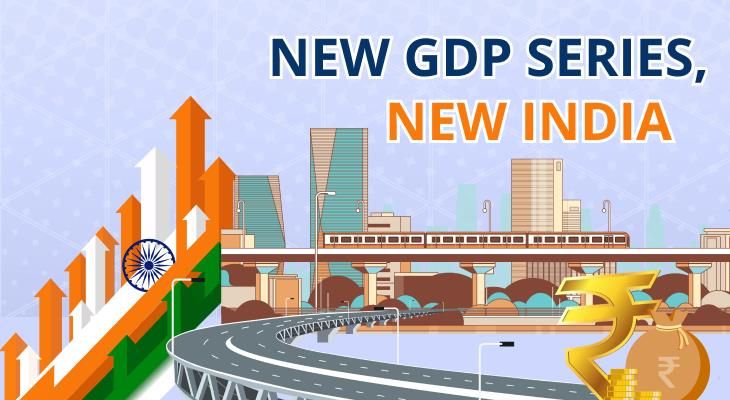
New GDP series, new India: what changes for growth, policy and you
India is changing how it measures GDP, especially the consumption part. It will also change how growth, demand and even sector stories from 2026 and beyond.Till now, India largely used the ‘commodity flow’ method to estimate private consumption. In simple terms, statisticians started from production. They took how much of a good was produced, adjusted for exports, imports, government use, stocks, wastage etc., and whatever was left was assumed to be what households consumed. This worked when production data (especially for agriculture and manufacturing) was strong, but household consumption surveys were infrequent.
What is changing in new GDP series?
In the new series (to be released on 27 Feb 2026), India will flip this logic for a big chunk of consumption. For 61 commonly consumed items (mainly food) it will now use actual Household Consumption Expenditure Survey (HCES) data from 2022‑23 and 2023‑24. It will also consider 34 services and non‑food items like mobility, fuel, health, education, air/rail travel, electricity, fuel etc. It will use administrative data such as e‑Vahan vehicle registrations, DGCA air traffic numbers, Railways data, petroleum sales and power‑use statistics. Instead of inferring what households might be consuming from production, it will increasingly measure what households say they are consuming and what systems show they are using.
How is this different from earlier GDP calculation?
Let us understand it with an example:
e-Vahan Vehicle Registrations:
- Old Method: The estimate of vehicle consumption (cars, bikes, etc.) might be inferred by looking at vehicle production and supply data. They would consider how many vehicles are manufactured in India, imported, etc.
- New Method: Now, the government will use real vehicle registration data from the e-Vahan system. This means it will track how many people are buying and registering vehicles.
- Example: If 100,000 cars are registered in the year, it directly reflects consumption, rather than guessing based on production data.
Petroleum Sales:
- Old Method: The old method might have estimated petroleum consumption by looking at production levels or imports.
- New Method: The government will now track actual sales data from petroleum companies (e.g., how much fuel is being sold to consumers at pumps).
- Example: If 5 million liters of petrol are sold every month, it’s directly counted as part of the consumption data, giving a precise reading of how much fuel consumers are using.
Why Is This Better?
- Accuracy: The new method relies on actual data from systems that directly measure consumption (e.g., e-Vahan, DGCA), so it gives a clearer and more accurate picture of how households and businesses are spending and consuming.
- Transparency: It removes the guesswork and provides a direct way to measure consumption, which is important for better policymaking and economic forecasting.
- Real-Time Data: The integration of real-time data from these systems will make GDP estimates more up-to-date and reflective of current trends, instead of relying on outdated assumptions or surveys.
How does this align with global standards?
Most major economies already rely heavily on household expenditure surveys plus administrative and big‑data sources for the consumption side of GDP, combined with UN‑style classifications like COICOP 2018. The new series will move from the old 1999 COICOP classification of consumption to COICOP 2018.
It is the latest UN standard used widely by other countries to group spending into categories like food, housing, transport, health, education, recreation etc. That brings India’s household consumption classification much closer to global norms, making cross‑country comparisons easier and the ‘India vs world’ growth story more comparable.
The move brings India closer to:
- OECD practices, where regular household budget surveys and scanner data feed into national accounts.
- UN System of National Accounts (SNA 2008) guidelines, which encourage using the best available micro‑data instead of relying solely on commodity flows.
Where India will still be different is in the coverage and quality of survey data. As HCES (Household Consumption Expenditure Survey) is improving but may still struggle with under‑reporting at the top end and coverage of informal digital spends. So the debate on ‘true’ consumption will not disappear, it will just rest on a different set of assumptions.
This new method of calculating GDP gives a better picture of today's economy, which is more focused on consumer spending and services. However, experts warn that the Household Consumption Expenditure Survey (HCES) method has its own issues. For example, wealthier households might not report all their spending accurately, which means the new method could underestimate demand from high-income people. This is like the old method, which struggled to capture data from the informal sector and service-based industries.
What might this mean for common people?
For an ordinary citizen, the way GDP is calculated doesn’t change monthly expenses, but it changes the official picture of the economy that drives policy, markets and media narratives.
- If the new series shows stronger growth in non‑food spending, policymakers may feel more comfortable continuing with consumption‑supportive policies rather than only focusing on food and subsidies.
- If it reveals that consumption is weaker than earlier thought, especially in certain segments, the government may redirect schemes or subsidies to those areas.
- Interest rates and taxes: Better consumption data feeds into RBI’s growth and inflation views and into Budget assumptions. That affects loan EMIs, taxes and welfare spending.
- Targeting of schemes: Knowing exactly how much poorer households spend on essentials vs services can refine food, fuel or cash‑transfer policies.
In short, the new GDP series will not directly put more money in your pocket, but it can lead to better‑targeted policies and a more accurate reading of whether Indians are really doing better or not.
Impact on sectors and markets
Because the new series will give more weight and better measurement to non‑food, services and mobility, some sector narratives may look different:
- Consumer discretionary & durables: If household surveys show strong spends on mobiles, appliances, clothing and personal care, measured GDP growth in these segments could rise, supporting a more bullish case for listed FMCG, retail and durable companies.
- Travel, auto & fuel: Using e‑Vahan, DGCA and rail data means vehicle demand, air travel and mobility will be mapped more precisely. That can sharpen the market’s view on autos, aviation and fuel retailers.
- Health & education: Direct use of administrative data can highlight whether out‑of‑pocket health and education spending is rising faster than assumed, feeding into the investment story for hospitals, diagnostics, ed‑tech and private universities.
- Agri & food: As food’s share in the average household budget falls, agriculture and traditional food segments may carry lower weight in PFCE, potentially moderating their perceived contribution to GDP even if volumes are steady. That can influence debates on MSPs, food subsidies and agri reforms.
India’s new way of calculating GDP is basically a big clean‑up of how we measure ‘India’s growth story’. Till now, a lot of numbers were built from factory and production data but couldn’t be matched properly and had many discrepancies. That made it hard to know what was really driving growth and often led to big revisions later.
So now the government wants to use fresher household surveys and hard usage data plus a global standard format for classifying spending. So that GDP reflects what people buy and use in today’s service and digital‑heavy economy. If this is implemented with updated data, it can quietly transform GDP from a confusing headline into a more reliable dashboard for the economy. So, when we say, ‘India is growing’, now new GDP calculation will give solid statistical backbone to the India’s growth story.
More Related Articles
Understanding the meaning and benefits of the systematic trading system
 October 23, 2026 | 0 mins read
A systematic trader is an individual who uses a predesigned and backtested trading strategy to buy and sell financial instruments such as stocks, futures, currencies, or commodities. Instead of relying on gut feelings or emotions, they use a systematic trading system built on predefined rules, quantitative analysis, and technology to make trading decisions.

Muhurat Trading 2026: Will stock market be open on 8th November Sunday?
October 23, 2026 | 0 mins read
Muhurat Trading 2026 will be held on Sunday, 8 November 2026, on Diwali Laxmi Puja. NSE and BSE will open their equity markets for a special afternoon session, with continuous trading beginning at 2:20 pm IST. Trading in securities not covered by the Closing Auction Session (CAS) will continue until 3:30 pm, while continuous trading in CAS-eligible securities will end at 3:15 pm. For investors, Muhurat Trading combines a long-standing Diwali tradition with an opportunity to participate in the stock market. Here is a guide to the date, timings and session structure for 2026.
How stock market psychology influences investment decision-making
October 23, 2026 | 0 mins read
Stock market psychology refers to the collective emotions, sentiment, and behavioural biases that influence the buying and selling decisions of investors. Rather than relying on fundamental and technical analysis, investors may sometimes react based on emotions, which can influence market movements.