
October 27, 2026 | 5 min read
REIT vs InVIT: Which Is Safer for Long-Term Investing?
India is home to a diverse range of investments, from traditional options like fixed deposits to market-linked instruments such as stocks, mutual funds, REITs and InvITs. This blog compares REIT vs InvIT to help investors make an informed investment decision.
What are REITs and InvITs?
Real Estate Investment Trusts (REITs) work in a similar fashion to mutual funds. However, instead of investing the pooled money in different securities, a REIT invests the collective amount primarily in completed, income-generating commercial real estate such as offices, malls, business parks, and warehouses.
REIT investing allows investors to participate in the real estate market without buying or managing property directly. Investors can earn returns through the income generated by these properties, primarily in the form of rentals, along with the potential for capital appreciation in the value of the underlying assets.
InvITs (Infrastructure Investment Trusts) work similarly to mutual funds and REITs. These, however, invest in operational infrastructure assets such as highways, gas pipelines, and telecom towers, instead of securities and real estate, respectively.
InvITs generate revenue through sources such as toll collections, transmission charges, and long-term service contracts. They allow retail investors to participate in India's infrastructure growth without owning or operating these assets themselves.
Both REITs and InvITs are regulated by the Securities and Exchange Board of India (SEBI), listed on recognised stock exchanges. These are also required to distribute at least 90% of their Net Distributable Cash Flows (NDCF) to unit holders.
How REIT investing works for long-term investors
REITs pool money from multiple investors and invest it into income-generating commercial real estate. After accounting for management expenses and regulatory requirements, they distribute a significant portion of their NDCF to unit holders.
Long-term investors earn returns from REITs in two ways:
- Regular income distributions generated primarily from rental income. Investors who reinvest these distributions may benefit from the power of compounding over time.
- Potential capital appreciation if the value of the underlying properties and REIT unit prices increase over time.
REITs may also offer some protection against inflation, as property values and rental income often tend to rise during inflationary periods. Additionally, by investing across multiple commercial properties, REITs help diversify risk, making them a suitable option for investors with a long-term investment horizon.
That said, REIT returns are not guaranteed. These are influenced by factors such as occupancy levels, rental demand, interest rates, operating costs, and overall real estate market conditions.
How InvIT investments help generate income
InvITs generate revenue from operational infrastructure assets. Common income sources include:
- Toll collections
- Power transmission charges
- Lease rentals
- Usage charges
- Long-term infrastructure contracts
After deducting necessary expenses, the remaining NDCF is distributed to investors, in accordance with SEBI regulations. This is primarily in the form of interest, dividends and, where applicable, repayment of debt. Investors may also benefit from capital appreciation if the market price of InvIT units increases over time.
As many infrastructure assets operate under long-term contracts, InvITs can offer relatively stable cash flows. However, returns remain subject to project performance, regulatory changes, and economic conditions.
Major differences between REIT vs InvIT
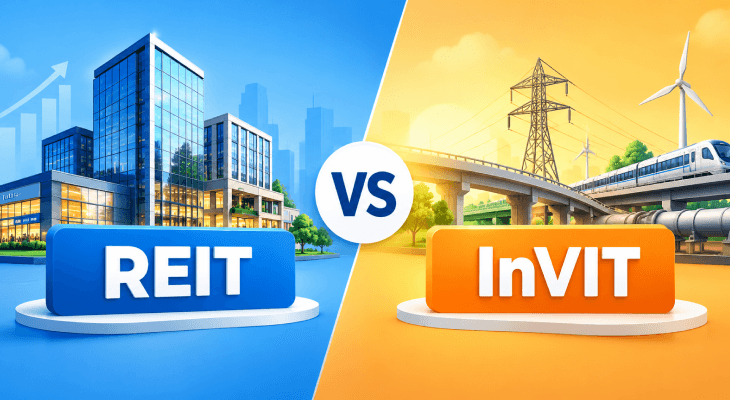
Although REITs and InvITs follow a similar pooled investment model, they differ on certain grounds.
Particulars | REIT | InvIT |
|---|---|---|
Underlying assets | Commercial real estate such as office spaces, malls, and warehouses | Infrastructure assets such as roads, bridges, power grids, and towers |
Primary revenue source | Rental and lease income | Toll collections, usage fees, and long-term contracts |
Risk factors | Market-driven risks (property demand, valuation, rental slowdown) | Project-specific (traffic-volume risks, regulatory risks) |
Capital appreciation potential | Generally higher | Moderate, with greater focus on regular income |
Suitable for | Investors seeking exposure to commercial real estate | Investors seeking exposure to infrastructure assets and relatively stable cash flows |
REIT vs InvIT: Which is better for long-term investing?
There is no clear winner in the REIT vs InvIT debate. The better choice depends on an investor’s financial goals, risk appetite, and investment strategy.
REITs may suit investors seeking exposure to commercial real estate with the potential for regular income and long-term capital appreciation. InvITs, on the other hand, may appeal to investors who prefer regular cash flows over capital growth and are comfortable with project-specific risks.
Benefits and risks of investing in REITs and InvITs
REITs and InvITs provide investors with exposure to income-generating assets without direct ownership. However, like any investment, they offer both benefits and risks.
Benefits of REITs
- Accessibility: Investors can gain exposure to commercial real estate with a relatively small investment.
- Diversification: REITs invest across multiple commercial real estate properties, helping diversify the portfolio and spread risk.
- Liquidity: REITs are traded on stock exchanges, making them more liquid than traditional real estate investments.
- Regular income and capital appreciation: Investors may benefit from periodic income distributions and potential growth in REIT unit prices.
- Professional management and transparency: REIT portfolios are managed by experienced professionals and regulated by SEBI.
Disadvantages of REITs
- Interest rate sensitivity: Rising interest rates can increase borrowing costs and affect REIT returns.
- Market and real estate risks: Returns depend on occupancy levels, rental demand, and overall market conditions.
- Limited growth potential: Since REITs are mandated to distribute a significant portion of their NDCF to unit holders, they may retain less capital for expansion.
- Market-linked returns: Income and capital appreciation are not guaranteed.
Benefits of InvITs
- Regular income: InvITs distribute a significant portion of their cash flows to investors.
- Infrastructure exposure: They offer access to infrastructure assets without direct ownership.
- Professional management and transparency: InvITs are managed by professional teams and regulated by SEBI.
- Portfolio diversification: InvITs add exposure to an asset class that differs from traditional equity and debt investments.
Disadvantages of InvITs
- Project-specific risks: Returns depend on the performance of the underlying infrastructure assets. Factors such as lower traffic volumes, operational issues, or reduced demand can affect cash flows.
- Regulatory risks: Changes in government policies and regulations may impact the performance of InvITs.
- Interest rate sensitivity: Rising interest rates may impact valuations and financing costs.
- Liquidity risk: Although InvITs are listed on stock exchanges, lower trading volumes may make it difficult to buy or sell units quickly.
Conclusion
When comparing REIT vs InvIT, there is no one-size-fits-all option. Both provide access to income-generating assets without the need for direct ownership. Understanding their differences can help investors make informed long-term investment decisions.
More Related Articles

Understanding the meaning and benefits of the systematic trading system
 October 23, 2026 | 0 mins read
A systematic trader is an individual who uses a predesigned and backtested trading strategy to buy and sell financial instruments such as stocks, futures, currencies, or commodities. Instead of relying on gut feelings or emotions, they use a systematic trading system built on predefined rules, quantitative analysis, and technology to make trading decisions.

Muhurat Trading 2026: Will stock market be open on 8th November Sunday?
October 23, 2026 | 0 mins read
Muhurat Trading 2026 will be held on Sunday, 8 November 2026, on Diwali Laxmi Puja. NSE and BSE will open their equity markets for a special afternoon session, with continuous trading beginning at 2:20 pm IST. Trading in securities not covered by the Closing Auction Session (CAS) will continue until 3:30 pm, while continuous trading in CAS-eligible securities will end at 3:15 pm. For investors, Muhurat Trading combines a long-standing Diwali tradition with an opportunity to participate in the stock market. Here is a guide to the date, timings and session structure for 2026.

How stock market psychology influences investment decision-making
October 23, 2026 | 0 mins read
Stock market psychology refers to the collective emotions, sentiment, and behavioural biases that influence the buying and selling decisions of investors. Rather than relying on fundamental and technical analysis, investors may sometimes react based on emotions, which can influence market movements.
FAQ
Yes. Both REITs and InvITs can help diversify an investment portfolio by providing exposure to commercial real estate and infrastructure assets. Their performance drivers differ from those of traditional equity and debt investments.