
February 13, 2025 | 6 min read
What is a Cumulative Fixed Deposit?
While the stock market can give you lucrative returns, some investors like to stick with assured returns like those you get from a fixed deposit (FD) scheme. Fixed deposits are offered by banks and certain non-financial banking companies and are of two types: cumulative and non-cumulative. The distinction is mainly due to the interest that is paid from either. The kind of FD you opt for is based on whether you wish to have your interest payments made regularly or when your FD reaches maturity.
Furthermore, deposit schemes are easy to open and a cumulative FD calculator can help you decide how much to invest at a particular rate of interest. You also get to know your maturity amount. Explore all about a cumulative FD in this article, and learn how it is different from a non-cumulative FD so you can decide which is suitable for you.
What is a cumulative fixed deposit?
A fixed deposit is a financial instrument aimed to invest a fixed sum for a fixed tenure. The fixed deposit yields an interest rate, also fixed before the deposit starts. The word “cumulative” refers to the collection of things, so a cumulative fixed deposit is one in which the accrued interest is collected till the maturity of the fixed deposit. When the deposit tenure ends, the investor collects interest collected for the whole tenure along with the principal invested, at one time. Before you begin a cumulative fixed deposit, you can decide your principal to invest depending on your financial goals by using a cumulative FD calculator to decide the sums invested.
A cumulative fixed deposit is a fixed deposit scheme in which the interest is reinvested at regular intervals. Typically, this occurs on a quarterly or annual basis. So, when the interest is earned over your principal sum, it is added to it, and the next interest amount is based on the principal together with your last interest. Thus, interest raises your principal due to the effect of compounding (as you get interest on the interest and principal). On maturity, you get the sum of your principal amount plus interest payments compounded.
Suitability of a Cumulative Fixed Deposit
Before you consider a cumulative fixed deposit, you may want to think of your investment goals. Typically, this deposit works as a long-term deposit as the effect of compounding permits you to earn a large corpus at maturity. You may think of investing in such a scheme if you have long-term financial goals like buying a home, planning for retirement, or funding a child’s higher education or marriage. Furthermore, you can use a cumulative fixed deposit calculator to compute your maturity amount and decide how much you wish to invest.
What is the meaning of a non-cumulative fixed deposit?
A cumulative fixed deposit calculator helps you to compute sums that you may make at the maturity of your FD, depending on the interest you accrue throughout the term of the FD. In case, you wish to make the most of an FD offering you a regular income source, you may go in for a non-cumulative fixed deposit. Here, you can invest a fixed amount (principal) for a fixed period (tenure) with a fixed interest rate that gives you regular payouts. Interest is not collected over the course of the fixed deposit tenure, but instead, it is paid out to the investor at regular intervals (1 month, 3 months, 6 months).
As the bank does not withhold the interest, there is no accumulation of interest over time (as in a cumulative FD) and no compounding effect. Additionally, due to the interest being paid to the investor on a regular basis throughout the FD term, the rate of interest on such an FD may be lower relative to a cumulative fixed deposit.
Difference Between Cumulative and Non-Cumulative FD
The difference between a cumulative FD and a non-cumulative FD is highlighted in the table below:
Differential Parameter | Cumulative Fixed Deposit | Non-Cumulative Fixed Deposit |
Meaning | Interest is accrued throughout the course of the FD | Interest is not collected throughout the FD term |
Interest Payment | Payment on the FD is made at maturity of the FD, collected by the investor as a single summative payment. | Interest payments are made on a monthly, quarterly, or half-yearly basis. |
Reinvestment of Capital | The depositor/investor earns interest on the principal and then interest on the interest plus the principal. The investor gets a compounding effect of interest accumulation and this is why cumulative fixed deposit rates are high relative to non-cumulative FD interest rates. | There is no chance of reinvestment as interest is paid out at fixed and regular intervals, that is, it is not invested into the FD. Therefore, interest rates on a non-cumulative FD are lower compared to a cumulative FD. |
Suitability | People who have a stable income can go in for a cumulative FD, especially if they want to collect a corpus for a financial requirement for the future. | As payouts are regular and assured, retirees, freelancers, housewives, etc, can benefit. |
Income Flow | There is no income from interest generated during the tenure of the FD. | There is a regular and fixed income flow generated through interest payments throughout the FD’s tenure. |
Best Cumulative Fixed Deposit Rates 2024
Now that you know a lot about a cumulative FD, you should also know that Indian banks and non-banking financial companies (NBFCs) offer investors some of the best cumulative fixed deposit interest rates. Here, ten of the potentially best interest rates according to FD schemes in banks (3-year tenure) are highlighted, with an initial investment (principal) of ₹2 crores:
Banks | Cumulative Interest Rates |
Punjab & Sind Bank | 5.30% - 5.80% |
Fincare Small Finance Bank | 6.50% |
Canara Bank | 5.45% - 5.95% |
KTDFC | 6% - 6.25% |
Yes Bank | 6.25% - 7.00% |
Shriram City | 7.50% - 7.80% |
Equitas Small Finance Bank | 6.50% - 6.66% |
Mahindra Finance | 6.20% - 6.45% |
Lakshmi Vilas Bank | 5.65% - 6.15% |
Sundaram Finance | 5.77% - 6.27% |
How to Maximise FD Returns
It's simple and convenient to begin your investment with a cumulative FD. Moreover, you can easily choose the FD that matches your unique financial requirements and goals and even do FD-related calculations with an online cumulative Investors find it easy to maximise returns with a cumulative FD calculator.
If you choose a cumulative FD as one of your investment avenues, you will see that your returns can be effectively maximised, as your interest is reinvested for the full duration of the FD. This translates to the interest in the first cycle of interest payment being added to your principal. So your principal is increased with the additional interest. As your FD continues from here, you would earn interest on this increased principal in the subsequent cycle of interest payment. So you get the advantage of compound interest with each cycle of interest payment that follows. This carries on till your FD comes to a conclusion. This is how you can efficiently maximise your returns.
Conclusion
A cumulative FD can be considered by investors who have an existing source of income, but wish to collect a corpus to fund a future financial requirement, such as a child’s higher education, or a marriage. As the effect of compounding can maximise cumulative FD returns, this FD can be a lucrative investment to save money in a disciplined manner and gain a substantial corpus at maturity.
More Related Articles

How Rising Oil Prices Impact Stock Market Investments
 October 9, 2026 | 0 mins read
A petroleum price hike, driven by rising global crude oil prices, can have far-reaching consequences for the economy and financial markets worldwide. As India imports over 88% of its crude oil requirements, understanding the impact of rising oil prices on stock market investments is essential for investors.
Understanding the meaning and impact of a current account deficit on an economy
October 9, 2026 | 0 mins read
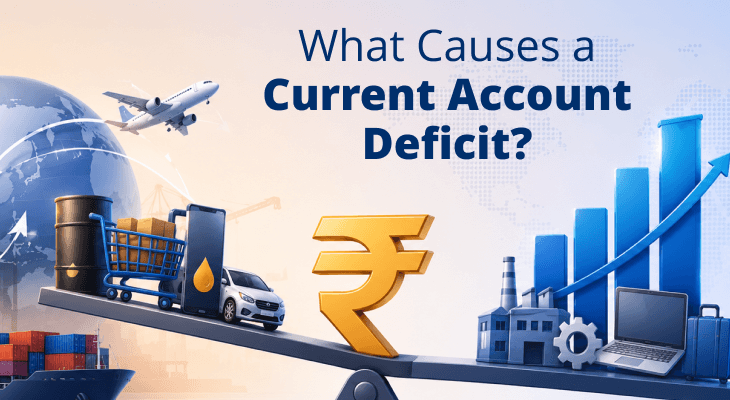
The current account is an important component of a country’s balance of payments. A current account deficit occurs when a country’s total payments to the rest of the world exceed its total earnings from abroad. These payments include imports of goods and services, investment income paid to foreign investors, and current transfers. These earnings include receipts from exports of goods and services, income earned from overseas investments, and current transfers such as remittances. A country’s current account deficit is generally expressed as a percentage of its gross domestic product (GDP).

Revenge trading meaning explained: Causes, impact, and how to avoid it
October 9, 2026 | 0 mins read
in revenge trade, they are often driven by emotions such as anger, frustration, fear, or disappointment rather than sound analysis. In the process, they overlook carefully planned trading strategies designed around their financial goals, investment horizon, and risk appetite. More often than not, revenge trading results in further losses, creating a vicious cycle that becomes increasingly difficult to escape.
FAQ
Cumulative fixed deposits may be opted for those investors who have an existing regular source of income and wish to finance certain future objectives through a cumulative FD.