
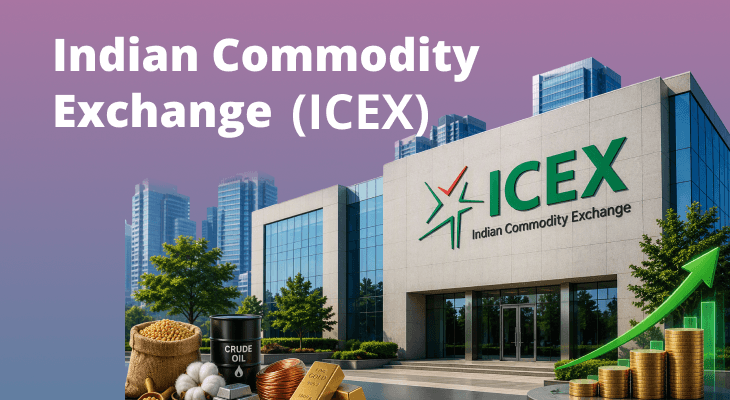
July 30, 2026 | 8 min read
What is the Indian Commodity Exchange (ICEX)?
Most investors associate commodity trading in India with the Multi Commodity Exchange (MCX). However, MCX is not the only exchange that has sought to develop India's commodity derivatives market. One of the notable names was the Indian Commodity Exchange (ICEX), which introduced specialised contracts such as diamond and steel futures.
Although ICEX played an important role in the evolution of India's commodity markets, it is no longer a recognised commodity derivatives exchange. Today, commodity trading in India is primarily carried out through active exchanges such as MCX.
Understanding the Indian Commodity Exchange remains useful because it highlights how India's commodity market has evolved over the years. It also demonstrates the challenges of building liquidity and participation in specialised commodity contracts.
What was the Indian Commodity Exchange (ICEX)?
The Indian Commodity Exchange (ICEX) was a commodity derivatives exchange that provided an electronic platform for trading commodity futures contracts.
Like other commodity exchanges, ICEX offered standardised futures contracts that allowed participants to hedge against price fluctuations or take positions based on expected price movements. The exchange operated under the country's commodity market regulatory framework, which later came under the supervision of the Securities and Exchange Board of India (SEBI).
Unlike larger exchanges that focused on widely traded commodities, ICEX aimed to develop specialised contracts in niche segments. While this approach brought innovation to the market, attracting sustained trading volumes proved challenging.
Today, ICEX no longer operates as a recognised commodity derivatives exchange, making it part of India's commodity market history rather than its current trading ecosystem.
History and Background of ICEX
ICEX was established in 2009, when India's commodity derivatives market was expanding and several exchanges operated across different commodity segments.
A significant regulatory change took place in 2015 when the Forward Markets Commission (FMC) merged with SEBI. This brought commodity derivatives under a unified regulatory framework and strengthened oversight of the sector.
ICEX attempted to differentiate itself by launching specialised products instead of competing directly in heavily traded commodities.
Some of its notable initiatives included:
- Diamond futures, introduced in 2017, which aimed to bring greater standardisation and transparency to diamond pricing.
- Steel futures, launched in 2018, to help market participants manage price volatility in the steel sector.
While these products attracted attention, they did not achieve the level of market participation needed to build sustained liquidity. Over time, ICEX exited the exchange business and no longer functions as a recognised commodity derivatives exchange.
What Commodities were Traded on ICEX?
ICEX did not offer a wide basket of commodities like other exchanges. Its product range was more selective, with a focus on segments that require structured pricing mechanisms.
Some of its notable offerings included:
Diamond Futures
Diamond futures were introduced to create a transparent pricing benchmark for a market where prices often depended on private negotiations, certification standards, and product quality. Although the concept was innovative, standardising diamonds for exchange trading proved difficult, limiting market participation.
Steel Futures
Steel futures were designed to help manufacturers, traders, and businesses manage price fluctuations in steel. These contracts had potential as a hedging tool but did not witness sustained trading activity.
These products reflected ICEX's efforts to expand India's commodity derivatives market, even though they did not achieve widespread adoption.
Why Did ICEX Exit the Exchange Business?
Building a successful commodity exchange depends heavily on liquidity. Active participation from traders, hedgers, institutions, and other market participants ensures efficient price discovery and smooth trade execution.
ICEX faced several challenges in achieving this objective:
- Limited trading volumes in specialised contracts.
- Difficulty attracting consistent participation from market participants.
- Competition from established exchanges with deeper liquidity.
- Challenges in building active markets for niche commodities.
As a result, ICEX was unable to establish itself as a major trading venue and eventually exited the exchange business.
Although ICEX no longer functions as a commodity derivatives exchange, it remains an important part of India's financial market history. Its journey offers several insights:
- Innovation alone does not guarantee market success.
- Liquidity is essential for a successful exchange.
- Specialised products require broad industry participation.
- Regulatory oversight alone cannot create active markets without sufficient demand.
For investors analysing commodity market stocks in India, understanding the evolution of India's commodity exchanges provides useful context for today's market structure.
What is MCX?
Today, commodity derivatives trading in India is largely centred around the Multi Commodity Exchange (MCX). While ICEX attempted to carve out a niche with specialised contracts, MCX developed into the country's primary commodity exchange by attracting broad market participation and offering a diverse range of products.
Looking at the differences between the two exchanges helps explain why MCX continues to dominate India's commodity derivatives market, while ICEX eventually exited the exchange business.
MCX and ICEX: A Historical Comparison
Aspect | MCX | ICEX |
Market Position | India's leading commodity derivatives exchange with the highest trading volumes | Operated as a smaller exchange focused on niche commodity contracts before exiting the exchange business |
Product Range | Gold, silver, crude oil, natural gas, base metals and selected agricultural commodities | Introduced specialised products such as diamond and steel futures |
Liquidity | High liquidity supported by strong retail and institutional participation | Limited trading volumes, making it difficult to build sustained liquidity |
Trading Activity | High trading activity and active price discovery across multiple contracts | Trading activity remained relatively limited |
Market Depth | Multiple actively traded contracts with efficient price discovery | Fewer actively traded contracts |
Primary Use | Widely used for trading, hedging and price risk management | Sought to develop specialised commodity segments but did not achieve broad adoption |
Current Status | Active recognised commodity derivatives exchange | No longer operates as a recognised commodity derivatives exchange |
MCX's broader product portfolio, deeper market participation and higher trading volumes enabled it to become India's dominant commodity derivatives exchange. ICEX, despite introducing specialised contracts, was unable to build the same level of sustained market activity.
How to Trade Commodity Derivatives in India Today
Although ICEX is no longer available as a trading platform, investors can participate in commodity derivatives through active recognised exchanges such as MCX. The general process includes:
- Open a trading account with a broker that offers access to commodity derivatives.
- Submit PAN, Aadhaar, and bank details for KYC. Once verified, your account can be activated for commodity trading.
- After that, you need to fund your account. Since trading is margin-based, you only deposit a portion of the contract value.
- Before placing any trade, it is important to study the market. Commodity prices depend on global demand, supply conditions, currency movement, and policy changes. These factors can shift quickly.
- Once you are ready, place your order through the trading platform. You can take either a buy or a sell position depending on your expectation.
Before trading, investors should understand contract specifications, margin requirements, and the risks associated with leveraged products.
What are the Benefits of Trading on Commodity Exchanges?
Commodity exchanges provide a regulated platform for trading commodity derivatives. Whether you are a trader, investor, or business managing price risk, they offer several advantages.
1. Regulated Trading Environment: Recognised commodity exchanges such as MCX operate under the oversight of SEBI. They use standardised contracts, transparent pricing mechanisms, and established settlement systems, helping create a fair and orderly market.
2. Structured Price Discovery: Commodity exchanges determine prices through real-time buying and selling activity. This transparent price discovery helps traders, businesses, and policymakers make informed decisions based on market demand and supply.
3. Hedging Opportunities: Businesses exposed to fluctuations in commodity prices can use futures contracts to hedge against adverse price movements. This helps improve cost planning and reduce uncertainty.
4. Easy Market Access: Investors can trade commodity derivatives through SEBI-registered brokers using online trading platforms. This makes commodity markets accessible from anywhere in India.
5. Portfolio Diversification: Commodity derivatives can complement traditional investments such as equities and mutual funds. Since commodity prices often respond differently to economic events, they may help diversify an investment portfolio.
What are the Risks in Commodity Trading?
While commodity derivatives offer opportunities, they also involve risks that investors should understand before trading.
1. Low Liquidity: Not all commodity contracts attract the same level of trading activity. Contracts with lower liquidity may be more difficult to buy or sell at the desired price.
2. Price Volatility: Commodity prices can change rapidly due to global supply and demand, geopolitical events, weather conditions, currency movements, and government policies.
3. Margin-Based Exposure: Commodity futures are traded on margin, meaning a relatively small investment controls a much larger contract value. While this can amplify gains, it can also increase losses.
4. External Influences: Commodity prices are influenced by a wide range of domestic and international factors. Understanding these drivers requires continuous market monitoring and research.
Conclusion
ICEX was established with the objective of expanding India's commodity derivatives market through specialised contracts such as diamond and steel futures. While it introduced innovative products and contributed to the evolution of commodity trading, it was unable to build the sustained liquidity needed for long-term success.
Today, ICEX no longer operates as a recognised commodity derivatives exchange. Commodity derivatives trading in India is primarily conducted through active exchanges such as MCX, which offer a wider range of products and significantly higher market participation.
Understanding ICEX as a historical case study helps investors appreciate how India's commodity markets have evolved and why liquidity, participation, and efficient price discovery remain central to the success of any exchange.
More Related Articles

SEBI Proposes CAS Changes: What Could Change for Derivatives Settlement, IEPs & Timings?
 September 17, 2026 | 0 mins read
A month after introducing the new Closing Auction Session, SEBI has proposed changes after early market feedback raised concerns about derivatives settlement on expiry days, changing auction prices and trading timings. SEBI is not scraping CAS. Instead, it wants to make expiry settlement clearer, improve the auction process and help traders understand that indicative auction prices are not the same as actual traded prices.
ETF trading rules from 7 September: What changes for retail investors?
September 7, 2026 | 0 mins read
If there was no trade during the final 30 minutes on the previous day, the exchange will use that day’s last traded price. If there was no trade at all on the previous day, the latest available closing NAV will be used. The base price will also be adjusted for corporate actions, if applicable. From April 1, 2027, SEBI expects stock exchanges and mutual fund AMCs to use the previous day’s closing NAV as the base price after resolving operational issues.
How MSCI rebalancing tested India's Closing Auction System on August 31
September 2, 2026 | 0 mins read
India’s new Closing Auction Session (CAS) processed a record ₹39,718 crore turnover, on 31 August 2026 as MSCI India Index latest index rebalancing took effect at the market close. The event showed that CAS could handle an exceptional concentration of institutional flow. However, there were some sharp, and sometimes counterintuitive, stock moves. This shows that the quality of closing-price discovery is still being tested.
FAQ
ICEX was a commodity derivatives exchange launched in 2009 to facilitate futures trading in specialised commodities. It introduced products such as diamond and steel futures but no longer operates as a recognised commodity derivatives exchange.