
Dow Theory in Technical Analysis
- What is Dow Theory all about?
- Core principles (tenets) of Dow Theory
- Understanding market trends in technical analysis
- Applying Dow Theory in stock trading decisions
Ever wondered if Dow Theory is linked to the Dow Jones index? You are absolutely right. There’s a deep historical connection.
Charles Dow, the founding editor of the Wall Street Journal and co-founder of Dow Jones & Company, first laid out the principles of what we now call Dow Theory through editorials between 1900 and 1902. It wasn’t formally labeled as a theory until after his passing, when his successor, William P. Hamilton, organised and expanded these insights into what became a foundational concept in technical analysis.
Dow also introduced two of the most referenced indices in the world: the Dow Jones Transportation Average (DJTA) and the Dow Jones Industrial Average (DJIA), both integral to his theory.
What is Dow Theory?
At its core, Dow Theory is about recognising and confirming market trends. It remains widely followed even today for its clarity and simplicity.
The theory asserts that a trend is valid if it consistently breaks previous highs or lows. In a bullish trend, the market forms higher highs and higher lows. Conversely, a bearish trend shows lower highs and lower lows. For a trend to be confirmed, both DJIA and DJTA should move in the same direction.
To explain his thinking, Dow used a vivid analogy involving ocean tides. He described how a person might determine the high tide by placing a stick where each wave reaches. When waves begin falling short of the stick, it’s a sign that the tide has turned. He likened this method to reading the stock market's tides—both DJIA and DJTA must reflect the same "tide" to confirm a trend.
The Six Tenets of Dow Theory
The Market Discounts Everything

The first tenet aligns with the efficient market hypothesis, stating that markets instantly absorb and reflect all available information, including macroeconomic news and unexpected events. This belief implies that stock prices are always fair, incorporating all known factors affecting demand and supply.
The Market Moves in Three Trends
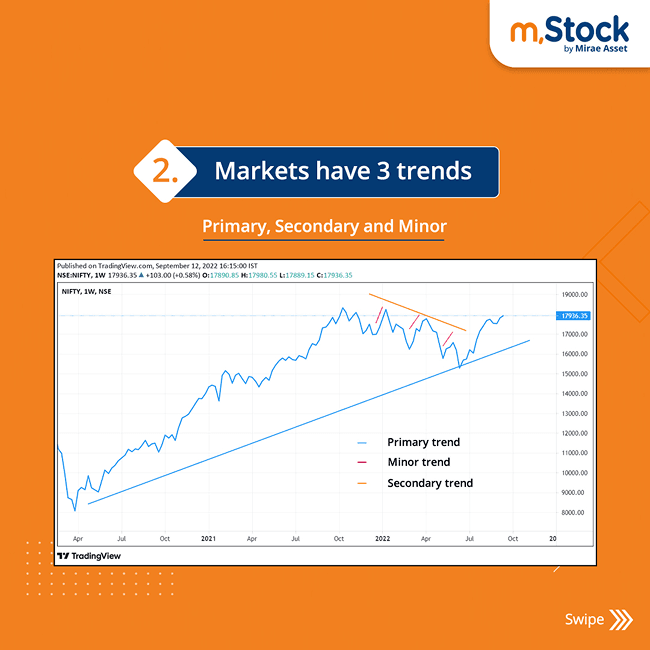
Dow identified three coexisting market trends, each operating over a different time frame:
Primary Trend (Major):
This long-term trend is the broadest wave in market movement and can last from a year to several years. A bullish primary trend forms progressively higher highs and lows, while a bearish trend does the opposite.
Secondary Trend (Intermediate):
These are corrective movements against the primary trend, lasting from a few weeks to a few months. Typically, they retrace around 50% of the previous move but can also pull back by 1/3rd or 2/3rd.
Minor Trend (Short-term):
These are small, short-lived fluctuations, usually lasting less than three weeks, and occur within secondary trends.
Dow compared these to an ocean tide (primary), waves (secondary), and ripples (minor).
3. Each Primary Trend Has Three Phases

The primary trend, whether bullish or bearish, unfolds in three distinct phases:
Accumulation Phase:
Smart money or informed investors begin to quietly enter positions at the end of a downtrend.
Public Participation Phase:
Momentum builds, prices rise, and the broader public enters the market, driving volumes higher.
Distribution Phase:
Early investors start offloading their positions as the market reaches a euphoric stage. Volumes remain high, but risk of reversal increases.

4. Averages Must Confirm Each Other
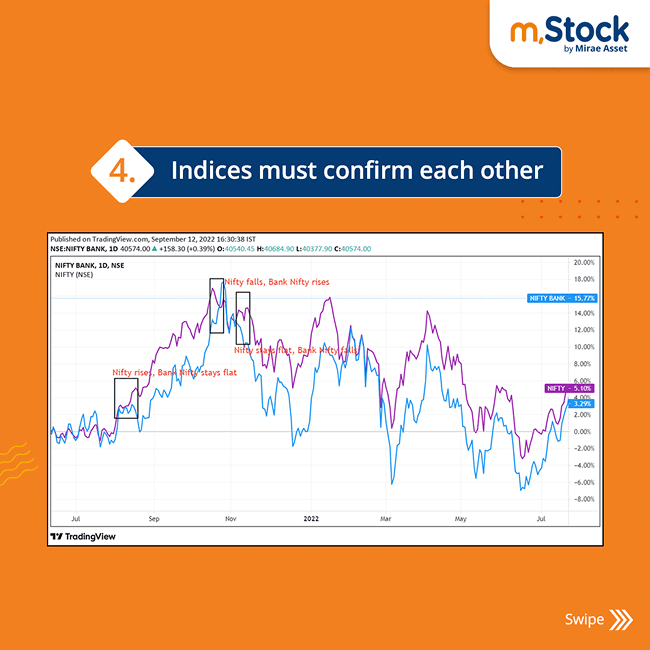
Dow emphasized that both the DJIA and DJTA must reflect the same trend for it to be validated. If one index rises while the other lags or declines, the trend is considered unconfirmed. Confirmation between indices serves as a checkpoint for trend reliability.
5. Volume Confirms the Trend
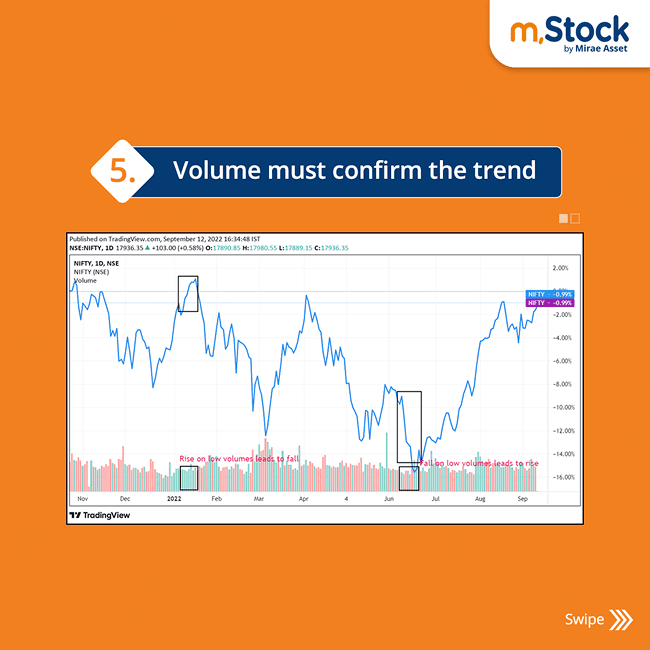
While Dow acknowledged that price action holds more weight than volume, he considered volume a secondary but essential confirming indicator.
In a bullish phase, volume should expand on price advances and shrink during pullbacks.
In a bearish phase, volume should increase as prices fall and decrease during rallies.
This volume behavior helps validate the direction and strength of the trend.
6. A Trend Persists Until Clear Reversal Signals Appear
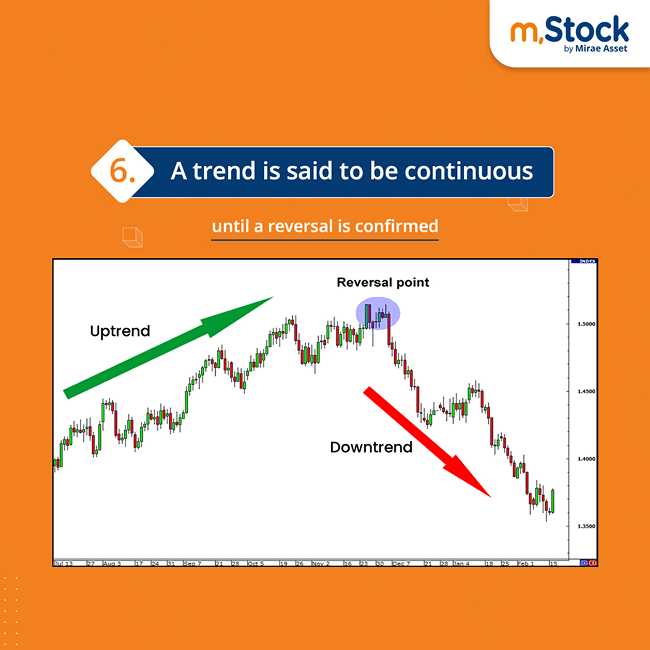
A trend is expected to continue until proven otherwise. However, distinguishing between a reversal and a temporary correction can be challenging. Misinterpreting a secondary trend as a full reversal can lead to poor decisions. Dow emphasised the need for definitive signals before concluding that the primary trend has ended.
Points to Remember
Dow Theory remains timeless, with its core concepts still relevant over 100 years later
It serves as the foundation of modern technical analysis
Identifying primary vs. secondary trends requires skill and experience
Confirming when a trend has been conclusively reversed can be difficult and may need support from fundamental analysis
Dow Theory offers directional clarity, but traders should combine it with other technical tools for more accurate decisions