
October 9, 2026 | 9 min read
Black Swan Events Explained: Meaning, Examples, and Market Impact
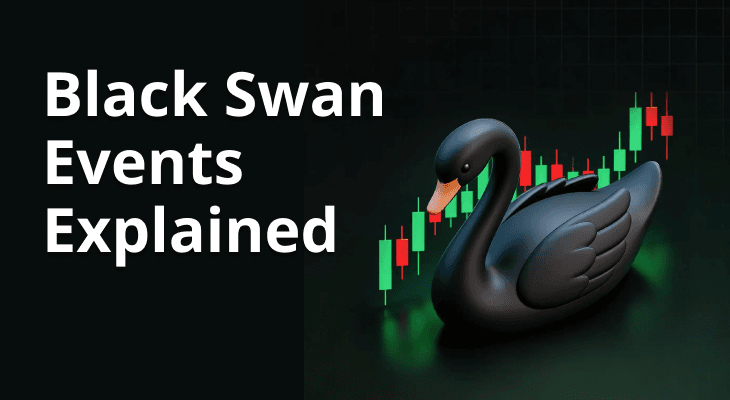
Financial markets are influenced by factors such as economic growth, interest rates, corporate earnings, and geopolitical developments. While many market movements follow evolving economic conditions, unexpected events can sometimes trigger sharp declines, extreme volatility, and widespread uncertainty. These rare and unpredictable occurrences are known as black swan events.
Although black swan events cannot be predicted with certainty, understanding their impact highlights the importance of diversification, risk management, and disciplined investing. This blog explains what black swan events are, how they affect financial markets, and why they matter to investors.
What Are Black Swan Events in the Stock Market?
A black swan event is a rare and unexpected event with a significant impact on financial markets, economies, or society. In the stock market, such events often trigger sudden shifts in investor sentiment, sharp price movements, and heightened volatility. Unlike normal market corrections driven by changing economic conditions or valuations, black swan events emerge with little warning and lead to rapid reassessment of risk.
For example, an unexpected global crisis may prompt investors to move capital from equities to relatively safer assets such as government bonds or gold, resulting in widespread selling across stock markets even when the long-term fundamentals of many companies remain unchanged.
Origin of the Term "Black Swan"
The term ‘Black Swan’ was popularised by Nassim Nicholas Taleb in his 2007 book The Black Swan. Before black swans were discovered in Australia, Europeans believed all swans were white because they had never observed otherwise. Taleb used this analogy to describe highly improbable events that challenge established assumptions and seem easier to explain only after they occur.
Are Black Swan Events Common?
Black Swan events are, by definition, rare. Most market movements result from factors such as economic data, monetary policy, business cycles, and geopolitical developments that investors already monitor. However, history shows that unexpected shocks can occur, making it important for investors to prepare for uncertainty rather than assume markets always follow historical patterns.
What Is the Meaning and Characteristics of Black Swan Events?
According to Taleb's framework, black swan events have three defining characteristics:
1. Highly unpredictable
Black Swan events occur outside normal expectations and cannot be anticipated using conventional forecasting models. Unlike scheduled events such as central bank meetings or earnings announcements, they emerge without warning.
2. Significant Impact
Black Swan events affect multiple parts of the economy rather than a single company or sector. They can influence stock and bond markets, commodities, currencies, business activity, consumer confidence, and global trade, often resulting in heightened market volatility.
3. Seems Obvious Only in Hindsight
After a Black Swan event happens, people often believe the warning signs were obvious. This hindsight bias can create a false impression that the event was predictable, even though it was not recognised beforehand.
How Do Black Swan Events Differ from Normal Market Corrections?
Not every sharp market decline is a Black Swan event. Corrections caused by factors such as rising inflation or higher interest rates are generally expected market responses. It is defined by its unexpected nature and widespread impact rather than the size of the market decline alone.
Why Are Black Swan Events Difficult to Predict?
Black Swan events often arise from circumstances with little historical precedent, limiting the usefulness of traditional forecasting models based on past data and observable trends. As a result, many experienced investors focus less on predicting such events and more on building diversified portfolios that can withstand periods of extreme uncertainty.
What Are Some Major Black Swan Events and Their Impact on Financial Markets?
Throughout history, several Black Swan events have reshaped financial markets and changed the way investors approach risk management. While each event had different underlying causes, they all generated significant uncertainty and led to major changes in investor behaviour.
1. The 2008 Global Financial Crisis
The global financial crisis began with problems in the US housing market and quickly evolved into a worldwide banking and credit crisis.
As major financial institutions faced severe losses, confidence in the global financial system deteriorated. Stock markets around the world experienced substantial declines, credit availability tightened, and many economies entered recession.
Black Swan impact:
- Sharp decline in global equity markets.
- Increased market volatility.
- Banking sector instability.
- Greater emphasis on financial regulation and risk management.
Although some economists had highlighted vulnerabilities in the financial system beforehand, the speed and severity of the crisis surprised much of the market.
2. The COVID-19 Pandemic (2020)
The COVID-19 pandemic became one of the most significant black swan events in recent history.
As countries imposed lockdowns and travel restrictions, businesses faced unprecedented operational challenges. Supply chains were disrupted, consumer spending patterns changed, and uncertainty increased across nearly every industry.
Global equity markets experienced sharp corrections during the early months of the pandemic before recovering as governments and central banks introduced extensive fiscal and monetary support.
Black Swan impact:
- Rapid increase in market volatility
- Sharp correction across global equity markets
- Significant disruption to aviation, tourism, hospitality, and retail sectors
- Accelerated adoption of digital technologies and remote working
3. The September 11 Terrorist Attacks (2001)
The terrorist attacks in the United States created immediate uncertainty across global financial markets.
US stock exchanges temporarily suspended trading, while investors shifted towards traditionally defensive assets as concerns about geopolitical stability increased.
Black swan impact:
- Temporary closure of US stock markets.
- Increased demand for safe-haven assets.
- Higher market volatility across global exchanges.
- Long-term changes in aviation, insurance, and security-related industries.
Can Black Swan Events Create Opportunities?
Although Black Swan events are generally associated with uncertainty and losses, they can also create opportunities for disciplined long-term investors.
During periods of widespread panic, fundamentally strong businesses may experience significant price declines alongside weaker companies. Investors with diversified portfolios, sufficient liquidity, and a long-term investment horizon may find opportunities to invest gradually as valuations become more attractive.
However, attempting to predict or time a Black Swan event is extremely difficult. Rather than trying to forecast such events, investors are generally better served by maintaining sound asset allocation, adequate diversification, and disciplined risk management practices.
How Do Black Swan Events Influence the Stock Market and Investors?
The Black Swan impact extends beyond temporary market volatility. These events can change investor behaviour, affect liquidity, alter asset prices, and even reshape investment strategies for years after the event has passed.
While every black swan stock market event is unique, certain market reactions are commonly observed.
1. Sharp Increase in Market Volatility
One of the earliest effects of a Black Swan event is a surge in volatility. As uncertainty rises, investors rapidly reassess company valuations and future economic conditions.
This often results in large intraday price swings, higher trading volumes, and wider bid-ask spreads, making markets more volatile than usual.
2. Move to Safer Assets
During periods of extreme uncertainty, many investors reduce exposure to riskier assets and shift capital towards investments perceived to be relatively safer.
Examples include:
- Government securities
- Gold
- High-quality fixed-income instruments
- Cash or cash-equivalent investments
This movement of capital can put additional pressure on equity markets, particularly in sectors that are more sensitive to economic slowdowns.
3. Sector-Wise Impact Varies
Not every industry reacts in the same way during a Black Swan stock market event.
For example:
- Banking and financial services may face pressure if credit risks increase.
- Travel, hospitality, and aviation businesses may be affected during global disruptions.
- Technology, healthcare, or consumer staples may sometimes demonstrate greater resilience depending on the nature of the event.
The extent of the impact depends on how closely each sector is linked to the underlying cause of the disruption.
4. Investor Sentiment Changes Quickly
A defining feature of Black Swan events is the rapid shift in market sentiment.
Fear and uncertainty can encourage investors to sell assets even when the long-term fundamentals of individual companies remain relatively unchanged. As a result, markets may temporarily overreact before gradually stabilising as more information becomes available.
5. Long-Term Market Recovery Is Common
Although Black Swan events can cause sharp corrections, history shows that many global markets have eventually recovered over the long term.
The pace of recovery depends on factors such as policy responses, economic conditions, corporate earnings, and investor confidence. While short-term volatility can be significant, disciplined investors often avoid making decisions based solely on temporary market panic.
How Can Traders and Investors Prepare for Black Swan Events?
As black swan events are, by definition, difficult to predict, preparing for them is generally more practical than trying to forecast when they will occur. The objective is not to eliminate risk completely but to build resilience so that unexpected market shocks have a more manageable impact on aportfolio.
Some practical approaches include:
- Diversify across asset classes: Holding investments across equities, debt instruments, gold, and other asset classes can reduce the impact of a sharp decline in any one segment of the market.
- Avoid excessive leverage: Borrowed money can amplify both gains and losses. During highly volatile markets, leveraged positions may face margin calls or forced liquidation, increasing overall risk.
- Maintain an emergency cash buffer: Keeping adequate liquidity can help you meet financial needs without selling long-term investments during periods of market stress.
- Invest with a long-term perspective: Short-term market disruptions can be unsettling, but investors with clearly defined long-term goals are often better positioned to navigate temporary volatility.
- Review your portfolio periodically: Regular portfolio reviews help ensure that your asset allocation continues to align with your investment objectives and risk tolerance as market conditions evolve.
Preparation cannot prevent black swan events, but it can improve investors’ ability to respond rationally instead of reacting emotionally.
What Risk Management Techniques Can Help During Black Swan Events?
Risk management becomes especially important during periods of extreme uncertainty. While no strategy can eliminate losses, disciplined practices can help limit their impact on portfolios.
- Use Appropriate Position Sizing: Avoid allocating an excessive portion of your capital to a single investment or trade. Smaller position sizes reduce the effect of unexpected market movements on your overall portfolio.
- Build a Diversified Portfolio: Diversification remains one of the most effective methods of managing risk. Investing across sectors, market capitalisations, and asset classes reduces dependence on the performance of any single investment.
- Rebalance Periodically: Major market movements can alter your original asset allocation. Periodic rebalancing helps restore the intended balance between growth-oriented and relatively defensive investments.
- Avoid Emotional Decision-Making: Periods of panic often encourage impulsive buying or selling. Instead of reacting to headlines or sharp market moves, evaluate whether the underlying investment thesis has changed. Decisions based on long-term objectives are generally more consistent than those driven by fear or excitement.
- Have a Predefined Risk Management Plan: Professional traders often establish rules before entering a trade, including acceptable loss limits, position sizing, and exit criteria. Similarly, long-term investors benefit from having a disciplined investment plan that guides decisions during periods of heightened uncertainty rather than making changes based solely on market sentiment.
Conclusion
Black Swan events are rare and unpredictable occurrences that can cause significant disruption across financial markets. While they cannot be forecast with certainty, investors can reduce their impact through diversification, prudent risk management, appropriate asset allocation, and a disciplined long-term approach.
Instead of trying to predict the next crisis, investors are generally better served by building resilient portfolios that can withstand periods of heightened market volatility and changing economic conditions.
More Related Articles
How to Calculate Risk-Reward Ratio in Stock Trading?
 October 9, 2026 | 0 mins read
The risk reward ratio compares the amount of money a trader is prepared to risk on a trade with the amount they expect to earn if the trade reaches the target price. Before entering a trade, experienced traders usually estimate two things: the maximum amount they are willing to lose if the trade goes wrong and the potential profit if the trade performs as expected. Comparing these two values helps determine whether the trade offers a favourable balance between risk and reward.
Advantages and Risks of Overnight Trading in Stock Markets
October 9, 2026 | 0 mins read
Overnight trading refers to holding a stock or other security beyond the end of one trading session with the intention of continuing to hold it when the market reopens. Unlike intraday trading, where positions are closed before the market closes, overnight trading exposes investors to price movements that occur outside regular trading hours.

HDFC Bank and Kotak Mahindra Bank Name New CEOs: What the Appointments Mean
October 6, 2026 | 0 mins read
Two leading private sector banks, HDFC Bank and Kotak Mahindra Bank, have announced new Managing Directors and Chief Executive Officers (MD & CEOs). HDFC Bank appointed Anup Bagchi, while Kotak Mahindra Bank named Anup Kumar Saha as its leader. The appointments are significant because leadership changes at large banks can influence business priorities, customer strategy, lending growth, deposit mobilisation, technology investments and investor confidence. However, a new CEO appointment does not by itself change a bank’s fundamentals overnight, the impact depends on execution over time.
FAQ
Black swan events can disrupt economic activity by affecting trade, employment, consumer spending, business confidence, and financial markets. Depending on the nature of the event, governments and central banks may introduce policy measures to support economic stability and restore investor confidence.