
March 24, 2026 | 6 min read
Decoding today’s stock market crash: War, Oil, and the patterns we have seen before
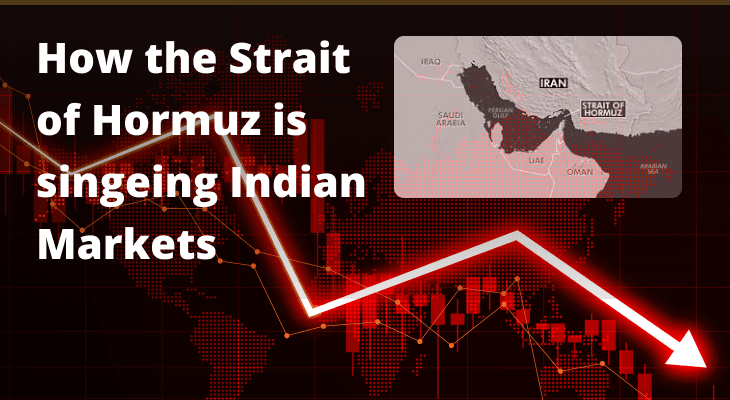
Indian equities are once again under pressure today (March 23, 2026) as war‑driven tensions singed Asian markets early on Monday. This was caused by another spike in oil prices, a weaker rupee, and elevated global volatility keep traders firmly in risk‑off mode. Nifty and Sensex whipsawed due to headlines that amplify the fears of the war around the Iran conflict and US President Trump’s ultimatum on the Strait of Hormuz.
At the same time India VIX spiked sharply in March, signalling a clear jump in fear and uncertainty. Today’s sell‑off fits into a larger pattern seen in the past with double‑digit drawdowns. So, what does history suggest for investors when emotions and volatility are both running high?
Top 5 reasons for today’s stock market fall
1. War escalation and Hormuz risk
You no longer see only generic West Asia conflict headlines. Today’s fall follows specific escalation by US President Donald Trump’s 48‑hour ultimatum over the weekend to Iran over reopening the Strait of Hormuz. Iran’s warned that it could fully close the straits if its energy assets were attacked.
There were also reports of missile strikes on a joint US–British base at Diego Garcia, which the UK government later confirmed after Iran fired two missiles at the facility. These developments tell traders that the risk of a prolonged disruption to one of the world’s key oil routes remains high.
2. Oil shock: Crude oil price spike no longer looks like a blip
Brent now trades near $112-$113 a barrel, after rising almost 50%-60% in barely a month. India’s crude oil basket moved above $100. The market is no longer treating this as a one‑off. It is starting to price in structurally higher fuel and input costs for at least the next few quarters.
This has direct implications for India. Higher crude inflates the import bill, widens the current account deficit, raises the risk of higher inflation and complicates the government’s fiscal math.
3. Rupee slide and FII exodus
The rupee now trades near a record low around ₹93-₹94 per US dollar. It is down roughly 3% since the latest phase of the conflict began and stands out as one of Asia’s weaker currencies this month. A falling rupee makes every barrel of imported oil costlier in rupee terms, adds to imported inflation and scares foreign investors who benchmark returns in dollars.
Foreign Institutional Investors have responded by selling aggressively into every bounce. Heavy FII outflows again today, with Domestic Institutional Investors unable or unwilling to fully absorb the supply.
4. Volatility, margin pressure and technical breaks
India VIX already surged sharply in March on geopolitical jitters even before today’s move and is now trading around 26–27. It is close to a 21‑month high for the fear index. The last time in 2026, VIX spiked to this zone was when Brent first shot above 100 dollars a barrel and Middle East tensions escalated, triggering a sharp risk‑off move across Indian equities.
Previously India VIX was in this band was during the Russia–Ukraine in early 2022, when war headlines, sanctions and a spike in oil created a similar fear‑driven jump in volatility.
Elevated VIX means option prices rise and leveraged traders face bigger swings in mark‑to‑market. As indices break key technical levels such as Nifty slipping below 23,000 and then 22,700 and Sensex slicing through 73,000, margin calls and stop‑losses kick in.
5. Second‑order worries: growth, earnings and IPO appetite
With crude elevated and borrowing costs already high, investors now worry about slower growth and weaker earnings in FY27. Banks, autos, realty and discretionary consumption names price in not just higher costs but also a softer demand outlook.
This fear spilling into the primary market. GSP Crop Science’s IPO, which closes just as this sell‑off plays out, looks set for an almost flat listing even after decent subscription.
What March’s sell‑off has in common with past market shocks
Since December 2025, the market has already slipped into a mini drawdown, and March 2026 simply turned that slide into a full‑blown double‑digit fall. Nifty was mildly negative in December 2025 and January 2026 as heavy FII selling, stretched valuations and rising US bond yields triggered profit‑taking. The benchmark index edged lower in February on concerns about slower global growth and sticky inflation.
However, March 2026 delivered the real damage, with Nifty down about 10.51% for the month, and roughly 13.76% year‑to‑date, as the Iran–US–Israel war triggered. As Brent crude pushed towards $110-$120, the rupee fell to record lows near 94 per US dollar. India VIX spiked to above 20% late February. The heightened uncertainty sparked aggressive unwinding of positions across banks, autos, OMCs and other cyclicals.
How frequent are such large falls in the market?
The Nifty 50 returned a negative double-digit return, with the index down more than 13% as of Monday. This kind of sharp, external shock‑led decline is not new for the Indian stock markets. In March 2020, Nifty plunged about 23.25% when Covid‑19 lockdowns froze mobility worldwide, and earnings visibility collapsed, and FIIs dumped Indian equities in one of the fastest global risk‑off waves in history.
The current damage has not come out of nowhere but on top of a four‑month phase from December 2025 to March 2026 of negative returns. A very similar pattern played out a few years earlier, from October 2024 to around March 2025, when the Nifty dropped from its late‑September peak and logged four months of negative returns. As the post–Israel–Palestine conflict fallout widened into direct Iran–Israel tensions in West Asia, markets grew nervous about a broader regional war, higher oil prices and fresh pressure on global growth and inflation. It led to a spike crude oil prices during the same period, US bond yields and the dollar stayed elevated, and FIIs yanked out over ₹1 lakh crore while rotating toward cheaper markets like China.
Across these episodes, what stands out is that double‑digit monthly falls and clusters of weak months have coincided with big external shocks, like pandemic lockdowns in 2020, rates and FII exodus in 2024‑25, and now the US-Israel-Iran war‑driven crude oil spike in 2026. Usually, the markets trace back their path once the external factors subside and cease to sway markets across the world, including India.
More Related Articles

How Much Risk Should You Take in Your 20s, 30s, 40s & 50s?
 July 24, 2026 | 0 mins read
Risk is the price one has to pay for return. The higher the potential gain, the more uncertainty you take on to get it. Every investment carries some degree of that uncertainty the question is how much makes sense for where you are in life. A 25-year-old and a 55-year-old looking at the same stock market are in fundamentally different situations. At 25, putting most of your savings into equity mutual funds is a reasonable decision. At 55, the same decision could leave you in a difficult position if markets fall sharply in the years leading up to retirement.

How to Choose the Right Investment Method for Short‑Term Goals
July 24, 2026 | 0 mins read
A short-term goal is any financial target you need to meet within 1-3 years. This could be building an emergency fund, saving for a holiday, making a down payment on a house, or setting money aside for advance tax payments. Because the money has a fixed purpose and a financial need that is not too far into the future. The priority is simple: protect what you have and make sure you have easy access to it when you need it.

What is Rights Entitlement (RE) in the Stock Market?
July 23, 2026 | 0 mins read
At times, your demat account may reflect entries that fall outside the familiar pattern of buying and selling securities. Rights entitlement is one such instance. It appears quietly, and requires timely action on your part. You might notice an extra line item against a stock you already own, tagged differently, priced differently. It is not a bonus, not a split, and not exactly a new investment either. But it does carry value.