
May 27, 2026 | 11 min read
Understanding Contango: Meaning, Benefits, and Examples
When you track commodity prices or trade futures contracts, you may notice that prices for delivery at a later date are sometimes higher than today’s prices. This pattern reflects a specific futures market structure known as contango. It occurs when contracts with longer expiry dates trade at a premium above near-month or spot prices. This situation is commonly observed in commodity markets and, at times, in other futures-based instruments. Understanding contango’s meaning requires looking beyond price direction and focusing on the shape of the futures curve. Recognizing how contango works will help you better interpret futures curves, manage rollover costs, and avoid misreading market trends that may initially appear bullish.
What Is Contango?
Contango is a pricing structure seen in futures markets where contracts scheduled for delivery at a later date trade at higher prices than contracts nearing expiry or the current spot price. It helps to separate price movement from price structure. Contango does not suggest that the market expects prices to rise sharply. Instead, it reflects the practical cost of holding the underlying asset over time. These costs may include storage, insurance, financing, and other carrying expenses that accumulate the longer the asset is held.
Contango is most commonly observed in commodities that can be stored with relative ease, such as crude oil, metals, or certain agricultural products, when inventories are comfortable. However, the concept also applies to other futures-based instruments where time-related costs influence pricing.
How Contango Works in the Futures Market
In the futures market, contango reflects how prices adjust over time to account for the cost of holding an asset. Rather than indicating price direction, it explains how futures contracts are structured across different expiry dates.
1. Upward-Sloping Futures Curve
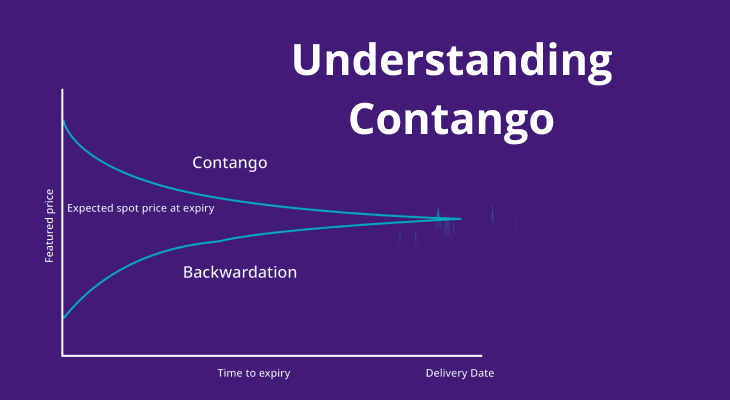
In a contango market, futures prices rise as contract expiry moves further into the future. Near-month contracts trade lower, while longer-dated contracts are priced higher, forming an upward-sloping futures curve that reflects time-related holding costs.
2. Cost-of-Carry Pricing
Futures prices in contango factor in the cost of carrying the underlying asset. These costs include storage, insurance, financing, and handling expenses, which increase with time and push longer-dated futures prices above spot levels.
3. Stable Spot Market Conditions
Contango commonly develops when spot market supply is comfortable and immediate demand is not urgent. With no pressure on near-term availability, spot prices remain steady while futures prices rise to reflect holding costs.
4. Price Convergence at Expiry
As a futures contract approaches expiry, its price gradually converges toward the spot price. In contango, this convergence usually occurs from above, which can erode returns for traders holding long positions.
5. Rollover Impact on Positions
When positions are rolled forward in a contango market, traders sell a cheaper near-month contract and buy a more expensive next-month contract. Over time, this repeated process leads to a negative roll yield.
What Causes Contango?
Contango develops due to a combination of economic costs, market structure, and expectations. The following factors explain why futures prices often rise with longer delivery periods:
1. Storage and Holding Costs
Commodities such as crude oil, metals, or agricultural produce must be stored safely until delivery. Warehousing, insurance, and handling expenses increase over time, and these cumulative costs are built into longer-dated futures contracts, pushing their prices above near-term levels.
2. Financing and Interest Costs
Holding physical commodities ties up capital that could otherwise earn interest. Futures prices reflect this opportunity cost, especially in positive interest rate environments, resulting in higher prices for contracts with longer maturities.
3. Excess Supply in Spot Markets
When supply exceeds immediate demand, spot prices tend to remain subdued. With no urgency to secure the asset immediately, futures prices rise to account for carrying costs, creating a contango structure across contract expiries.
4. Market Expectations and Seasonality
Expectations of higher future demand, due to seasonal consumption, infrastructure needs, or geopolitical developments, can lift longer-dated futures prices. Even without current shortages, these expectations contribute to an upward-sloping futures curve.
5. Ease of Physical Storage
Contango is more common in commodities that are easy and economical to store. When inventory can be held without significant constraints, futures markets naturally price in the cost of time, reinforcing contango conditions.
Contango vs Backwardation
Backwardation and contango are two opposite price structures in the futures market. Both describe how futures prices compare with the current spot price. However, they arise from very different market conditions and have distinct implications for traders and investors.
Contango occurs when futures contracts with later expiry dates trade at higher prices than the spot price or near-month contracts. Backwardation, on the other hand, is a market condition where futures prices trade below the spot price. In backwardation, the spot price is higher because immediate demand is strong or supply is tight. Buyers are willing to pay a premium for prompt delivery, resulting in a downward-sloping futures curve.
Understanding contango vs normal backwardation is crucial because these structures affect rollover returns, hedging efficiency, and the performance of futures-based instruments, even if spot prices remain unchanged.
Aspect | Contango | Backwardation |
|---|---|---|
Definition | Futures prices trade above the spot price and increase with longer expiries | Futures prices trade below the spot price and decrease with longer expiries |
Futures curve shape | Upward sloping across maturities | Downward sloping across maturities |
Primary driver | Cost of carry (storage, insurance, financing) | Scarcity premium from tight supply or urgent demand |
Spot market condition | Comfortable inventories; low urgency for immediate delivery | Tight inventories; high urgency for immediate delivery |
Role of storage | Storage is available and economical; costs are priced into futures | Storage may be constrained or costly; immediate access is valued |
Market expectations | Stable supply and demand; no near-term shortage | Expectation of near-term relief or restocking |
Rollover effect (long positions) | Negative roll yield (sell low, buy higher next month) | Positive roll yield (sell high, buy lower next month) |
Impact on futures-based ETFs | Performance drag over time if contango persists | Performance tailwind if backwardation persists |
Common examples | Crude oil or base metals during high inventories | Agricultural commodities during crop shortages |
Trading implication | Spread traders focus on curve shape; outright longs face carry costs | Long positions may benefit even if spot prices are flat |
Contango and Backwardation Example
Each contango and backwardation example below is illustrative and meant to show how futures prices can differ across expiries under different market conditions.
Contango Examples
1. Crude Oil
The crude oil is trading at a spot price of ₹6,000 per barrel. The one-month futures contract is priced at ₹6,120, and the three-month contract trades at ₹6,350. This upward price progression across expiries indicates contango, reflecting storage and financing costs.
2. Copper
If copper trades at ₹720 per kg in the spot market, the three-month futures contract might trade at ₹740 and the six-month contract at ₹760. The rising futures prices illustrate contango in a market with comfortable inventory levels.
3. Natural Gas
The natural gas is priced at ₹320 per MMBtu in the spot market. If the one-month futures contract trades at ₹335 and the three-month contract at ₹360, the higher future prices show contango driven by storage and low immediate demand.
Backwardation Examples
1. Wheat
If wheat trades at ₹2,400 per quintal in the spot market, the one-month futures contract may trade at ₹2,350 and the three-month contract at ₹2,280. Futures prices below spot levels indicate backwardation due to tight supply.
2. Aluminium
The aluminium trades at ₹220 per kg in the spot market. If the near-month futures contract is priced at ₹215 and the three-month contract at ₹205, this downward-sloping curve illustrates backwardation caused by supply constraints.
3. Soybean
If soybean trades at ₹5,000 per quintal in the spot market, the one-month futures contract might trade at ₹4,900 and the three-month contract at ₹4,750. This pricing structure reflects backwardation during periods of strong immediate demand.
Benefits of Contango
Contango is often viewed negatively by long-term futures investors, but it offers several practical advantages depending on your role in the market. The benefits become clearer when viewed from a structural and risk-management perspective.
1. Transparent Price Discovery
Contango creates a clear and structured futures curve that reflects storage, financing, and holding costs. This transparency helps you understand how much of a futures price is driven by time-related expenses rather than short-term speculation.
2. Hedging Efficiency for Producers
For producers and inventory holders, contango allows you to lock in higher future selling prices while holding physical stock. This improves planning certainty and protects margins by offsetting storage and financing costs over time.
3. Opportunities for Spread Traders
Contango provides defined opportunities for calendar spread strategies. By trading the price difference between near-month and far-month contracts, you can potentially profit from changes in the futures curve rather than outright price movements.
4. Signals of Market Stability
A contango structure often indicates adequate supply and the absence of immediate shortages. This helps traders and investors assess market balance and avoid misinterpreting rising futures prices as signs of short-term supply stress.
5. Supports Inventory Management
Contango encourages storage and inventory build-up when supply is abundant. This supports smoother supply chains by incentivising market participants to hold stock for future delivery rather than flooding the spot market.
Risks and Limitations of Contango
While contango has structural benefits, it also comes with risks, especially for traders and investors who hold futures-based positions for extended periods. Being aware of these limitations will help you to avoid unexpected performance drag.
1. Negative Roll Yield
In a contango market, rolling futures contracts means selling a cheaper near-month contract and buying a more expensive next-month contract. This repeated process creates a negative roll yield, which can steadily reduce returns even if spot prices remain unchanged.
2. Performance Drag in Futures-Based ETFs
Commodity ETFs that rely on futures contracts are particularly vulnerable to prolonged contango. Frequent rollovers at higher prices can cause these ETFs to underperform the underlying commodity’s spot price over time, confusing investors who expect price tracking.
3. Misleading Price Signals
Rising futures prices in contango may appear bullish at first glance, but they often reflect carrying costs rather than genuine demand strength. Misinterpreting contango as a positive price signal can lead to poorly timed trades.
4. Higher Holding Costs for Long Positions
Traders maintaining long futures positions in contango markets face higher implicit holding costs. These costs accumulate over time and can outweigh gains from favourable price movements, particularly in slow or range-bound markets.
5. Strategy Sensitivity to Market Structure
Contango reduces the effectiveness of simple buy-and-hold strategies in futures markets. Without accounting for curve structure and rollover impact, even well-researched trades can deliver disappointing results despite stable market conditions.
How Contango Impacts Traders and Investors
Contango affects market participants differently depending on strategy, holding period, and the instrument used. Delving deeper into these impacts will aid you in avoiding complications linked to the futures pricing structure.
1. Short-Term Traders
For short-term traders, contango shifts the focus from outright price movement to futures curve behavior. You often need to factor in spreads, timing, and contract selection, as holding costs can quickly offset gains from small price movements.
2. Long-Term Futures Investors
If you hold futures contracts over longer periods, contango can steadily erode returns through repeated rollovers. Even when spot prices remain stable or rise modestly, negative roll yield can result in underperformance over time.
3. Futures-Based ETF Investors
Investors in futures-based ETFs are especially exposed to contango. Frequent contract rollovers at higher prices can create a performance drag, causing the ETF to lag behind the actual movement of the underlying commodity.
4. Hedgers and Commercial Participants
For producers and consumers, contango can be useful rather than harmful. It allows you to lock in future prices that account for storage and financing costs, improving budgeting certainty and reducing exposure to short-term market volatility.
5. Spread and Curve Traders
Contango creates structured opportunities for calendar spread strategies. By trading the price difference between near- and far-month contracts, you can focus on curve dynamics rather than predicting whether prices will rise or fall.
How to Identify Contango in the Market
You can identify contango by analyzing how futures prices are arranged across different delivery months. The following indicators can help you spot contango conditions clearly and consistently:
1. Spot vs Futures Price Comparison
Compare the current spot price with futures prices across multiple expiries. If futures contracts with longer maturities are consistently priced higher than near-month contracts, it indicates a contango structure in the market.
2. Futures Curve Shape
Review the futures curve published by the exchange. An upward-sloping curve, where prices rise progressively with each later expiry, is a clear and widely used signal of contango.
3. Rollover Performance
Monitor how positions behave during contract rollovers. If rolling from a near-month contract to the next-month contract repeatedly results in losses, the underlying futures market is likely in contango.
4. Inventory and Storage Levels
Track inventory data and storage availability. High stock levels and sufficient storage capacity usually support contango, as futures prices incorporate storage, insurance, and financing costs.
5. Market and Exchange Commentary
Follow market reports and exchange disclosures. References to surplus supply, carrying costs, or financing expenses often align with contango conditions in commodity futures markets.
Recognizing these signals early helps you adjust strategies, manage rollover costs, and avoid misinterpreting future prices driven by market structure rather than demand strength.
Conclusion
Contango is a core concept that explains how futures prices are shaped by time, cost, and market balance. Comprehending contango’s meaning enables you to avoid misreading higher futures prices as bullish signals and prepares you for the impact of rollover costs. Equally, recognizing backwardation allows you to identify markets driven by immediate demand or supply constraints. By analyzing futures curves, storage costs, and rollover effects, you can align trading and investment strategies with market structure rather than price alone. This awareness is essential for navigating commodity futures, ETFs, and derivative markets more effectively.
More Related Articles
SEBI Proposes CAS Changes: What Could Change for Derivatives Settlement, IEPs & Timings?
 September 17, 2026 | 0 mins read
A month after introducing the new Closing Auction Session, SEBI has proposed changes after early market feedback raised concerns about derivatives settlement on expiry days, changing auction prices and trading timings. SEBI is not scraping CAS. Instead, it wants to make expiry settlement clearer, improve the auction process and help traders understand that indicative auction prices are not the same as actual traded prices.
ETF trading rules from 7 September: What changes for retail investors?
September 7, 2026 | 0 mins read
If there was no trade during the final 30 minutes on the previous day, the exchange will use that day’s last traded price. If there was no trade at all on the previous day, the latest available closing NAV will be used. The base price will also be adjusted for corporate actions, if applicable. From April 1, 2027, SEBI expects stock exchanges and mutual fund AMCs to use the previous day’s closing NAV as the base price after resolving operational issues.

How MSCI rebalancing tested India's Closing Auction System on August 31
September 2, 2026 | 0 mins read
India’s new Closing Auction Session (CAS) processed a record ₹39,718 crore turnover, on 31 August 2026 as MSCI India Index latest index rebalancing took effect at the market close. The event showed that CAS could handle an exceptional concentration of institutional flow. However, there were some sharp, and sometimes counterintuitive, stock moves. This shows that the quality of closing-price discovery is still being tested.
FAQ
Backwardation and contango describe futures price structures in commodity markets. In contango, futures prices are higher than spot prices, reflecting storage and financing costs. In backwardation, futures prices are lower than spot prices, usually due to tight supply or strong immediate demand for the commodity.