
May 12, 2026 | 4 min read
Why Form 15G and Form 15H Are Important for Taxpayers
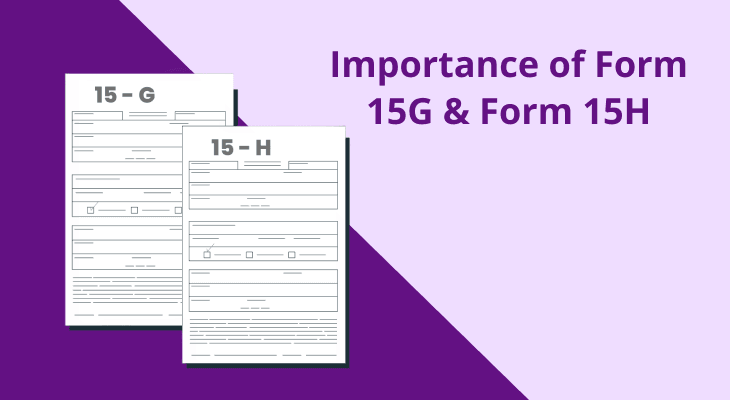
Forms are an integral part of the financial world, including taxation. While the Income Tax Act, 2025 is expected to streamline and reduce the number of tax-related forms, two declarations continue to remain important for investors – Form 15G and Form 15H.
This article explains the meaning and importance of these forms, how to complete a Form 15G download or Form 15H download, and the common mistakes taxpayers should avoid.
Form 15G and15H: simple tools to avoid 10% TDS
Certain types of income, such as interest, dividends, and rent, are subject to Tax Deducted at Source (TDS). This means the payer of the income tax deducts at a prescribed rate before crediting the income to your account and deposits it with the government on your behalf.
TDS rates vary depending on the nature of income, the payer, and the recipient, and can range from 0.1% to 30%. Some commonly encountered incomes that attract 10% TDS are listed below:
Section | Nature of transaction | Threshold (₹) | TDS rate |
|---|---|---|---|
192A | Premature withdrawal from Employees’ Provident Fund (EPF) | 50,000 | 10% |
193 | Interest on securities | 10,000 | 10% |
194 | Dividends | 10,000 | 10% |
194A | Interest on bank/post office deposits | 50,000 | 10% |
194A | Interest on bank/post office deposits (senior citizens) | 1,00,000 | 10% |
194A | Interest (others) | 10,000 | 10% |
194K | Dividend from mutual funds | 10,000 | 10% |
Now consider this: if you earn ₹10 lakh as interest income from securities, ₹1 lakh may be deducted as TDS, and you would get a credit of ₹9 lakh in your bank account. This will happen even if your total income is below the basic exemption limit.
This is exactly where Form 15G and Form 15H become useful. These are self-declaration forms submitted to the payer to confirm that your total income is below the taxable limit and that your tax liability is nil, thereby requesting them not to deduct TDS.
Form 15G vs Form 15H: key differences
Although both forms serve the same purpose, they apply to different categories of taxpayers.
Factor | Form 15G | Form 15H |
|---|---|---|
Applies to |
|
|
Conditions |
|
|
Typical users |
|
|
How to download and submit Form 15G or Form 15H
Here is a step-by-step guide for completing the Form 15G download or Form 15H download.
Step 1: Visit the official income tax website: https://incometaxindia.gov.in/
Step 2: Click on ‘Tax laws & Rules’ > ‘Forms/Download’ > ‘Income Tax Forms’.
Step 3: Locate Form 15G or Form 15H and download it in PDF format.
Step 4: Print the form and fill in details such as name, address, taxpayer status, Permanent Account Number (PAN), and estimated income.
Step 5: Submit the completed form to the relevant payer. For instance, if the form is for interest income on a fixed deposit, submit it to your bank. On the other hand, if it is for dividends on mutual funds, submit it to your fund house.
Notes:
- You must submit the form separately to each payer from whom income is received.
- Many banks and financial institutions allow online submissions.
Common mistakes to avoid while submitting Form 15G or Form15H
Here are some mistakes to avoid when using Form 15G or Form 15H:
Not checking eligibility
If you have any tax liability, regardless of the amount, you are not eligible to submit Form 15G or Form 15H. You must check your tax position first.
Ignoring certain income sources
Taxpayers often consider bank interest and dividends while submitting tax declaration forms. However, these forms may also be used for less common incomes, such as partial EPF withdrawals.
Not submitting to different payers
Submitting a single form does not cover all income sources. Each payer requires a separate form submission to prevent TDS deduction.
Submitting the form late
Ideally, you must submit the form at the beginning of the financial year to avoid the chance of deductions. Once the deduction is made, it cannot be reversed by the payer, and claiming the refund through the Income Tax Return (ITR) becomes the only option.
Not submitting PAN
Even if you are not eligible for the 15G/H Form, submitting your PAN helps avoid higher TDS rates.
Conclusion
Form 15G and Form 15H are important tools for taxpayers to avoid unnecessary upfront tax deductions on eligible income. Submitting the correct form on time ensures better cash flow and reduces the hassles of claiming refunds later.
More Related Articles
New tax rules 2026: How to save tax in 2026?
 August 6, 2026 | 0 mins read
The new Income Tax Act, 2025, replaces the long-standing Income Tax Act, 1961, to modernise, simplify, and streamline India’s direct tax system. Effective from April 1, 2026, the new tax rules introduce revised deduction and allowance provisions, rationalised Tax Collected at Source (TCS) rates, updated Income Tax Return (ITR) filing deadlines, and stricter compliance measures.
How to Save Tax Under the New Tax Regime in 2026?
July 29, 2026 | 0 mins read
If you are planning your finances for FY 2026–27 and beyond, understanding the new tax regime of 2026 can help you reduce your tax outgo without relying heavily on deductions. Over the last few years, the government has gradually made the new regime more attractive through revised tax slabs, higher rebates, and simplified filing rules. In this blog, you will learn how to save tax under the new regime, compare it with the old regime, understand the latest slabs, and avoid common mistakes while filing your return.
Income Tax Notice in 2026: Causes, Types & What to Do
July 29, 2026 | 0 mins read
Receiving an income tax notice can feel stressful, especially when you are unsure why it arrived or how to respond. In many cases, the notice is not a penalty but a request for clarification, verification, or correction from the Income Tax Department.
FAQ
You can find the latest forms on the official Income Tax Department website. Alternatively, you can also download it from the websites of banks and financial institutions.