
January 13, 2026 | 2 min read
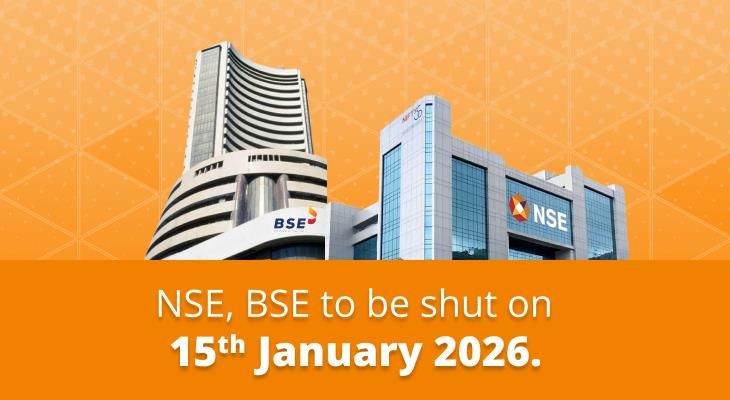
NSE, BSE declare trading holiday on 15 January on account of BMC election
The Maharashtra government announced January 15 as a public holiday due to local body elections across 29 municipal corporations. 10 million eligible voters may hit the booths during BMC polls. As stock market was closed on polling day of Lok Sabha 2024, now investors are curious to know if bank and exchanges be shut on the day of BMC election 2026.
Any exclusions from the January 15 Holiday?
January 15 does not appear in Maharashtra's earlier announced roster of 24 public holidays for 2026. It is issued solely for electoral activities, so it remains limited to the designated local bodies without any extension across the whole state.
Will there be bank holiday?
The Maharashtra government has issued an order under Section 25 of the Negotiable Instruments Act, 1881. Normally, markets overseen by RBI like the one for government securities, call money, triparty repo, and forex markets cease operations on Negotiable Instruments Act holidays. However the Reserve Bank of India has not yet released any guidance on bank holidays for January 15, 2026.
Will NSE BSE be closed on 15th Jan?
Stock exchanges will remain closed for trading on January 15 due to the Municipal Corporation elections in Maharashtra. In a circular, BSE said that trading will be suspended for the day across the equity segment, equity derivatives, commodity derivatives, and electronic gold receipts.
The NSE notified that the Exchange shall be closed for trading in the morning session. However, the evening trading session will be open for trading as per the timings given below:
Segment | Trading Session on January 15, 2026 | Market Timings |
|---|---|---|
Commodity Derivatives (COM) | Morning Session: Closed | - |
Evening Session: Open | Start time: 17:00 hours | |
End time: 23:55 hours |
More Related Articles

SEBI Proposes CAS Changes: What Could Change for Derivatives Settlement, IEPs & Timings?
 September 17, 2026 | 0 mins read
A month after introducing the new Closing Auction Session, SEBI has proposed changes after early market feedback raised concerns about derivatives settlement on expiry days, changing auction prices and trading timings. SEBI is not scraping CAS. Instead, it wants to make expiry settlement clearer, improve the auction process and help traders understand that indicative auction prices are not the same as actual traded prices.

ETF trading rules from 7 September: What changes for retail investors?
September 7, 2026 | 0 mins read
If there was no trade during the final 30 minutes on the previous day, the exchange will use that day’s last traded price. If there was no trade at all on the previous day, the latest available closing NAV will be used. The base price will also be adjusted for corporate actions, if applicable. From April 1, 2027, SEBI expects stock exchanges and mutual fund AMCs to use the previous day’s closing NAV as the base price after resolving operational issues.

How MSCI rebalancing tested India's Closing Auction System on August 31
September 2, 2026 | 0 mins read
India’s new Closing Auction Session (CAS) processed a record ₹39,718 crore turnover, on 31 August 2026 as MSCI India Index latest index rebalancing took effect at the market close. The event showed that CAS could handle an exceptional concentration of institutional flow. However, there were some sharp, and sometimes counterintuitive, stock moves. This shows that the quality of closing-price discovery is still being tested.