
April 25, 2025 | 9 min read
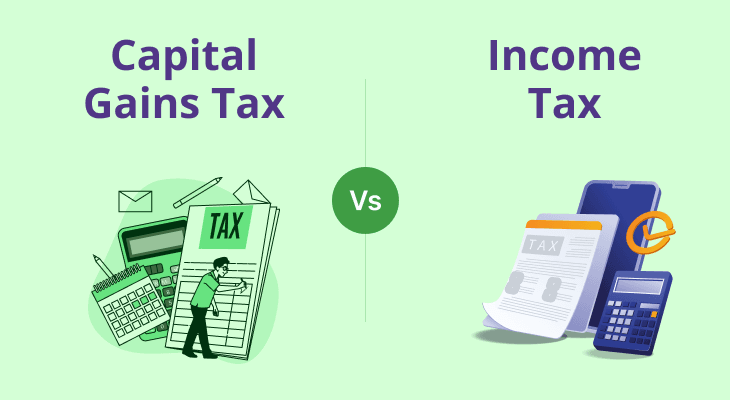
Capital Gains Tax vs Income Tax: Key Differences Every Investor Should Know
The Government of India levies taxes on various types of income, whether it is your salary, business earnings or profits from different investments. However, not all these incomes are taxed the same way. Different rules may apply depending on the source of income. For example, income tax and capital gains tax are two distinct types of taxes, each with its own set of regulations, rates, and implications. Understanding the difference between capital gains tax and income tax can help you plan and manage your finances better. Let’s explore these two taxes in detail in this article.
What is income tax?
Income tax is a tax charged on a person’s earnings. The Income Tax (IT) Act, 1961, lays down specific guidelines for how different types of earnings are taxed. Anyone who earns a taxable income is required to pay tax as per the applicable rules and prevailing tax rates.
According to Section 2(31) of the IT Act, the term ‘person’ includes:
- Individuals
- Hindu Undivided Families (HUFs)
- Firms, including Limited Liability Partnerships (LLPs)
- Companies
- Bodies of Individuals (BOIs) or Associations of Persons (AOPs)
- Local Authorities
- Artificial Juridical Person (not covered under any of the above-mentioned categories)
Additionally, income tax can be charged on the following types of income:
- Income from salary
- Income from business or profession
- Income from house property
- Income from capital gains
- Income from other sources
Income tax is levied based on specific tax rates and the selected tax regime. India offers two tax regimes—the old regime and the new regime. Below is a breakdown of the tax rate and brackets for Assessment Year (AY) 2025-26:
Old tax regime for individuals below 60
Income tax slab | Income tax rate |
Income up to ₹ 2,50,000 | Nil |
₹ 2,50,001 to ₹ 5,00,000 | 5% above ₹ 2,50,000 |
₹ 5,00,001 to ₹ 10,00,000 | ₹ 12,500 + 20% above ₹ 5,00,000 |
₹ 10,00,001 to ₹ 50,00,000 | ₹ 1,12,500 + 30% above ₹ 10,00,000 |
₹ 50,00,001 to ₹ 100,00,000 | ₹ 1,12,500 + 30% above ₹ 10,00,000 |
₹ 100,00,001 to ₹ 200,00,000 | ₹ 1,12,500 + 30% above ₹ 10,00,000 |
₹ 200,00,001 to ₹ 500,00,000 | ₹ 1,12,500 + 30% above ₹ 10,00,000 |
Above ₹ 500,00,000 | ₹ 1,12,500 + 30% above ₹ 10,00,000 |
Old tax regime for individuals aged over 60 but below 80
Income tax slab | Income tax rate |
Income up to ₹ 3,00,000 | Nil |
₹ 3,00,001 to ₹ 5,00,000 | 5% above ₹ 3,00,000 |
₹ 5,00,001 to ₹ 10,00,000 | ₹ 10,000 + 20% above ₹ 5,00,000 |
₹ 10,00,001 to ₹ 50,00,000 | ₹ 1,12,500 + 30% above ₹ 10,00,000 |
₹ 50,00,001 to ₹ 100,00,000 | ₹ 1,12,500 + 30% above ₹ 10,00,000 |
₹ 100,00,001 to ₹ 200,00,000 | ₹ 1,12,500 + 30% above ₹ 10,00,000 |
₹ 200,00,001 to ₹ 500,00,000 | ₹ 1,12,500 + 30% above ₹ 10,00,000 |
Above ₹ 500,00,000 | ₹ 1,12,500 + 30% above ₹ 10,00,000 |
Old tax regime for individuals aged 80 or more
Income tax slab | Income tax rate |
Income up to ₹ 5,00,000 | Nil |
₹ 5,00,001 to ₹ 10,00,000 | 20% above ₹ 5,00,000 |
₹ 10,00,001- ₹ 50,00,000 | ₹ 1,12,500 + 30% above ₹ 10,00,000 |
₹ 50,00,001- ₹ 100,00,000 | ₹ 1,12,500 + 30% above ₹ 10,00,000 |
₹ 100,00,001- ₹ 200,00,000 | ₹ 1,12,500 + 30% above ₹ 10,00,000 |
₹ 200,00,001- ₹ 500,00,000 | ₹ 1,12,500 + 30% above ₹ 10,00,000 |
Above ₹ 500,00,000 | ₹ 1,12,500 + 30% above ₹ 10,00,000 |
New tax regime for individuals below 60
Income tax slab | Income tax rate |
Income up to ₹ 3,00,000 | Nil |
₹ 3,00,001 to ₹ 7,00,000 | 5% above ₹ 3,00,000 |
₹ 7,00,001 to ₹ 10,00,000 | ₹ 20,000 + 10% above ₹ 7,00,000 |
₹ 10,00,001 to ₹ 12,00,000 | ₹ 50,000 + 15% above ₹ 10,00,000 |
₹ 12,00,001 to ₹ 15,00,000 | ₹ 80,000 + 20% above ₹ 12,00,000 |
₹ 15,00,001 to ₹ 50,00,000 | ₹ 1,40,000 + 30% above ₹ 15,00,000 |
₹ 50,00,001 to ₹ 100,00,000 | ₹ 1,40,000 + 30% above ₹ 15,00,000 |
₹ 100,00,001 to ₹ 200,00,000 | ₹ 1,40,000 + 30% above ₹ 15,00,000 |
Above ₹ 200,00,001 | ₹ 1,40,000 + 30% above ₹ 15,00,000 |
New tax regime for individuals aged over 60 but below 80
Income tax slab | Income tax rate |
Income up to ₹ 3,00,000 | Nil |
₹ 3,00,001 to ₹ 7,00,000 | 5% above ₹ 3,00,000 |
₹ 7,00,001 to ₹ 10,00,000 | ₹ 20,000 + 10% above ₹ 7,00,000 |
₹ 10,00,001 to ₹ 12,00,000 | ₹ 50,000 + 15% above ₹ 10,00,000 |
₹ 12,00,001 to ₹ 15,00,000 | ₹ 80,000 + 20% above ₹ 12,00,000 |
₹ 15,00,001 to ₹ 50,00,000 | ₹ 1,40,000 + 30% above ₹ 15,00,000 |
₹ 50,00,001 to ₹ 100,00,00 | ₹ 1,40,000 + 30% above ₹ 15,00,000 |
₹ 100,00,001 to ₹ 200,00,000 | ₹ 1,40,000 + 30% above ₹ 15,00,000 |
Above ₹ 200,00,001 | ₹ 1,40,000 + 30% above ₹ 15,00,000 |
New tax regime for individuals aged 80 or more
Income tax slab | Income tax rate |
Income up to ₹ 3,00,000 | Nil |
₹ 3,00,001 to ₹ 7,00,000 | 5% above ₹ 3,00,000 |
₹ 7,00,001 to ₹ 10,00,000 | ₹ 20,000 + 10% above ₹ 7,00,000 |
₹ 10,00,001 to ₹ 12,00,000 | ₹ 50,000 + 15% above ₹ 10,00,000 |
₹ 12,00,001 to ₹ 15,00,000 | ₹ 80,000 + 20% above ₹ 12,00,000 |
Above ₹ 15,00,000 | ₹ 1,40,000 + 30% above ₹ 15,00,000 |
₹ 15,00,001 to ₹ 50,00,000 | ₹ 1,40,000 + 30% above ₹ 15,00,000 |
₹ 50,00,001 to ₹ 100,00,000 | ₹ 1,40,000 + 30% above ₹ 15,00,000 |
₹ 100,00,001 to ₹ 200,00,000 | ₹ 1,40,000 + 30% above ₹ 15,00,000 |
Above ₹ 200,00,001 | ₹ 1,40,000 + 30% above ₹ 15,00,000 |
What is capital gains tax?
Capital gains tax applies to the profit made from selling a capital asset, such as stocks, bonds, property, etc. There are two types of capital gains tax:
- Short-Term Capital Gains (STCGs) tax: If an asset is sold within a short holding period, the profit is classified as a short-term capital gain and taxed accordingly.
- Long-Term Capital Gains (LTCGs) tax: If an asset is held for a longer duration before being sold, the profit is considered long-term capital gain and is subject to different tax rates.
The tax treatment of capital gains depends on the holding period of the asset, with distinct tax rates for short-term and long-term gains.
Here are some examples of how some capital assets are taxed:
Property
- STCGs: If the property is sold within 24 months of acquisition, the profits are treated as short-term gains and taxed as per the individual’s applicable income tax slab rates.
- LTCGs: If the property is sold after 24 months, the gains are classified as long-term and are eligible for preferential tax treatment. For LTCGs on the sale of property, the applicable tax rate depends on the date of sale.
- If the property is sold before July 23, 2024, LTCGs are taxed at 20% with indexation.
- For sales made on or after July 23, 2024, if the property was purchased on or before July 22, 2024, you can choose between 20% with indexation or 12.5% without indexation.
- If the property was purchased on or after July 23, 2024, LTCGs are taxed at 12.5% without indexation benefits.
Mutual funds
- Equity: For equity-oriented mutual funds (where at least 65% of the portfolio is invested in domestic equity shares), if the units are held for more than 12 months, the gains qualify as LTCGs and are taxed at a rate of 12.5% on gains exceeding ₹1.25 lakh per financial year. LTCGs up to ₹1.25 lakh per year are tax-free. If the units are held for 12 months or less, the gains are classified as STCGs and taxed at 20%.
- Debt: In the case of debt-oriented mutual funds (where 65% or more is invested in debt instruments and money market securities), taxation depends on both the date of investment and the holding period.
- For investments made before April 1, 2023, and redeemed between April 1, 2024, and July 22, 2024, if the holding period is more than 36 months, the gains are treated as LTCGs and taxed at 20% with indexation. If held for less than 36 months, the gains are treated as STCGs and taxed as per the investor’s income tax slab.
- For redemptions on or after July 23, 2024, if held for more than 24 months, LTCGs are taxed at 12.5% without indexation. If held for less than 24 months, the gains are treated as STCGs and taxed as per the slab rate.
- For investments made on or after April 1, 2023, gains are taxed as per the applicable slab rate, regardless of the holding period.
- Hybrid: For hybrid mutual funds (which invest between 35% and 65% in domestic equity), taxation depends on both the date of investment and the holding period.
- If funds are redeemed between April 1, 2024, and July 22, 2024, and held for more than 36 months, the gains are taxed at 20% as LTCGs with indexation benefits. If held for 36 months or less, the gains are treated as STCGs and taxed as per the slab rate.
- If redeemed on or after July 23, 2024, LTCGs are taxed at 12.5% (without indexation) for holdings over 24 months, while STCGs for holdings under 24 months are taxed as per the slab rate.
How is a capital gain calculated?
A capital gain is calculated based on how long you have held the asset.
Calculating STCGs
Here’s how to calculate it:
- Start with the selling price, which is the amount you receive when selling the asset.
- Deduct selling expenses, like brokerage fees or legal charges.
- Subtract the purchase price and the cost of improvement.
- Apply exemptions as applicable under sections 54B and 54D that may reduce your taxable gain.
The amount you are left with is your short-term capital gain, which is then taxed based on the applicable rates.
Calculating LTCGs
Here’s how to calculate it:
- Take the selling price of the asset.
- Deduct selling expenses.
- Subtract the adjusted purchase price and cost of improvement. You can adjust these for inflation, if applicable, using the Cost Inflation Index.
- Apply exemptions as applicable under sections 54, 54D, 54EC, 54F, and 54B to reduce your taxable amount.
The final amount is your long-term capital gain, which is then taxed as per the prevailing rates.
Capital gains tax vs income tax – what are the differences?
Points of difference | Income tax | Capital gains tax |
Charged on | Income from salary, business, house property, etc., as specified under the IT Act | Profits earned from selling capital assets like real estate and mutual funds |
Rates | Taxed as per income slabs defined by the government | Different tax rates apply depending on the asset type and holding period |
Holding period | Not applicable as income tax is levied on income earned within a financial year | Depends on how long the asset is held; STCGs and LTCGs have different holding periods and tax rates |
Conclusion
Income tax and capital gains tax follow different structures, rules, and rates. Understanding the basic principles is essential to ensure accurate tax planning. Tax rules are also subject to change over time, and there may be additional nuances based on your individual financial situation. Therefore, it is advisable to consult a qualified tax professional when filing your returns, especially if you have any doubts.
An Income Tax Calculator helps you estimate how much tax you need to pay based on your income, deductions, and exemptions. Use our Income Tax Calculator to understand your tax liability better and plan smarter to save more.
More Related Articles

Understanding tax on buying gold and selling gold in India
 September 30, 2026 | 0 mins read
For generations, gold has symbolised not just wealth and financial security, but also tradition and prestige in Indian households. While physical jewellery and coins continue to be the preferred choice for many, investors today are increasingly exploring alternatives such as digital gold, Gold Exchange-Traded Funds (ETFs), and other gold-backed investments. Regardless of the form, understanding how tax on gold works is essential. This article explains the tax rules applicable to buying and selling different types of gold in India.
What is tax compliance
September 30, 2026 | 0 mins read
Whether you are a startup, small business, or an established company, ensuring income tax compliance and GST compliance (Goods and Services Tax compliance) is essential for smooth business operations. This article serves as a comprehensive guide to tax compliance in India.
New tax rules 2026: How to save tax in 2026?
August 6, 2026 | 0 mins read
The new Income Tax Act, 2025, replaces the long-standing Income Tax Act, 1961, to modernise, simplify, and streamline India’s direct tax system. Effective from April 1, 2026, the new tax rules introduce revised deduction and allowance provisions, rationalised Tax Collected at Source (TCS) rates, updated Income Tax Return (ITR) filing deadlines, and stricter compliance measures.