
February 13, 2026 | 5 min read
CGST vs SGST vs IGST: Impact on Businesses and Consumers
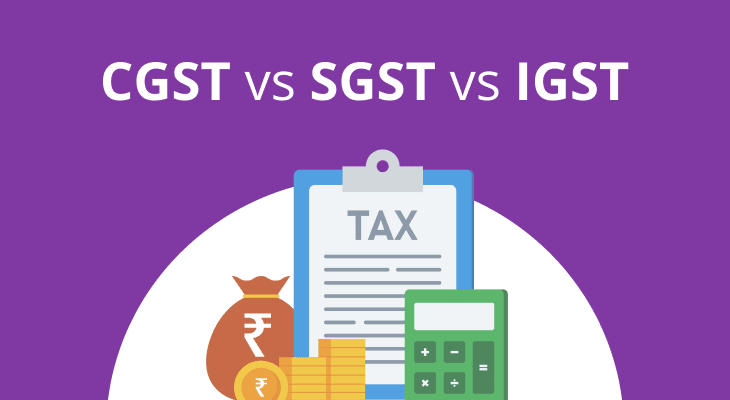
Understanding the difference between CGST, SGST and IGST is no longer optional- it’s a basic financial skill for today’s working professionals, entrepreneurs, and responsible taxpayers. Since the rollout of the Goods and Services Tax (GST) on July 1, 2017, India’s indirect tax system has seen one of its biggest transformations.
GST was introduced to make taxes simpler by replacing many different taxes with one common system. It helps businesses and consumers avoid confusion, reduces double taxation, and makes buying and selling across India easier. Yet, within this ‘one tax’ framework exist three key components, namely CGST, SGST, and IGST, that determine who collects the tax and how it is shared.
To truly understand the impact of GST, it’s important to know how these components work, how they differ, and how they affect your wallet - whether you’re earning a salary, running a startup, or growing a business.
What Is CGST, SGST, and IGST?
GST is structured to ensure that both the Central and State governments receive their share of tax revenue. This is where CGST, SGST, and IGST come in.
- Central Goods and Services Tax (CGST) is charged on transactions that happen within the same state and is collected by the Central Government.
- State Goods and Services Tax (SGST) is also charged on intra-state transactions but is collected by the respective State Government.
- Integrated Goods and Services Tax (IGST) applies when goods or services move from one state to another or are imported into India. IGST is collected by the Centre and later shared with the destination state.
This structure ensures tax flows to the state where goods or services are consumed - a key principle of GST known as destination-based taxation.
Difference Between CGST, SGST, and IGST
The core difference between CGST, SGST and IGST lies in where the transaction takes place.
If a sale happens within the same state, GST is split into CGST and SGST. If the sale crosses state borders, IGST is charged instead.
For example, if a product attracts 18% GST:
Transaction | Tax Breakdown | Collected By | GST |
|---|---|---|---|
Intra-state | CGST + SGST | Centre + State | 9% CGST + 9% SGST |
Inter-state | IGST | Centre (shares with destination state) | 18% IGST |
This distinction ensures that tax revenues are divided while keeping the tax structure uniform across the country. Understanding this difference helps businesses apply the right tax and avoid costly compliance errors.
Examples for Better Understanding
Let’s look at the difference between CGST, SGST and IGST with examples that reflect real-life situations.
Example 1: Intra-state transaction
A furniture dealer in Jaipur sells a sofa worth ₹1,00,000 to a customer in Jaipur.
Tax | Tax Breakdown | Collected By |
|---|---|---|
CGST | 9% | ₹9000 |
SGST | 9% | ₹9000 |
Total GST | 18% | ₹18,000 |
Here, both the Centre and the Rajasthan government receive tax directly.
Example 2: Inter-state transaction -H3
A smartphone manufacturer in Tamil Nadu sells phones worth ₹2,00,000 to a retailer in Maharashtra.
Tax | Tax Breakdown | Collected By |
|---|---|---|
IGST | 18% | ₹36,000 |
The Centre collects IGST and later transfers Maharashtra’s share since the goods are consumed there.
These examples show how GST adapts seamlessly to the nature of the transaction without increasing the overall tax burden.
Also Read: GST Registration - What is GST Registration & its Types
Impact of GST on Businesses
The impact of GST on businesses has been deep and far-reaching.
Simplified tax structure
GST replaced multiple indirect taxes like VAT, service tax, and excise duty. Businesses now deal with one system, one return framework, and largely uniform rules across states.
Also Read- VAT and GST Difference: A Clear Tax Comparison | mStock
Improved inter-state trade
Before GST, moving goods across states involved checkpoints, entry taxes, and paperwork. IGST removed these barriers, significantly reducing logistics time and costs - especially for manufacturing, e-commerce, and FMCG companies.
Input tax credit efficiency
Businesses can now claim credit for taxes paid on inputs, services, and capital goods. This avoids the tax-on-tax problem and improves profit margins.
Compliance pressure on small businesses
While GST benefits organised businesses, smaller firms often struggle with return filings, digital compliance, and frequent regulatory changes. However, schemes like the Composition Scheme and simplified returns aim to ease this burden.
Overall, GST rewards compliance and scale, pushing businesses toward formalisation and transparency.
Impact of GST on Consumers
For consumers, the impact of GST is visible in everyday spending.
More transparent pricing
GST bills clearly show tax components, making it easier to understand how much tax you are paying - something that was not always obvious earlier.
Lower prices on many essentials
Several daily-use items fall under low or zero GST slabs, helping control household expenses.
Higher tax on certain services
Some services, such as telecom, insurance, and dining out, saw higher effective tax rates compared to the pre-GST era. However, this is balanced by improved service quality and input tax credits for providers.
Uniform pricing across states
GST reduced price differences between states, ensuring fair pricing regardless of where you buy goods or services.
For informed consumers, GST has made pricing clearer and taxation more predictable.
Benefits of Understanding GST Components
Knowing the difference between CGST, SGST, and IGST helps in more ways than one:
- Businesses can avoid wrong tax charging and penalties
- Professionals can better evaluate invoices and expenses
- Entrepreneurs can plan pricing and cash flows more accurately
- Consumers become more aware and financially confident
In short, GST knowledge empowers better financial decisions.
Also Read: GST in India: Meaning, Advantages & Disadvantages Explained | m.Stock
Thus, GST marked a decisive shift in India’s tax journey. Understanding the difference between CGST, SGST and IGST helps decode how this system works in daily life. While the transition hasn’t been without challenges - especially for small businesses - the long-term benefits of transparency, efficiency, and a unified market are undeniable.
For today’s young professionals and business owners, GST literacy isn’t just about compliance - it’s about smarter money management, better planning, and responsible participation in India’s growth story.
More Related Articles

SEBI Proposes CAS Changes: What Could Change for Derivatives Settlement, IEPs & Timings?
 September 17, 2026 | 0 mins read
A month after introducing the new Closing Auction Session, SEBI has proposed changes after early market feedback raised concerns about derivatives settlement on expiry days, changing auction prices and trading timings. SEBI is not scraping CAS. Instead, it wants to make expiry settlement clearer, improve the auction process and help traders understand that indicative auction prices are not the same as actual traded prices.

ETF trading rules from 7 September: What changes for retail investors?
September 7, 2026 | 0 mins read
If there was no trade during the final 30 minutes on the previous day, the exchange will use that day’s last traded price. If there was no trade at all on the previous day, the latest available closing NAV will be used. The base price will also be adjusted for corporate actions, if applicable. From April 1, 2027, SEBI expects stock exchanges and mutual fund AMCs to use the previous day’s closing NAV as the base price after resolving operational issues.
How MSCI rebalancing tested India's Closing Auction System on August 31
September 2, 2026 | 0 mins read
India’s new Closing Auction Session (CAS) processed a record ₹39,718 crore turnover, on 31 August 2026 as MSCI India Index latest index rebalancing took effect at the market close. The event showed that CAS could handle an exceptional concentration of institutional flow. However, there were some sharp, and sometimes counterintuitive, stock moves. This shows that the quality of closing-price discovery is still being tested.
FAQ
Yes. IGST is collected by the Centre and later shared with the destination state.