
February 13, 2026 | 10 min read
Total Return Index vs Price Index: Key Differences
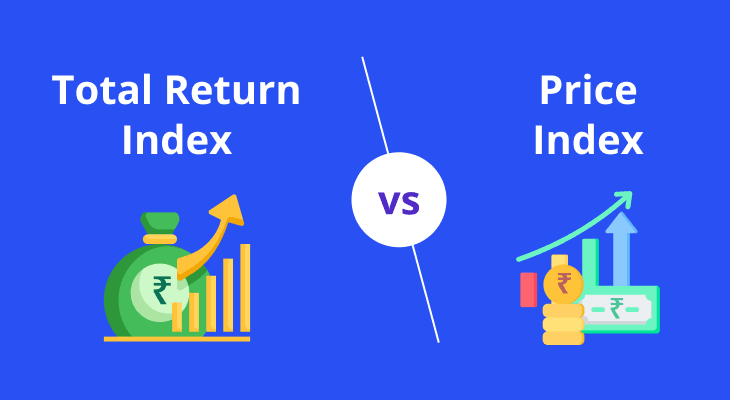
When you track the stock market, you likely refer to widely recognised benchmarks such as the Nifty 50 or the Sensex to gauge overall movement. However, what many investors overlook is that the method used to calculate these indices can influence how they judge their own performance. Most people end up comparing returns against a price index, which captures only share price movements while ignoring a key component of actual earnings, dividends. This is where the total return index becomes far more accurate. Unlike a simple price-based measure, TRI incorporates both price changes and reinvested dividends, giving a clearer picture of the real growth your investments generate. With SEBI now mandating TRI for mutual fund benchmarking, understanding the distinction is not just useful but crucial.
By knowing how these indices differ, especially if you invest through index funds or compare funds against benchmarks, you can make smarter decisions and rely on metrics that truly reflect long-term performance.
What Is a Price Index?
A price index measures how the value of a stock market index changes based purely on the movement of share prices. It does not factor in dividends or any additional income companies distribute to shareholders. Because of this, it reflects market direction but not the total returns an investor actually earns. A price index is useful for understanding market momentum, short-term sentiment, and historical price trends, but it offers only a partial picture of performance.
To understand the concept more clearly, consider its key characteristics:
Tracks Only Price Movements
A price index rises or falls solely based on the change in the market prices of its constituent stocks. If prices go up, the index moves up; if they fall, the index declines.
Excludes Dividend Income
Even if companies pay high dividends, a price index does not add those payouts into the return calculation. In reality, investors who reinvest dividends would earn more than what the price index suggests.
Helps Gauge Market Sentiment
As price indices react quickly to price changes, it is often used by traders to understand intraday direction, market strength, or weakness.
Does Not Reflect True Investor Returns
Due to the fact that dividends are omitted, the price index tends to underreport long-term returns, especially in markets where dividend yields form a meaningful part of total earnings.
Simple and Historically Popular
Price indices such as the Nifty 50 (Price Return index) and Sensex (Price Return index) were once the standard reference for benchmarking because they were easy to calculate and track.
Also Read: What is Sensex and How is it Calculated? | m.Stock
Example of a Price Index
Suppose an index consists of three stocks:
Stock | Previous Price | Current Price | Weight |
|---|---|---|---|
A | ₹100 | ₹110 | 40% |
B | ₹200 | ₹190 | 40% |
C | ₹50 | ₹55 | 20% |
- Stock A rises by 10%
- Stock B falls by 5%
- Stock C rises by 10%
Using their weights, the price index movement is calculated only using price changes:
Price Index Change = (10% × 40%) + (-5% × 40%) + (10% × 20%) = +4%
Even if these companies simultaneously declared dividends, the price index would still show only a 4% rise, because dividends are not included.
This example highlights why a price index can show a lower return than what investors actually earn in real portfolios.
What Is a Total Return Index (TRI)?
A total return index (TRI) offers the most realistic picture of how an index performs over time. Unlike a standard price index, which tracks only share price changes, a TRI assumes that all dividends paid by the companies in the index are reinvested back into it. This makes TRI a more comprehensive representation of wealth creation, especially for long-term investors who benefit from both price appreciation and dividend compounding.
As mutual funds automatically reinvest dividends, TRI has become the fairest and most accurate benchmark for evaluating fund performance. It measures what an investor actually earns, not just how prices move.
Imagine an index starts at 1,000 points. During the year, the total share price rose by 8%, taking the price index to 1,080.
Now, suppose the companies in the index also paid dividends worth 2% of the index value.
If these dividends are reinvested:
- Dividend gain = 1,000 × 2% = 20 points
- New base for compounding = 1,020
- After applying the 8% price rise on this adjusted base, the TRI becomes:
1,020 × 1.08 = 1,101.6
So while the price index ends at 1,080, the TRI ends at 1,101.6, showing a higher return.
Following are the core elements that define a TRI:
Captures Full Earnings
A TRI includes both price movements and reinvested dividends, offering a complete view of returns that mirrors real investing behaviour.
More Accurate Benchmarking
Since fund managers reinvest dividends, comparing them against TRI ensures a level playing field, unlike a price index, which ignores a major portion of returns.
Shows Compounding Power
Dividends reinvested over time compound. TRI displays this compounding effect, helping you understand the true pace of long-term market growth.
Reliable Across Market Cycles
When price returns slow down, dividends often make up a meaningful chunk of total gains. TRI captures this contribution accurately.
Difference Between Price Index and Total Return Index
Understanding the difference between a price index and a total return index (TRI) is essential because both measure market performance but tell very different stories. While a price index shows how stock prices move, TRI reveals what investors actually earn when dividends are reinvested. The table below helps you see how each behaves in real-world investing:
Aspect | Price Index (PRI) | Total Return Index (TRI) |
|---|---|---|
Meaning | Tracks only share price movements and ignores dividend payouts. | Tracks share price changes along with reinvested dividends, reflecting full investor returns. |
What It Measures | Market sentiment and short-term direction are based purely on price. | True wealth creation includes price movement, dividends, and their compounding effect. |
Return Accuracy | Understates actual returns because dividends are excluded. | Provides the most accurate picture of returns, especially over long periods. |
Use in Benchmarking | Traditional benchmark for many years; still used for quick price-only comparisons. | SEBI-mandated benchmark for Indian mutual fund schemes because it offers a fair comparison of fund performance. |
Volatility Reflection | Shows volatility based only on price swings, making it narrower in scope. | Reflects price volatility and dividend stability, often appearing smoother over time. |
Relevance to Investors | Useful for traders focusing on short-term price action. | More relevant for long-term investors who benefit from dividend reinvestment. |
Impact During High Dividend Periods | Shows little improvement, even if companies pay high dividends. | Shows significantly higher returns when dividends are substantial, revealing true compounding. |
Data Source | Daily closing prices of index constituents. | Closing prices and dividend distribution data from each company in the index. |
Example | If the Nifty Price Index rises 7% in a year, that reflects price gains only. | If Nifty TRI rises 11% in the same year, the extra 4% reflects dividends compounded back into the index. |
Best For | Short-term traders, technical analysts, or those tracking immediate market movement. | Mutual fund benchmarking, retirement planning, long-term portfolio analysis, and passive investing. |
Why TRI Is More Accurate for Investors?
A TRI mirrors the way money grows in real life. When dividends are reinvested, your capital compounds faster. If you compare your mutual fund returns with a Price Index, you may think the fund underperformed, even if it matched or beat the TRI.
Here’s why TRI is more accurate:
Captures the Full Picture of Returns
A total return index reflects the actual growth an investor experiences because it includes both price appreciation and reinvested dividends. A price index only shows the rise or fall in share prices, ignoring dividend income that adds meaningfully to long-term gains. By capturing every source of return, TRI presents a truer measure of how wealth compounds over time.
Also Read: Tax on Dividend Income in India: Exemptions, Reliefs & TDS Rules
Prevents Misleading Performance Comparisons
When you compare a mutual fund’s returns with a price index, the fund may appear weaker simply because the benchmark excludes dividends. TRI removes this mismatch. Aligning the benchmark’s methodology with the way funds actually operate helps you judge performance fairly and prevents distorted conclusions.
Mirrors Real Investment Behaviour
Most investors, whether directly in equities or through funds, tend to reinvest dividends. A total return index mirrors this real-world behaviour, making it far more practical for analysing performance. It represents how an investor’s capital truly grows, rather than presenting returns that only exist on paper.
Essential for Evaluating Index-Based Products
In index funds, where the goal is to match market performance as closely as possible, using TRI is crucial. Since index funds reinvest all dividends received from companies, comparing them against a benchmark that does the same ensures accuracy. This is why regulators insist on TRI for benchmarking mutual funds.
Also Read: What are Index Funds? Meaning, Types, and Benefits | m.Stock
Offers a Better View of Long-Term Compounding
Dividends, though small individually, accumulate significantly over long periods. A total return index shows how these reinvested payouts boost overall returns. This makes TRI especially helpful for long-term investors who rely on compounding to build wealth steadily and consistently.
Role of Index Funds
When you invest through index funds, you are essentially choosing a strategy that mirrors the market rather than trying to beat it. As the objective is to replicate an index’s performance faithfully, the type of benchmark used, whether a price index or a total return index, plays a decisive role in how accurately your returns are measured. Here are the key aspects explained clearly:
Ensures True Return Matching
In index funding, the fund manager buys the same stocks as the benchmark index. Most of these stocks pay dividends, which get reinvested within the fund. A total return index captures this reinvestment, making it a far more accurate reflection of what investors actually earn. If the benchmark was a price index, the scheme would appear to outperform or underperform artificially because dividends are ignored.
Prevents Benchmark Distortion
A price index only shows price appreciation, which makes it an incomplete standard for evaluating index funds. As index funding replicates both stock prices and dividend flow, comparing its performance to a benchmark that skips dividends creates a misleading gap. Using a total return index removes this distortion and allows a fair, transparent comparison.
Supports SEBI’s Fairness Mandate
Regulators insist on TRI benchmarking because index funding aims for consistency, not alpha generation. A total return index provides a level playing field; every index fund, regardless of AMC or investment style, is measured against a benchmark that reflects how money grows in real terms.
Also Read: What Are Asset Management Companies? Meaning, Types & More
Helps Investors Judge Tracking Accuracy
Tracking error is central to index fund returns’ analysis. It reflects how closely the fund follows its benchmark. Because a total return index includes dividends, fund tracking improves and becomes more meaningful. A price index benchmark might make tracking error look unnecessarily high or low, masking the fund’s true efficiency.
Provides Clearer Expectations for Long-Term Wealth
Over long periods, dividends contribute significantly to total market returns. Investors in passive funds rely on index funds to benefit from this compounding effect. A total return index mirrors that compounding, helping you set more realistic expectations. A price index would understate growth and lead to conservative or inaccurate assumptions about long-term wealth creation.
Also Read: What is the Difference Between Active & Passive Funds? |m.Stock
Conclusion
Understanding the difference between a Price Index and a Total Return Index is essential if you want to evaluate market movements and mutual fund returns meaningfully. A Price Index only shows capital appreciation, while a TRI tells the full story by adding the dividend effect.
Since SEBI now mandates TRI for mutual fund benchmarking, it has become the standard for honest, accurate comparisons. Whether you are analysing long-term returns, tracking index funds, or assessing market growth, TRI should be your preferred measure; it reflects the returns you actually experience as an investor.
More Related Articles
Understanding the meaning and benefits of the systematic trading system
 October 23, 2026 | 0 mins read
A systematic trader is an individual who uses a predesigned and backtested trading strategy to buy and sell financial instruments such as stocks, futures, currencies, or commodities. Instead of relying on gut feelings or emotions, they use a systematic trading system built on predefined rules, quantitative analysis, and technology to make trading decisions.

Muhurat Trading 2026: Will stock market be open on 8th November Sunday?
October 23, 2026 | 0 mins read
Muhurat Trading 2026 will be held on Sunday, 8 November 2026, on Diwali Laxmi Puja. NSE and BSE will open their equity markets for a special afternoon session, with continuous trading beginning at 2:20 pm IST. Trading in securities not covered by the Closing Auction Session (CAS) will continue until 3:30 pm, while continuous trading in CAS-eligible securities will end at 3:15 pm. For investors, Muhurat Trading combines a long-standing Diwali tradition with an opportunity to participate in the stock market. Here is a guide to the date, timings and session structure for 2026.

How stock market psychology influences investment decision-making
October 23, 2026 | 0 mins read
Stock market psychology refers to the collective emotions, sentiment, and behavioural biases that influence the buying and selling decisions of investors. Rather than relying on fundamental and technical analysis, investors may sometimes react based on emotions, which can influence market movements.
FAQ
SEBI mandated the use of TRI to ensure fair performance comparison. Price Indices exclude dividends, which can distort mutual fund performance. TRI includes reinvested dividends, offering a more accurate and transparent benchmark aligned with how funds generate returns.