
February 13, 2025 | 6 min read
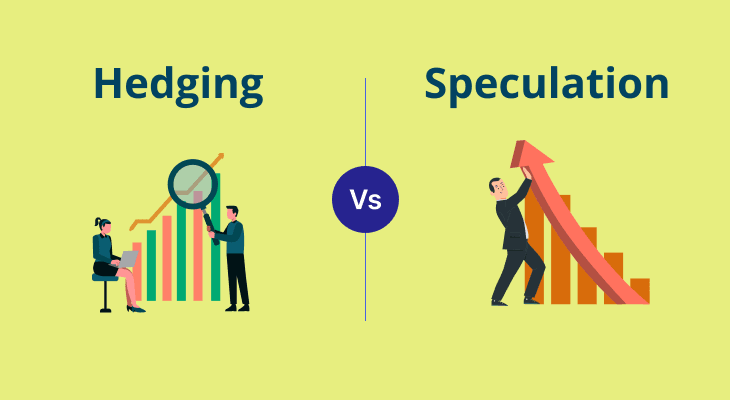
Difference Between Hedging and Speculating
Managing risk and seeking opportunities in the stock markets are essential for financial success. Two widely used approaches — hedging and speculating — serve these purposes but differ significantly in their methods, objectives, and outcomes. Understanding these concepts and their distinctions is critical for investors, traders, and businesses to navigate the dynamic world of finance effectively.
What is Hedging?
Hedging is a risk management strategy used to protect against adverse price movements in investments or business operations. It involves taking offsetting positions in financial instruments to reduce potential losses.
Key Features of Hedging:
Objective: Minimise financial risks caused by fluctuations in market variables like currency rates, interest rates, or commodity prices.
Instruments Used: Commonly includes futures, options, forwards, and swaps.
Participants: Typically employed by businesses, institutional investors, or individuals with significant exposure to specific risks.
Example: An importer expecting a rise in the dollar value might hedge by purchasing currency futures to lock in current rates.
What is Speculation?
Speculation involves taking calculated risks in financial markets to earn profits from price fluctuations. Different from hedging, the primary aim of speculation is not risk management but profit generation.
Key Features of Speculation:
Objective: Generate profits by anticipating price movements in financial assets.
Instruments Used: Stocks, commodities, derivatives, or forex markets are popular avenues.
Participants: Usually individual traders, retail investors, or hedge funds.
Example: A trader might buy stocks of a company expecting positive earnings reports to boost share prices.
Key Differences Between Hedging and Speculation
Here’s a table that captures the distinctions of hedging vs. speculation:
Aspect | Hedging | Speculation |
Purpose | Risk reduction and protection against potential losses by offsetting risks, ensuring stability and security | Profit generation by taking calculated risks from anticipated price movements |
Risk Exposure | Minimised by offsetting positions | High, as it involves taking on risks |
Participants | Businesses, institutions, risk-averse investors | Traders, retail investors, hedge funds |
Outcome | Reduces uncertainty | Can result in significant gains or losses |
Market View | Focused on managing adverse scenarios in volatile markets | Relies on predicting future price movements where significant price movements are expected |
Horizon | Usually a longer-term perspective | Often has a shorter time horizon, |
Costs | Can be costly due to the need for derivative instruments like options and futures, which require regular premiums or margin payments. | Usually less expensive in terms of upfront costs but involves high risks that can lead to significant losses. |
Type of Investor | Typically institutional investors, businesses, and risk-averse individuals looking to safeguard investments | Generally retail investors or traders who are comfortable taking on high-risk investments in search of high rewards |
Leverage | Usually, lower leverage because the objective is to reduce risk, not amplify returns | Often involves high leverage, that can magnify potential profits or losses |
Purpose and Benefits of Hedging
Hedging serves as a risk management strategy to minimize potential losses from fluctuating prices in financial markets. It is primarily used by businesses and investors who want to protect their investments or assets from adverse market movements. For example, a company that imports goods from abroad may hedge against currency fluctuations to protect profit margins.
Benefits of Hedging:
Risk Reduction: Hedging allows businesses to limit exposure to price volatility, ensuring more predictable financial outcomes.
Stability: By protecting against market downturns, hedging stabilises cash flows and revenue.
Protection Against Adverse Price Movements: It shields investors from sharp movements in the price of assets, currencies, or commodities.
Peace of Mind: Investors can focus on their long-term goals without constant worry about market volatility.
Overall, hedging is an essential tool for managing risk, particularly for businesses and investors operating in uncertain or volatile markets.
Purpose and Risks of Speculation
Speculation involves taking calculated risks with the aim of profiting from future price movements. Unlike hedging, the objective of speculation is not to reduce risk but to embrace it for potentially higher returns. Speculators rely on their market analysis, predictions, and timing to make profitable trades.
Benefits of Speculation:
Potential for High Returns: By betting on the direction of market movements, speculators can gain significant profits if their predictions are correct.
Capitalizing on Market Trends: Speculators often profit from short-term trends or market inefficiencies, where others may not be looking.
Liquidity: Speculation contributes to market liquidity by encouraging active participation and trading.
Leverage: Speculators often use leverage to maximise potential returns, allowing them to control larger positions than they could with their own capital.
However, risks of speculation are also considerable:
Significant Losses: If the market does not move as expected, speculators can face substantial losses, especially when using leverage.
Volatility: Speculators are often exposed to high volatility, making their investments unpredictable and potentially hazardous.
Short-Term Focus: Speculation is often focused on short-term movements, which means the strategy can be more stressful and requires constant monitoring of the market.
Speculation can be an exciting and potentially lucrative strategy, but it requires careful market knowledge and a tolerance for risk.
Common Strategies in Hedging and Speculation
Hedging Strategies
Forward Contracts and Futures Contracts: These allow businesses or investors to lock in prices for assets (like commodities or currencies) at a future date, protecting them from adverse price movements.
Options Contracts: Buying put options can serve as a hedge against falling prices, while call options protect against rising prices. This strategy is popular in stock and commodities markets.
Currency Hedging: Multinational companies use currency hedging to protect against exchange rate fluctuations. This can be done through forward contracts, options, or foreign exchange swaps.
Interest Rate Hedging: Businesses or investors can use interest rate swaps to hedge against fluctuating interest rates, particularly in borrowing or lending activities.
Speculation Strategies
Long and Short Positions: Speculators often take long positions (buying assets in anticipation of price rises) or short positions (selling assets in anticipation of price drops). This strategy is common in stock and commodity markets.
Using Leverage: Speculators frequently employ leverage to amplify their potential returns, although this increases risk. By borrowing capital to invest, speculators can make larger bets on price movements.
Swing Trading: Swing Trading strategy involves buying and selling assets over a short time frame, capitalising on price swings or market volatility. It requires a deep understanding of market trends and technical analysis.
Arbitrage: In Arbitrage Trading, Speculators take advantage of price discrepancies between markets or similar assets. For instance, if a commodity is priced differently in two locations, they can buy low in one and sell high in another.
Each of these strategies reflects the contrasting goals and risk appetites of hedging and speculation. While hedging focuses on reducing risks, speculation embraces risks to earn potential rewards. Both strategies can be used in various markets, from stocks to commodities, depending on the investor's objectives and risk tolerance.
Conclusion
Understanding the difference between hedging and speculating is vital for making informed financial decisions. While hedging focuses on mitigating risks and ensuring stability, in speculation risks are taken to capitalise on market opportunities. Whether you're an investor or a business owner, knowing when to hedge or speculate can significantly influence your financial success.
More Related Articles

How Rising Oil Prices Impact Stock Market Investments
 October 9, 2026 | 0 mins read
A petroleum price hike, driven by rising global crude oil prices, can have far-reaching consequences for the economy and financial markets worldwide. As India imports over 88% of its crude oil requirements, understanding the impact of rising oil prices on stock market investments is essential for investors.

Understanding the meaning and impact of a current account deficit on an economy
October 9, 2026 | 0 mins read
The current account is an important component of a country’s balance of payments. A current account deficit occurs when a country’s total payments to the rest of the world exceed its total earnings from abroad. These payments include imports of goods and services, investment income paid to foreign investors, and current transfers. These earnings include receipts from exports of goods and services, income earned from overseas investments, and current transfers such as remittances. A country’s current account deficit is generally expressed as a percentage of its gross domestic product (GDP).

Revenge trading meaning explained: Causes, impact, and how to avoid it
October 9, 2026 | 0 mins read
in revenge trade, they are often driven by emotions such as anger, frustration, fear, or disappointment rather than sound analysis. In the process, they overlook carefully planned trading strategies designed around their financial goals, investment horizon, and risk appetite. More often than not, revenge trading results in further losses, creating a vicious cycle that becomes increasingly difficult to escape.
FAQ
Hedging aims to reduce risk by protecting against adverse price movements, while speculating involves taking risks to profit from potential price changes. Hedgers seek stability, while speculators seek high rewards.