
November 19, 2025 | 5 min read
How Global Indices Affect Indian Stocks?
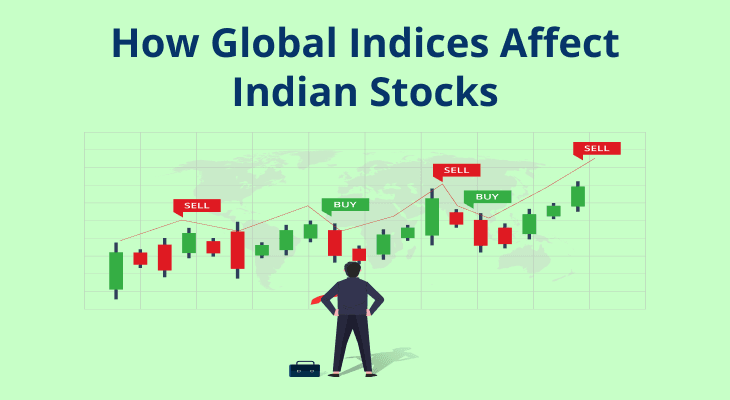
When you check the morning news, you often hear: “Nifty expected to open lower tracking weak global cues” or “Sensex likely to rise after US markets closed higher.” But why does the movement of the Dow Jones or S&P 500 in the US matter to India’s Sensex or Nifty?
The answer lies in the fact that financial markets across the world are deeply interconnected. With globalisation, foreign institutional investors (FIIs) and large funds move money across borders based on global risks, opportunities, interest rates, and currency trends. As a result, Indian indices no longer move just on local company fundamentals; they also reflect the pulse of global indices.
Also Read: FDI vs FII: Difference Between FDI And FII - What is FII and FID
Let’s find out more on this topic.
Introduction To Global Indices
Global indices represent the stock performance of large economies like the US, Europe, and Asia. Examples include:
- Dow Jones Industrial Average (DJIA) and S&P 500 (United States)
- FTSE 100 (United Kingdom)
- DAX (Germany)
- Nikkei 225 (Japan)
- Hang Seng (Hong Kong)
For Indian markets, the most watched are the US indices, because the US is the largest economy and home to the world’s biggest institutional investors. If the US markets rally or crash, the ripple effect is quickly felt in India through FII flows and investor sentiment.
Why Global Indices Matter
The Indian stock market may appear domestic, but it is globally integrated. Here’s why global indices matter so much:
- Foreign investors’ role: FIIs and foreign portfolio investors (FPIs) own a significant chunk of Indian equities. Their buy/sell decisions often track movements in US and European indices.
- Interlinked trade and finance: India imports crude oil and commodities that derive their pricesd through global tradely. A rise in Brent crude immediately affects India’s inflation outlook and auto sector margins.
- Macro linkages: Global indices reflect central bank actions, interest rates, and geopolitical risks, which have a direct spillover impact on Indian indices.
For example, in the early months of 2025, Foreign Institutional Investors (FIIs) greatly accelerated their withdrawals from Indian equities, offloading over ₹ 21.55 lakh crore in total, marking the highest-ever annual outflow on record, which dented the Sensex and Nifty performance significantly.
Factors Influenced By Global Indices
1. Investor Sentiment & FII Flow
FIIs often follow global cues. A crash in the Nasdaq (tech-heavy index) can lead to heavy selling in Indian IT stocks like Infosys and TCS. Conversely, a rally in US equities often attracts risk-on capital into India.
For example, in July 2024, when the US inflation data came lower than expected, Wall Street rallied, prompting FIIs to pump money back into Indian equities, especially the financial and IT sectors.
2. Currency and Dollar Index
The Dollar Index (DXY), which measures the USD against major currencies, has a strong correlation with Indian markets.
- A stronger dollar → FIIs pull money out of India, as returns in USD terms shrink.
- A weaker dollar → boosts foreign flows into India, lifting indices.
For example, in 2023, whenever the Dollar Index crossed 105, the rupee weakened, leading to FII outflows and pressure on Nifty.
3. Global Commodity Prices (Oil, Gold)
India imports over 80% of its crude oil. So, global crude prices directly hit corporate profitability, inflation, and fiscal deficit.
- Rising oil prices hurt autos, paints, airlines, and oil marketing companies.
- Gold prices reflect global risk sentiment, when gold rallies, it often signals risk-off mode in equities.
For example, during the Russia-Ukraine conflict in 2022, crude oil surged above $120 per barrel, leading to heavy selling in Indian auto and airline stocks.
4. Geopolitical & Macro Events
War, elections in the US, China slowdown, or Fed interest rate hikes—all these global events influence Indian indices.
For example, in late 2024 and early 2025, uncertainty around US elections and Middle East tensions kept Indian markets volatile, with the Nifty moving in sync with the S&P 500 and Brent crude prices.
Sectoral Impact
Different Indian sectors react differently to global cues:
- IT & Pharma: Benefit when the USD strengthens because they earn in foreign currencies. IT and Pharma companies usually gain during a dollar rally and underperform when the opposite happens.
- Oil & Gas, Auto, Capital Goods: Suffer when crude oil or global commodity prices rise, as costs increase. Typically, rising crude oil prices hurt Indian oil companies like IOCL and BPCL.
- Financials: Sensitive to US interest rates and bond yields. If US yields spike, FIIs sell Indian banks and financials.
- Export-driven sectors: Gain from global demand revival. For instance, the post-COVID recovery in US demand boosted Indian textile and specialty chemical stocks.
Case in Point: In September 2023, Fed Chairman Jerome Powell hinted at prolonged higher interest rates. Immediately, Indian banking stocks corrected as FIIs booked profits. This shows the direct correlation between global events and the stock market impact felt in India.
How Retail Investors Should Respond
Global indices are not just for analysts and institutions. You, as a retail investor, should also track them. Here’s how:
- Stay Informed: Track global indices (Dow, S&P 500, Nikkei, Hang Seng) every morning before Indian markets open.
- Watch the Dollar Index and Crude Oil: These two have the most direct short-term effect on Nifty/Sensex.
- Don’t Panic: Global markets often see short-term volatility. Avoid reacting to every overnight move.
- Use Diversification: Spread investments across asset classes (gold, bonds, equities) to balance global risks.
- Focus on Long-Term Trends: While global cues impact daily moves, Indian fundamentals, growth, demographics, consumption, etc., remain the bigger drivers over time. This is exemplified by the events of the last financial year (FY 2024-25). While FIIs offloaded stocks worth ₹ 21.5 lakh crore, domestic investors pumped in a record (approx) ₹ 6 lakh crore in the Indian stock market.
Conclusion
Global indices like the S&P 500, Dow Jones, and FTSE act as guiding lights for Indian markets, influencing FII flows, currency, commodities, and sectoral trends. While Indian indices are strongly impacted in the short term, local fundamentals still matter in the long run.
For retail investors, the key is to track global indices regularly, understand sector sensitivities, and avoid knee-jerk reactions. Instead, use this knowledge to time your entries, hedge risks, and stay prepared for volatility.
Explore our guides on FII flows, Dollar Index impact, and sectoral investing strategies to build a stronger market outlook.
More Related Articles

SEBI Proposes CAS Changes: What Could Change for Derivatives Settlement, IEPs & Timings?
 September 17, 2026 | 0 mins read
A month after introducing the new Closing Auction Session, SEBI has proposed changes after early market feedback raised concerns about derivatives settlement on expiry days, changing auction prices and trading timings. SEBI is not scraping CAS. Instead, it wants to make expiry settlement clearer, improve the auction process and help traders understand that indicative auction prices are not the same as actual traded prices.
ETF trading rules from 7 September: What changes for retail investors?
September 7, 2026 | 0 mins read
If there was no trade during the final 30 minutes on the previous day, the exchange will use that day’s last traded price. If there was no trade at all on the previous day, the latest available closing NAV will be used. The base price will also be adjusted for corporate actions, if applicable. From April 1, 2027, SEBI expects stock exchanges and mutual fund AMCs to use the previous day’s closing NAV as the base price after resolving operational issues.

How MSCI rebalancing tested India's Closing Auction System on August 31
September 2, 2026 | 0 mins read
India’s new Closing Auction Session (CAS) processed a record ₹39,718 crore turnover, on 31 August 2026 as MSCI India Index latest index rebalancing took effect at the market close. The event showed that CAS could handle an exceptional concentration of institutional flow. However, there were some sharp, and sometimes counterintuitive, stock moves. This shows that the quality of closing-price discovery is still being tested.
FAQ
Global indices like the S&P 500 or Dow Jones track stock performance in major economies. They matter to Indian investors because FIIs take cues from them. If global markets fall, Indian stocks often decline too, as foreign investors withdraw money, causing broad selling pressure in Nifty and Sensex.