
August 19, 2026 | 10 min read
Iron Condor Strategy with Example for Beginners
Markets do not always trend strongly. At times, prices remain within a narrow range, making directional trades more challenging. The iron condor strategy is designed for these market conditions. It doesn’t rely on a bullish or bearish outlook. It aims to generate returns when the underlying asset remains within a predefined price range. With clearly defined risk and reward, it has become a widely used approach among traders looking to capitalise on range-bound markets while maintaining controlled exposure.
What Is the Iron Condor Strategy?
The iron condor strategy is a neutral options trading strategy that is commonly used when you expect an underlying asset to remain within a specific price range until expiry. Rather than profiting from a significant upward or downward move, the strategy seeks to benefit from limited price movement and the gradual erosion of option premiums over time.
The strategy combines two spreads, a bull put spread and a bear call spread, to create a position with defined risk and defined reward. Since protective options are included on both sides, potential losses are capped from the outset. One of the reasons the condor option strategy is widely used is that it provides a broader profit range than some other neutral strategies. This means the underlying asset can move within a certain range without significantly affecting the trade's profitability
Understanding the Structure of an Iron Condor
The iron condor strategy is built using four option contracts with the same expiry date but different strike prices. Each option plays a specific role in balancing premium collection and risk management. Here are the details:
1. Sell an Out-of-the-Money Put Option
The first component involves selling an out-of-the-money put option. This position generates premium and forms the lower boundary of the strategy's profit zone. The trader expects the underlying asset to remain above this strike price until expiry.
2. Buy a Lower Strike Put Option
To limit downside risk, a put option is purchased below the short put strike. This protective option ensures that losses remain capped if the underlying asset experiences a sharp decline.
3. Sell an Out-of-the-Money Call Option
The third leg involves selling an out-of-the-money call option. Like the short put, this position generates a premium. It forms the upper boundary of the strategy's profit range and reflects the expectation that the underlying asset will stay below this strike price.
4. Buy a Higher Strike Call Option
A call option is purchased above the short call strike to protect against a significant upward move. This protective call limits the risk associated with the short call position and helps define the maximum possible loss.
How the Iron Condor Strategy Works in Sideways Markets
Here are the stages that explain how the iron condor strategy works in a sideways market. Each step helps you understand how the strategy is structured and managed when the underlying asset is expected to remain within a defined price range.
1. Both Short Options Remain Out of Danger
The short put and short call are placed outside the current market price. As long as the underlying asset stays between these strikes, neither side of the trade faces significant risk. This allows the position to maintain its profit potential.
2. The Probability of Profit Improves Over Time
Every day that passes without a major market move can be beneficial for the trade. As expiry draws closer, the likelihood of the underlying remaining within the selected range becomes increasingly important to the overall outcome.
3. Small Price Fluctuations Become Less Concerning
Markets rarely remain perfectly still. One advantage of the iron condor strategy is that it allows for a certain degree of price movement without immediately affecting profitability. This flexibility is one reason many traders use it during consolidating market phases.
4. Risk Remains Clearly Defined
Even if the market unexpectedly breaks out of its range, the protective options help ensure that losses remain capped. This allows traders to participate in neutral market conditions without taking on unlimited risk.
Iron Condor Strategy Example
Understanding an iron condor strategy example can make it easier to see how the position behaves under different market outcomes.
Assume a stock is currently trading at ₹1,000, and you expect it to remain within a relatively stable range until expiry. Based on this outlook, you establish the following position:
Position | Strike Price |
|---|---|
Buy Put | ₹900 |
Sell Put | ₹950 |
Sell Call | ₹1,050 |
Buy Call | ₹1,100 |
Suppose the trade generates a net premium of ₹20 per share.
1. If the Stock Closes Between ₹950 and ₹1,050
This is the most favourable outcome. Both short options expire worthless because the stock remains within the selected range. The long options also expire without value. In this scenario, you retain the entire premium collected when the trade was established.
2. If the Stock Moves Towards One of the Short Strikes
The position may still remain profitable even if the stock does not finish exactly in the middle of the range. As long as the stock stays within the breakeven levels, the trade can continue to generate a profit, although the amount may be lower than the maximum possible gain.
3. If the Stock Moves Beyond the Protective Strikes
Suppose the stock rises above ₹1,100 or falls below ₹900 by expiry. At this stage, the trade reaches its maximum loss zone. However, the protective call and put help ensure that losses remain limited rather than increasing indefinitely.
Possible Outcomes at Expiry
Stock Price at Expiry | Expected Result |
|---|---|
Between ₹950 and ₹1,050 | Maximum profit |
Near breakeven levels | Reduced profit |
Beyond ₹900 or ₹1,100 | Maximum loss |
This iron condor strategy example highlights the importance of strike selection. The wider the range between the short call and short put, the more room the underlying asset has to fluctuate while keeping the position profitable.
What Is a Short Iron Condor Strategy?
The short iron condor strategy is an advanced options strategy that aims to benefit when the underlying asset stays within a defined price range before expiry. It is created by selling an out-of-the-money call spread and an out-of-the-money put spread with the same expiry date, resulting in a position that performs best when the market stays within a defined range. Unlike a standard iron condor, which benefits from stable price action, this strategy is also designed for markets that remain range-bound. Traders use it when they expect low volatility and do not expect a large price move. The strategy combines multiple option contracts to create a defined-risk position with predetermined profit and loss potential.
Characteristics of a Short Iron Condor Strategy
1. Benefits From Limited Price Movement
The strategy is designed to perform better when the underlying asset moves significantly higher or lower instead of remaining within a narrow trading range.
2. Does Not Require a Directional View
A trader does not need to predict whether the market will move upward or downward. The focus is on the magnitude of the move rather than its direction.
3. Has a Defined Risk Profile
The structure includes protective options that limit potential losses. This allows traders to know the maximum risk before entering the trade.
4. Suitable for Breakout Expectations
The strategy is often considered when the market appears ready to move out of a consolidation phase or when a major event could trigger increased price activity.
5. Offers Limited Profit Potential
Although the strategy benefits from limited price movement, the maximum profit remains capped because of the way the option positions are structured.
What Is a Long Iron Condor Strategy?
A long iron condor is an options strategy that is generally used when you expect the underlying asset to make a significant move in either direction before expiry. It combines a bull call spread and a bear put spread to create a position with defined risk and defined reward.
The strategy typically requires a net debit at entry and achieves its best outcome when the underlying asset moves beyond the outer strike prices. It is often considered by traders seeking opportunities in higher-volatility or breakout market conditions.
Characteristics of a Long Iron Condor
Designed for Breakout or Volatile Markets.
The strategy is commonly used when the underlying asset is expected to make a significant move in either direction rather than stay in a tight range.
Provides Profit Outside the Middle Range.
Compared with neutral range-bound strategies, a long iron condor can benefit if price moves beyond the outer strike prices.
Combines Risk Control With Directional Flexibility.
The spread structure limits both maximum loss and maximum gain, while giving exposure to a large move in either direction.
Has Predetermined Profit and Loss Levels.
Both the maximum profit and maximum loss can be calculated before entering the trade.
Is Hurt by Time Decay.
As expiry approaches, time decay generally works against the position rather than for it.
Payoff Structure of the Iron Condor Strategy
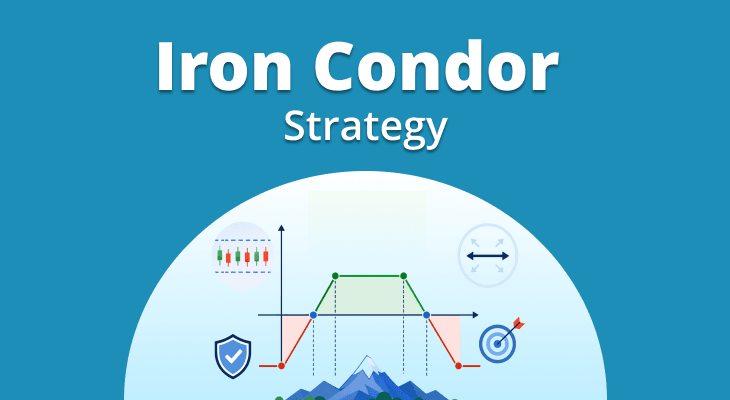
The payoff structure of an iron condor strategy illustrates how the trade's profit and loss vary with the market price at expiry. Unlike directional options strategies that rely on a bullish or bearish view, an iron condor is built around a predefined price range. The position performs best when the market remains within that range and becomes less profitable as prices move towards either side of the structure. As the strategy includes both short and long options, the potential reward and potential risk are known before the trade is entered. This allows traders to clearly identify their profit zone, breakeven levels, and maximum loss exposure in advance.
How to Set Up an Iron Condor Trade?
Setting up an iron condor strategy involves more than selecting four option contracts. The effectiveness of the trade often depends on choosing appropriate strike prices, assessing market conditions, and understanding the range within which you expect the underlying asset to trade. The following steps can help you build a structured iron condor position.
Step 1: Identify a Range-Bound Market
Before entering the trade, assess whether the underlying asset is likely to trade within a defined range until expiry. Many traders look for markets that are consolidating, showing limited directional momentum, or repeatedly reacting near support and resistance levels.
Step 2: Select an Expiry Date
Choose an expiry that aligns with your trading horizon and market outlook. The selected expiry should provide enough time for the trade to develop while allowing option premiums to gradually decline as expiration approaches.
Step 3: Choose the Short Strike Prices
The short put and short call form the core of the position. These strike prices typically define the expected trading range. The wider the distance between them, the more room the market has to fluctuate before affecting the trade's profitability.
Step 4: Add Protective Long Options
Once the short strikes are selected, purchase a put option below the short put strike and a call option above the short call strike. These options create the outer boundaries of the trade and help limit potential losses if the market makes an unexpected move.
Step 5: Evaluate the Risk and Reward
Before placing the trade, calculate the potential profit, maximum loss, and breakeven levels. Having a clear understanding of these figures can help determine whether the position offers a suitable risk-to-reward balance.
Conclusion
The iron condor strategy gives you a structured way to trade markets that lack a clear directional trend. It combines defined risk, a clearly identified profit range, and flexibility across different market conditions. Although the strategy involves multiple option contracts, a strong understanding of strike selection, payoff dynamics, and market behaviour can simplify the decision-making process. You can improve your chances of success by choosing suitable market conditions and managing risk effectively. When used with a well-defined trading plan, the condor option strategy can help you approach range-bound markets with greater confidence and discipline.
More Related Articles

SEBI Proposes CAS Changes: What Could Change for Derivatives Settlement, IEPs & Timings?
 September 17, 2026 | 0 mins read
A month after introducing the new Closing Auction Session, SEBI has proposed changes after early market feedback raised concerns about derivatives settlement on expiry days, changing auction prices and trading timings. SEBI is not scraping CAS. Instead, it wants to make expiry settlement clearer, improve the auction process and help traders understand that indicative auction prices are not the same as actual traded prices.

ETF trading rules from 7 September: What changes for retail investors?
September 7, 2026 | 0 mins read
If there was no trade during the final 30 minutes on the previous day, the exchange will use that day’s last traded price. If there was no trade at all on the previous day, the latest available closing NAV will be used. The base price will also be adjusted for corporate actions, if applicable. From April 1, 2027, SEBI expects stock exchanges and mutual fund AMCs to use the previous day’s closing NAV as the base price after resolving operational issues.

How MSCI rebalancing tested India's Closing Auction System on August 31
September 2, 2026 | 0 mins read
India’s new Closing Auction Session (CAS) processed a record ₹39,718 crore turnover, on 31 August 2026 as MSCI India Index latest index rebalancing took effect at the market close. The event showed that CAS could handle an exceptional concentration of institutional flow. However, there were some sharp, and sometimes counterintuitive, stock moves. This shows that the quality of closing-price discovery is still being tested.
FAQ
The maximum loss in an iron condor strategy is limited and known before entering the trade. Traders typically calculate it by subtracting the net premium received from the difference between the strike prices of either spread. This predefined risk helps traders plan positions and manage capital more effectively.