
October 9, 2026 | 4 min read
Understanding the meaning and impact of a current account deficit on an economy
There are several indicators used to assess an economy’s health, and the current account deficit is one of the most important. This article explains the meaning of a current account deficit, why it matters, its impact on the economy, and how governments and central banks can manage it.
What is current account deficit and why is it important?
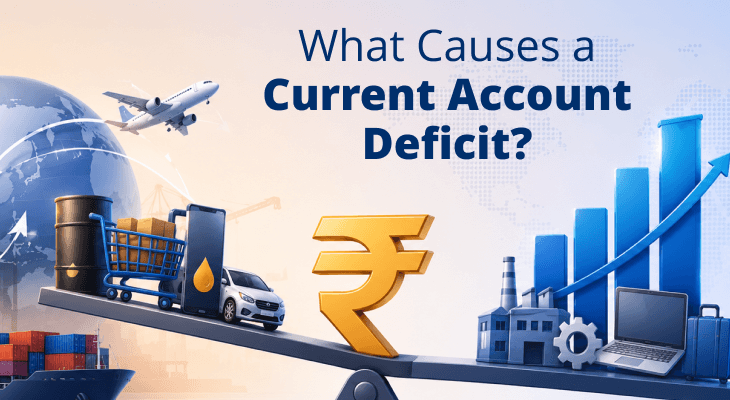
The current account is an important component of a country’s balance of payments. A current account deficit occurs when a country’s total payments to the rest of the world exceed its total earnings from abroad. These payments include imports of goods and services, investment income paid to foreign investors, and current transfers. These earnings include receipts from exports of goods and services, income earned from overseas investments, and current transfers such as remittances.
A country’s current account deficit is generally expressed as a percentage of its gross domestic product (GDP).
How does a current account deficit reflect a country’s economic health?
Although the word “deficit” often has a negative connotation, a current account deficit is not necessarily a sign of economic weakness. It reflects a country’s international transactions and should be assessed in terms of how the money is being put to use. For instance, if a country imports machinery, technology, or other capital goods to support infrastructure and industrial development, a moderate current account deficit can help boost economic growth in the long run and is generally considered manageable in such cases. The problem begins when there is a persistently high current account deficit. Therefore, monitoring the current account deficit is important for assessing a country’s economic stability.
Main causes of the current account deficit in an economy
Several factors are responsible for widening the current account deficit.
- Higher imports than exports: When the value of imports exceeds exports, there is a trade imbalance, which is a major component of the current account deficit.
- High crude oil import bill: India imports over 85% of its crude oil requirements. A higher crude oil import bill can significantly influence the current account deficit.
- Global commodity price volatility: Rising global prices of gold, fertilisers, electronics, energy, and other commodities lead to higher import bills, widening the deficit.
- Rising demand: A growing economy with strong consumer spending and business investment often increases demand for imported products, especially when domestic production is unable to meet the demand.
- Weak exports relative to imports: Despite increasing exports, if export growth remains moderate compared to growing imports, the deficit will persist.
Effects of the current account deficit on currency, inflation, and economic growth
Broadly, here are the implications of a current account deficit on different macroeconomic factors:
- Currency: A persistent current account deficit puts downward pressure on the country’s currency, leading to its depreciation. A weaker currency makes imports more expensive because the same goods and services would now require more domestic currency.
- Inflation: When the domestic currency depreciates and there is heavy reliance on imports, the cost of imported goods and inputs increases. The higher cost is usually passed on to consumers through higher prices for final goods and services, contributing to inflation.
- Economic growth: A moderate current account deficit financed through stable foreign investment can support economic growth. However, persistent dependence on foreign capital or external borrowing can increase economic vulnerabilities.
Factors that can lead to a current account crisis
A current account deficit does not always lead to a current account crisis. However, the risk increases under certain conditions, such as:
- Persistently high current account deficits over several years
- Excessive domestic consumption relative to production
- Weak export competitiveness
- Heavy reliance on short-term foreign borrowing
- High external debt obligations
- Rapid decline in foreign exchange reserves
- Declining investor confidence
How do governments and central banks manage the current account deficit?
When the current account deficit widens significantly, governments and central banks use a combination of monetary, trade, and structural measures to strengthen the country's external position and stabilise the domestic currency.
These measures include:
- Curbing imports: Gold, electronics, and other non-essential goods are often subject to higher import duties or restrictions during periods of high deficit, as these measures discourage imports.
- Promoting exports: Policies that encourage exports, such as Production-Linked Incentive (PLI) schemes, can boost exports, improve the trade balance, and, in some sectors, reduce dependence on imports.
- Improving competitiveness: Focusing on improving the economy’s productivity and competitiveness through investment in infrastructure, technology, education, and other promising sectors can help lower the current account deficit.
- Implementing monetary and fiscal policies: Appropriate changes in interest rates, taxation, government spending, and other macroeconomic policies can also help improve the trade balance.
Conclusion
A current account deficit occurs when a country pays more than it earns, i.e., its outflows exceed its inflows. A moderate current account deficit may support economic growth. However, persistent long-term deficits can endanger a country’s economic stability.
More Related Articles

How Rising Oil Prices Impact Stock Market Investments
 October 9, 2026 | 0 mins read
A petroleum price hike, driven by rising global crude oil prices, can have far-reaching consequences for the economy and financial markets worldwide. As India imports over 88% of its crude oil requirements, understanding the impact of rising oil prices on stock market investments is essential for investors.

Revenge trading meaning explained: Causes, impact, and how to avoid it
October 9, 2026 | 0 mins read
in revenge trade, they are often driven by emotions such as anger, frustration, fear, or disappointment rather than sound analysis. In the process, they overlook carefully planned trading strategies designed around their financial goals, investment horizon, and risk appetite. More often than not, revenge trading results in further losses, creating a vicious cycle that becomes increasingly difficult to escape.

How to Calculate Risk-Reward Ratio in Stock Trading?
October 9, 2026 | 0 mins read
The risk reward ratio compares the amount of money a trader is prepared to risk on a trade with the amount they expect to earn if the trade reaches the target price. Before entering a trade, experienced traders usually estimate two things: the maximum amount they are willing to lose if the trade goes wrong and the potential profit if the trade performs as expected. Comparing these two values helps determine whether the trade offers a favourable balance between risk and reward.
FAQ
A trade imbalance or a trade deficit occurs when a country’s imports exceed its exports. It is one of the largest components of the current account deficit. Thus, a high trade deficit leads to a high current account deficit.