
July 2, 2026 | 18 min read
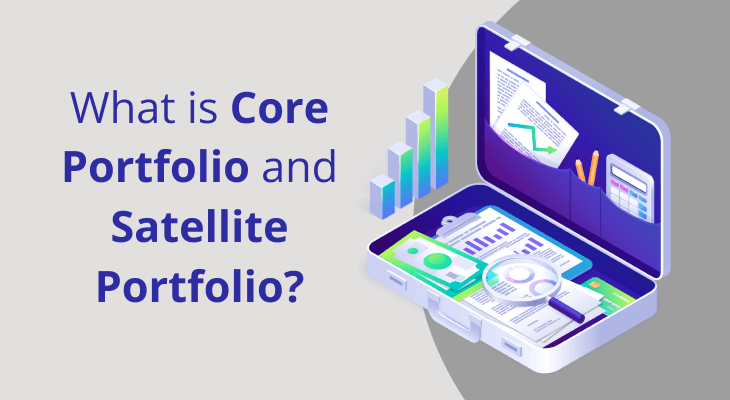
What is Core Portfolio and Satellite Portfolio?
A core and satellite portfolio is a way of structuring your investments so that most of your money sits in a stable core, while a smaller part goes into higher growth ‘satellite’ ideas. The goal is to balance steady compounding with the chance to earn extra returns without making the overall portfolio too risky.
In a core and satellite portfolio, you split your money into two parts. The core holds long-term, diversified investments that you plan to keep for many years. The satellite holds more focused, higher-risk, higher-return opportunities.
For Indian investors, the core often includes broad market index funds or ETFs (like Nifty 50 / Nifty Next 50) and sometimes high-quality debt. The satellites can include mid-cap or small-cap funds, sector/thematic funds, or even a few individual stocks. This structure helps investors avoid overtrading and still allow them to take targeted bets or explore specific themes with a small, controlled portion of the portfolio.
Why the Core and Satellite Approach Works
The core and satellite approach works because it clearly separates stability from investment ideas that could generate alpha for your portfolios. The core is designed to track the market and grow with the economy over time, while satellite allocations are meant to add ‘alpha’ (extra returns) if your ideas play out.
Aspect | Core Portfolio | Satellite Portfolio |
|---|---|---|
Main role | Foundation and stability | Extra growth and tactical ideas |
Allocation | Around 60%-80% of total investments | Around 20%-40% of total investments |
Risk level | Lower, broad-based, diversified | Higher, more concentrated or cyclical |
Investment style | Usually passive or low‑cost (index funds, ETFs) | Often active, thematic, sectoral, or stock‑specific |
Frequency of monitoring allocation | Low, can hold for many years | Higher, needs review and rebalancing |
Most of the portfolio (often 60%-80%) sits in low-cost, diversified holdings, which keeps costs and day-to-day volatility in check. The smaller satellite portion (20%-40%) lets you tilt towards themes you believe in. It can be like small caps, digital India, infrastructure, or global tech, without betting the entire portfolio on them.
What is the Difference Between a Core and Satellite Portfolio?
Think of the core as your regular monthly staples at home, and the satellites as occasional restaurant meals. The core keeps you going, the satellites add excitement but should never dominate.
Core and satellite portfolio allocation
There is no single ‘correct’ split, but many Indian and global examples use 60%-80% in the core and 20%-40% in satellites, depending on risk appetite. A conservative investor may choose 80% core and 20% satellite, while an aggressive investor might move closer to 60% core and 40% satellite.
For beginners in India, a simple starting point can be:
Core 70%-80%
Large-cap index funds or ETFs (Nifty 50, Sensex)
Maybe one flexi-cap or multi-cap mutual fund for additional diversification
Satellite 20%-30%
Mid-cap or small-cap funds
1–2 sector/thematic funds (like banking, infrastructure, or technology) if they match your view and risk profile
The key rule is that the core must stay larger than the satellites so that one bad call in the satellite portion does not derail your long‑term goals.
How to Build a Core-Satellite Portfolio?
Here are a few simple examples of core-satellite portfolios for Indian investors.
Example 1: Beginner with moderate risk (₹10 lakh equity portfolio)
Core 70% = ₹7 lakh
₹4 lakh in a Nifty 50 index fund or ETF
₹3 lakh in a Nifty Next 50 or Nifty 500 index fund for broader exposure
Satellite 30% = ₹3 lakh
₹1.5 lakh in a mid‑cap fund
₹1 lakh in a small‑cap fund
₹50,000 in a sector/thematic fund such as infrastructure or consumption
This investor gets strong diversification from the core, while the satellite bets can boost returns if mid/small caps and chosen sectors do well.
Example 2: Conservative investor close to retirement
Core 80%
40% in equity index funds or ETFs (large‑cap)
40% in high‑quality debt funds, target maturity funds, or other fixed income options
Satellite 20%
10% in hybrid or balanced advantage funds
10% in dividend‑oriented equity or low‑volatility equity strategies
Here, the focus is capital preservation and smoother returns, with limited room for growth‑oriented ideas.
Example 3: Aggressive young investor
Core 60%
50% in broad equity index funds/ETFs (Nifty 50 + Nifty Next 50)
10% in an international equity fund or global ETF to diversify outside India
Satellite 40%
15% in small‑cap funds
15% in thematic/sector funds (e.g., PSU, defence, digital, renewable energy)
10% in carefully selected individual stocks
This is suitable only for investors who can handle sharp ups and downs and have a long-time horizon.
What are the Common Mistakes Investors Make?
Making the satellite too big: When investors push satellites allocation beyond 40%–50%, the portfolio starts behaving like a high-risk, concentrated bet instead of a balanced core and satellite portfolio.
Chasing hot themes: Many investors keep adding new sector funds or small-cap funds based on recent performance, without trimming or rebalancing older positions.
Ignoring costs in the core: The core is meant to be low-cost and long-term focused, but some people fill it with expensive, high-churn funds, which reduces returns.
Not rebalancing: Over time, markets move, and the satellite portion of your portfolio can grow too large or too small. Without periodic rebalancing, the original risk profile gets distorted.
Avoiding these mistakes is more important than finding the perfect satellite idea.
A core and satellite portfolio is a simple, flexible framework where most of your money sits in a diversified, long‑term core, while a smaller portion is used for higher‑risk, higher‑return opportunities. For Indian beginners and independent investors, it offers a practical middle path between doing nothing and over‑trading. If you keep the core large, costs low and review your satellites regularly.
Disclaimer: This blog is only for educational and informational purposes and does not constitute investment advice. Please consult your financial advisor before taking any investment decisions.
More Related Articles

How to Use Factor Investing in Your Portfolio
 July 2, 2026 | 10 mins read
Factor investing means you choose investments based on specific, measurable characteristics that drive returns and risk, rather than just following market-cap weights or relying only on a fund manager’s judgement.
Why You Should Invest in ETFs via SIP?
July 2, 2026 | 7 mins read
An ETF SIP is a systematic investment plan where you invest a fixed amount in a chosen ETF at regular intervals, usually monthly. You still buy units on the exchange through your demat account, but you do this on a fixed date with a fixed amount.
How Should Investors Evaluate ETFs?
July 2, 2026 | 9 mins read
An Exchange Traded Fund (ETF) is a basket of securities that trades on the stock exchange like a share and usually tracks an index such as Nifty 50 or S&P 500. For beginners, ETFs can be a simple way to get diversified exposure, but only if you know how to evaluate what you are buying.
FAQ
Yes, a core and satellite portfolio is often recommended for beginners because it combines a simple, diversified core with a small, clearly defined area for experimentation. If beginners keep 60%-80% in the core and only use a small part for satellites, they can learn and explore without taking excessive risk.