
August 19, 2026 | 11 min read
Why Traders Use the 5-Minute ORB Setup?
The first few minutes after the market opens often set the tone for the rest of the trading session. Institutional orders get executed, overnight positions are adjusted, and fresh information gets reflected in prices. This creates a period of heightened activity that many intraday traders look to exploit.
One of the most widely followed approaches during this period is the ORB strategy. The setup is simple, rule-based, and focuses on trading momentum rather than predicting market direction. Whether you trade stocks, indices, or options, understanding the opening range breakout concept can help you identify potential trading opportunities while maintaining clear risk parameters.
What Is the 5-Minute ORB Strategy?
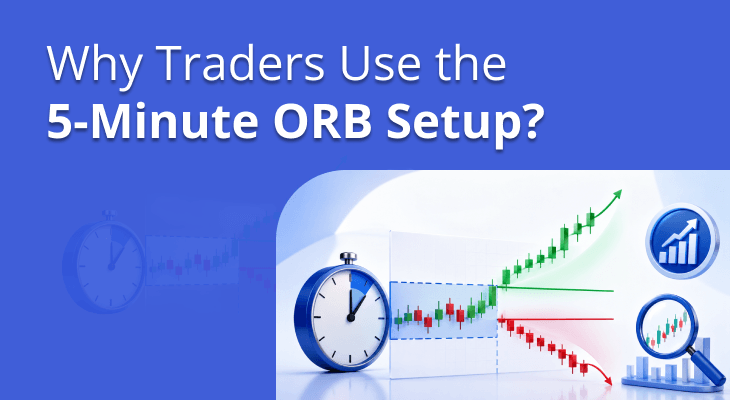
The 5-minute ORB strategy is an intraday trading approach based on the first 5-minute candle after the market opens. The high and low of this candle form the opening range.
These levels become important reference points for the rest of the session.
- A move above the high signals potential bullish momentum.
- A move below the low signals potential bearish momentum.
- Traders monitor these levels for possible breakout opportunities.
The strategy is built on a simple principle. If price moves beyond the opening range with strength, the move may continue as more traders join the trend.
How the Opening Range Breakout Strategy Works?
The ORB trading strategy follows a structured sequence. It starts with range formation and ends with trade management.
1. The Market Establishes an Initial Balance
The first few minutes of trading often represent a period of price discovery. Buyers and sellers react to fresh information, creating a temporary balance between demand and supply. This balance forms the opening range.
2. Price Tests the Range Boundaries
As the session progresses, the price begins testing either the upper or lower boundary of the range. Repeated tests of the same level can be significant. These interactions often provide clues about where pressure is building.
3. A Breakout Creates a Trading Opportunity
When prices move beyond the established range, market participants reassess their positions. Several events may occur simultaneously:
- Momentum traders enter new positions.
- Existing traders add to positions.
- Short sellers cover losing trades.
- Stop-loss orders get triggered.
This increase in activity can accelerate price movement.
4. Follow-Through Determines Trade Quality
Not every breakout develops into a strong trend. The quality of a breakout often depends on whether the price can continue making higher highs or lower lows after the initial move.
Post-Breakout Behaviour | What It May Indicate |
|---|---|
Strong continuation | Momentum remains intact |
Slow movement | Limited participation |
Immediate reversal | Failed breakout |
This stage helps traders assess whether momentum remains strong enough to support the move.
5. The Trade Evolves Into Trend or Consolidation
After the breakout, the price generally follows one of two paths.
Outcome | Characteristics |
|---|---|
Trend Development | Directional movement continues |
Consolidation | Price stabilises after the breakout |
Strong trend days often produce the most favourable ORB opportunities because momentum remains active throughout the session.
Step-by-Step Guide to the 5-Minute ORB Trading Strategy
The following steps explain how the strategy is typically implemented during an intraday trading session.
Step 1: Analyse Pre-Market Conditions
Before the market opens, review factors that may influence price movement, such as:
- Global market trends
- Economic announcements
- Earnings results
- Sector-specific news
- Gap-up or gap-down openings
Step 2: Identify the Opening Range
Wait for the first 5-minute candle to close. Mark its high and low, as these levels form the opening range and serve as potential breakout points.
Step 3: Observe Price Behaviour
Monitor how the price reacts around the opening range. Multiple tests of the high may indicate buying strength, while repeated tests of the low may signal selling pressure.
Step 4: Confirm the Breakout with Volume
A breakout backed by strong volume is generally considered more reliable than one with low volume. For instance:
Factor | Stock A | Stock B |
|---|---|---|
Breakout | Yes | Yes |
Volume Increase | 95% | 12% |
Relative Strength | Higher | Lower |
Step 5: Evaluate Risk-to-Reward
Compare the potential reward with the possible risk before entering a trade. For example:
Trade Parameter | Value |
|---|---|
Entry Price | ₹1,540 |
Stop-Loss | ₹1,520 |
Risk | ₹20 |
Target | ₹1,580 |
Potential Reward | ₹40 |
This setup offers a 1:2 risk-to-reward ratio.
Step 6: Track Post-Breakout Momentum
Watch whether the price continues moving in the breakout direction. Strong momentum is often supported by higher volume and a clear price trend.
Why is the 5-Minute ORB Strategy Popular in Options Trading?
The ORB strategy has gained significant popularity among options traders because it aligns well with the way option premiums react to intraday price movements.
1. It Helps Traders Focus on High-Activity Trading Sessions
Options generally perform best when the underlying asset shows a clear direction. The first hour of trading often experiences higher participation compared to other parts of the day. The opening range breakout approach helps traders concentrate on this active period instead of searching for opportunities throughout the session.
2. It Removes Much of the Guesswork
One challenge in options trading is deciding when momentum is strong enough to justify entering a position. The ORB trading strategy addresses this by using a predefined price range. Rather than predicting future movement, traders wait for the market to reveal its intent through a breakout. This rule-based approach can help create greater consistency in decision-making.
3. It Works Well During Volatility Expansion
Options traders often benefit when volatility increases after a period of consolidation. The opening range can act as an early consolidation zone. When price escapes this range, market activity often accelerates. This increase in momentum can influence option premiums and create trading opportunities.
4. It Supports Short-Term Trading Objectives
Many options traders prefer intraday setups because they avoid overnight risk and time decay concerns associated with holding positions for extended periods. The 5-minute ORB setup naturally fits this objective because it is designed to identify opportunities early in the trading day.
5. It Can Be Applied Across Different Market Conditions
The strategy is commonly used in:
- Index options
- Stock options
- Weekly expiry contracts
- Monthly expiry contracts
This flexibility allows traders to adapt the setup to different instruments while following the same underlying framework.
Common ORB Trading Mistakes Traders Should Avoid
The ORB strategy is straightforward in theory, but many traders struggle with execution. In most cases, losses do not occur because the strategy is ineffective. Understanding the most common mistakes can help improve discipline and prevent avoidable trading errors.
1. Treating Every Breakout as a Trading Opportunity
One of the biggest misconceptions about the opening range breakout approach is that every breakout deserves a trade. In reality, some breakouts occur during weak market conditions, while others lack sufficient participation from buyers or sellers.
2. Ignoring the Broader Market Trend
A breakout may look strong on an individual chart, but the broader market can influence its success. For instance, a bullish breakout in a stock may struggle if the overall market is facing heavy selling pressure.
Before evaluating an ORB setup, many traders analyse:
- Index direction
- Sector performance
- Overall market sentiment
This helps place the breakout in the right context.
3. Entering After a Large Initial Move
Many traders hesitate during the breakout and then enter after a significant portion of the move has already occurred.
Late entries can create two challenges:
- Higher risk exposure
- Reduced profit potential
The farther the price moves away from the opening range, the less attractive the risk-to-reward profile may become.
4. Overlooking Market Participation
A breakout is often more reliable when supported by broad participation. Some traders focus only on price and ignore whether the market is actively supporting the move.
Factors that can strengthen a breakout include:
- Rising trading activity
- Sector-wide strength
- Consistent momentum
- Strong follow-through
Without these factors, the breakout may struggle to sustain itself.
5. Taking Multiple ORB Trades in the Same Session
After a failed breakout, some traders immediately search for another setup in an attempt to recover losses. This behaviour can lead to overtrading. The ORB trading strategy is designed to identify quality opportunities, not constant trading opportunities. Taking too many trades can reduce overall discipline and increase transaction costs.
6. Neglecting Risk Management
Even strong setups can fail. This is why risk management remains an essential part of the strategy.
Common risk management mistakes include:
- Increasing position size after a loss
- Risking too much capital on a single trade
- Ignoring predefined exit levels
- Allowing small losses to grow into larger ones
Successful traders often focus on protecting capital first and seeking profits second.
7. Failing to Adapt to Different Market Conditions
The ORB setup does not perform the same way every day. Trending sessions, volatile sessions, and range-bound markets can produce very different outcomes.
Market Condition | Common Challenge |
|---|---|
Strong trend day | Holding winners too early |
Range-bound market | Frequent false breakouts |
High-volatility session | Sudden price swings |
Low-volume session | Lack of follow-through |
Recognising the type of market environment can help traders set more realistic expectations.
8. Skipping Post-Trade Analysis
Many traders spend time finding setups but very little time reviewing completed trades.
Trade analysis can reveal valuable insights, such as:
- Which market conditions produced the best results
- Which mistakes occurred repeatedly
- Whether the trade selection was effective
- How risk management decisions affected outcomes
These observations can help refine the execution of the open range breakout strategy.
Risk Management Rules for ORB Trading
A successful ORB strategy is not built on finding the perfect breakout. It is built on managing risk when the market behaves unexpectedly. Here are some rules that must be followed for a better risk management flow:
- Risk only a small portion of your capital on each trade, typically 1%–2% of your total trading capital.
- Always use a stop-loss to limit potential losses if the trade moves against your position.
- Wait for breakout confirmation instead of entering a trade on the first price spike.
- Trade with the prevailing market trend whenever possible to improve the probability of success.
- Avoid overtrading by taking only high-quality ORB setups that meet your trading criteria.
- Maintain a favourable risk-to-reward ratio, such as 1:2 or higher, before entering a trade.
- Do not chase missed breakouts, as late entries often increase risk and reduce potential rewards.
- Monitor trading volume, as stronger volume can help confirm the validity of a breakout.
- Avoid trading during major news events if they are likely to cause sudden price volatility.
- Keep a trading journal to review your trades, identify recurring mistakes, and refine your ORB strategy over time.
ORB Trading Strategy vs Other Intraday Strategies
Intraday traders use a variety of approaches to identify opportunities during the trading session. Some focus on momentum, while others look for trend reversals, support and resistance reactions, or short-term price fluctuations. The ORB strategy stands out because it is built around the market's opening activity. Here is the detailed comparison.
1. ORB vs Scalping
Scalping involves taking multiple trades throughout the day to capture small price movements. Traders often hold positions for only a few minutes or even seconds.
The opening range breakout approach takes a different route. It focuses on identifying a potentially meaningful move that develops after the market establishes its opening range. As a result, ORB traders typically execute fewer trades and spend more time waiting for quality setups.
2. ORB vs Reversal Trading
Reversal traders attempt to identify points where an existing trend may weaken or change direction. This requires analysing price exhaustion, support and resistance zones, and potential turning points.
The ORB trading strategy, on the other hand, does not attempt to predict reversals. It focuses on trading in the direction of emerging momentum once the market moves beyond the opening range. Due to this, ORB is often considered a momentum-based approach rather than a counter-trend strategy.
3. ORB vs Trend-Following Strategies
Trend-following strategies aim to capture sustained market moves. Traders often use moving averages, trendlines, or other indicators to identify the prevailing direction.
While both approaches seek to benefit from momentum, their entry logic differs. Trend-following strategies may generate signals at any point during the trading session. The open range breakout strategy concentrates on opportunities that emerge shortly after the market opens. This allows traders to participate in potential trends from an earlier stage.
4. ORB vs Support and Resistance Trading
Support and resistance traders focus on how the price reacts around established market levels.
They often look for:
- Breakouts from important zones
- Price rejections
- Range-bound trading opportunities
Although ORB also involves breakout trading, its reference levels come from the opening range rather than historical support and resistance areas. This gives the strategy a more time-specific framework.
5. ORB vs Indicator-Based Strategies
Many intraday strategies rely heavily on technical indicators such as moving averages, RSI, MACD, or Bollinger Bands.
In contrast, the ORB strategy is primarily driven by price action. While some traders use indicators as additional confirmation tools, the core setup is based on the relationship between price and the opening range. This simplicity is one reason many traders find the strategy easy to understand and implement.
Conclusion
The ORB strategy offers a structured way to analyse intraday market opportunities during the opening phase of a trading session. Its simplicity and clear framework make it popular among traders across different markets. However, the strategy works best when combined with patience, market awareness, and disciplined execution. Understanding both its strengths and limitations can help traders apply the opening range breakout approach more effectively and make better-informed trading decisions.
More Related Articles

SEBI Proposes CAS Changes: What Could Change for Derivatives Settlement, IEPs & Timings?
 September 17, 2026 | 0 mins read
A month after introducing the new Closing Auction Session, SEBI has proposed changes after early market feedback raised concerns about derivatives settlement on expiry days, changing auction prices and trading timings. SEBI is not scraping CAS. Instead, it wants to make expiry settlement clearer, improve the auction process and help traders understand that indicative auction prices are not the same as actual traded prices.

ETF trading rules from 7 September: What changes for retail investors?
September 7, 2026 | 0 mins read
If there was no trade during the final 30 minutes on the previous day, the exchange will use that day’s last traded price. If there was no trade at all on the previous day, the latest available closing NAV will be used. The base price will also be adjusted for corporate actions, if applicable. From April 1, 2027, SEBI expects stock exchanges and mutual fund AMCs to use the previous day’s closing NAV as the base price after resolving operational issues.

How MSCI rebalancing tested India's Closing Auction System on August 31
September 2, 2026 | 0 mins read
India’s new Closing Auction Session (CAS) processed a record ₹39,718 crore turnover, on 31 August 2026 as MSCI India Index latest index rebalancing took effect at the market close. The event showed that CAS could handle an exceptional concentration of institutional flow. However, there were some sharp, and sometimes counterintuitive, stock moves. This shows that the quality of closing-price discovery is still being tested.
FAQ
The 5-minute timeframe is the most widely used for ORB trading. It captures the market's initial direction while filtering some opening volatility. Traders seeking additional confirmation may use longer timeframes, but the 5-minute range remains the preferred choice.