
May 21, 2026 | 6 min read
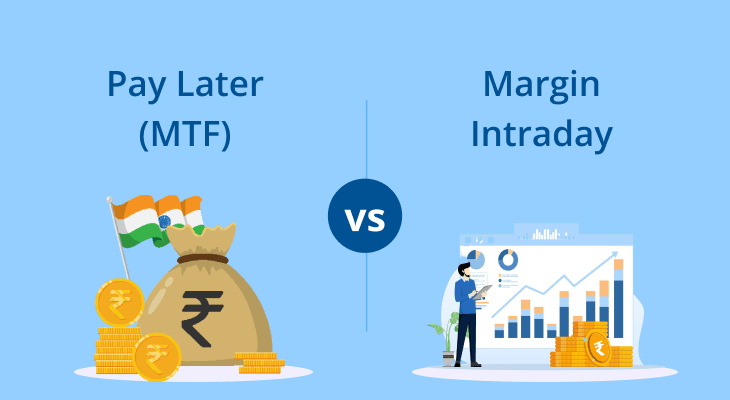
Pay Later (MTF) vs margin intraday – pros & cons
When it comes to using leverage in your trades, the way you apply it matters far more than the amount or multiple you receive. Margin Trading Facility and intraday margin both increase your buying power substantially. However, there are different mechanics at play, which need to be understood.
To begin with, MTF gives you more time, and intraday margin gives you really quick exposure. In this article, we explain how each works and what the main risks are involved due to the nature of leverage.
What is the fundamental difference between MTF and intraday margin?
The most important distinction between Pay Later (MTF) and intraday margin is the holding period. Intraday margin positions must close on the same trading day. Hence, you cannot carry them overnight, regardless of market direction.
Pay Later (MTF), by contrast, allows you to hold positions beyond the day. You can then maintain exposure for several days or longer, as long as you meet the margin requirements.
This difference shapes everything else, including cost, risk behaviour, and trading intent. Intraday margin focuses on short-term price movement. Whereas, Pay Later (MTF) aligns more with your positional strategies that need time to play out.
These contrasting factors define how each facility fits into your broader approach to the market:
- Duration of exposure
- Interest applicability
- Stock eligibility
- Margin maintenance rules
How does the Margin Trading Facility operate on a day-to-day basis?
Pay Later (MTF) allows you to purchase shares by paying only a portion of their value upfront. and your broker funds the remaining amount. The shares stay pledged as collateral. For example, the m.Stock’s Pay Later (MTF) interest starts from 8.99% p.a, and over 1,100+ scrips are at your disposal, for an unlimited holding period.
Most importantly, you continue to hold the shares beyond the trading session. This structure supports strategies where price movement unfolds over several days rather than just minutes or a few hours.
What financial obligations do you carry under MTF?
Since the share purchase is partly funded using borrowed funds from your broker, interest applies daily on that portion. That way, even if prices remain flat, the cost continues to accrue. Your margin levels must also remain within limits set by the broker.
In case the share price falls sharply, you may receive a margin call. Furthermore, failure to meet it can lead to a forced liquidation of your collateral.
What benefits remain intact while holding MTF positions?
Although your shares bought via Pay Later (MTF) are pledged, you generally retain entitlement to dividends, bonuses, and other corporate actions. That aspect matters for longer holding periods.
Advantages associated with MTF
- Extended holding flexibility
- Better deployment of limited capital
- Ability to spread exposure across stocks
Limitations to be factored in
- Ongoing interest cost
- Amplified downside due to leverage
- Restricted list of eligible shares
Why does intraday margin attract active traders?
If you’re looking at significant price movement within a single session, then intraday margin can help execute your trading strategy. Moreover, there is no transfer of ownership of the shares, but the profits depend on your precise execution and timing.
Since the positions close or square off before market hours end, you can avoid overnight exposure as well. This can reduce the risk of overnight developments and market sentiment shifts. Another distinction is that interest does not apply, which keeps the cost visibility clear.
Why is the intraday margin efficient?
You are committing a smaller amount of your capital to control a larger position in intraday trades. This efficiency is what supports rapid strategies and short selling, within the same day.
Where does the pressure increase?
A sudden move against your position can trigger margin calls due to the element of leverage. There can also be an automatic square-off without giving you an extended notice.
Benefits:
- Higher leverage for short-term opportunities
- No overnight holding risk
- Clear cost structures
Drawbacks
- Strict constraints on timing
- Losses can build up rapidly
- Volatile markets may lead to stress
Also Read: Margin Trading vs Short Selling Understanding Key Differences | m.Stock
Which risks differ most between MTF and intraday margin?
Leverage-based facilities like Pay Later (MTF) carry inherent risk, as prices can move in either direction. Trades may benefit from price appreciation, but interest accrues on the borrowed funds. If prices move against your position, margin calls can occur, and positions may need to be adjusted to maintain required margins.
Intraday margin concentrates risk into a shorter window (one session). Therefore, your losses can escalate quickly due to the high leverage. At the same time, recovery time does not exist after markets close.
Pay Later (MTF) allows you to hold your positions beyond a single session, giving more flexibility. However, it requires active monitoring of margins and interest costs.
Risk considerations you should assess
- Your ability to monitor markets consistently
- Comfort with leveraged losses
- Liquidity that’s available for margin calls
Should you consider MTF instead of intraday margin?
Pay Later (MTF) may suit your trading style if your strategy requires time. It fits traders who analyse fundamentals or expect gradual price movement rather than intraday volatility. The benefit of MTF is that it is similar to equity delivery trading, but the funds are partly borrowed, which provides you with enhanced exposure.
You also need patience and cost awareness with Pay Later (MTF) as the funded portion accrues a set interest. And this interest can steadily erode returns if your position is running a loss.
On the other hand, intraday margin will fit your needs if you are an experienced trader who acts decisively and manages stops strictly. Intraday trading may not be ideal for beginners or those in a learning phase.
Also Read: Delivery Trading vs Pay Later MTF: Key Difference Explained | m.Stock
A practical way to choose
- Prefer MTF for multi-day exposure
- Prefer intraday margin for same-day strategies
- Avoid mixing both without defined rules
Conclusion
Pay Later (MTF) and intraday margin are both trading tools; they’re not shortcuts that will result in amplified profits. Each demands a clear structure, risk control, and clarity of purpose. When used thoughtfully, they support your different trading objectives without overlap.
If you plan to explore either facility, opening an account with us at m.Stock gives you access to margin trading features with a ₹0 account opening fee. You can access our ₹10 brokerage plans for all trades. Before you begin trading, align every trade with your risk capacity and time horizon.
Also Read: Difference Between Intraday Trading & Delivery Trading | m.Stock
More Related Articles
Margin Trading Facility (MTF) vs Personal Loan: Which is Smarter for Leveraged Investing?
 July 3, 2026 | 0 mins read
Many investors reach a point where they want to invest more than their available capital. At that stage, you may consider borrowing to invest. Two common ways to do this are using a Margin Trading Facility (MTF) through your broker or taking a personal loan from a bank.
Step-by-Step Process of Pledging Holdings in MTF
May 26, 2026 | 0 mins read
Margin Trading Facility (MTF) has steadily found popularity among Indian equity investors who want more flexibility while placing trades. Instead of paying the entire share value upfront, you contribute only a portion, while the broker finances the remaining amount. This arrangement allows you to take positions that may otherwise require significantly higher capital. However, Pay Later (MTF) or Margin Trading Facility does not function in isolation. To protect the amount funded, brokers rely on pledged holdings.
What is MTF & Steps to Avail Pay Later (MTF)
May 22, 2026 | 0 mins read
Margin trading is a popular feature offered by financial institutions that allows investors to trade securities using borrowed funds. It enables traders to increase their purchasing power and potentially amplify their returns. In India, the Securities and Exchange Board of India (SEBI) regulates margin trading facilities provided by brokers and exchanges. This article will delve into the meaning of margin trading, its requirements, regulations, benefits, risks, and popular strategies used by traders in India.