
July 22, 2026 | 13 min read
Intraday Trading vs Positional Trading: Risk, Returns & Strategy
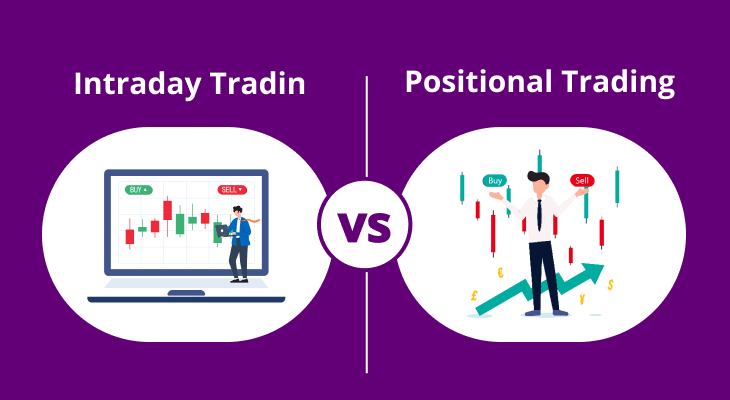
Most traders eventually face the question: intraday trading vs positional trading, which is better?. Both approaches aim to benefit from price movements, but they differ significantly in how trades are executed, how long positions are held, and how much time and attention they demand. Choosing between them is not about which method sounds more exciting, but which one aligns better with your financial goals.
Intraday trading involves buying and selling within the same trading session, with positions usually closed before the market ends. It is often chosen by traders who prefer short-term opportunities, quick decision-making, and active market participation. Positional trading, in contrast, involves holding trades for several days, weeks, or even longer to capture broader price trends.
The right choice depends on factors such as risk tolerance, available time, trading discipline, and market understanding. While one approach may suit someone who can actively track markets during the day, the other may be more practical for those who prefer a wider time horizon. Understanding the difference between intraday trading and positional trading can help you choose a strategy that fits your style more effectively.
What is Intraday Trading?
Intraday trading refers to buying and selling securities within the same trading day. All positions are usually closed before the market session ends, which means trades are not carried forward to the next day. The objective is to benefit from short-term price movements that occur during market hours.
Many traders are drawn to intraday trading because it offers active participation and the ability to capture opportunities in a shorter time frame. Since positions are squared off on the same day, there is no overnight exposure to events such as global market movements, earnings announcements, or unexpected news. In many cases, brokers may also provide margin facilities, allowing traders to take larger positions with comparatively lower capital, though this also increases risk.
For example, if a stock is bought at ₹500 and sold at ₹505 on the same day, the gain may appear small on a per-share basis. However, when traded in larger quantities, even modest price moves can become meaningful. The same principle applies in reverse, where small adverse moves can also lead to losses quickly.
Unlike long-term investing, intraday trading is less focused on company fundamentals and more focused on market behaviour. Traders often study price action, volume trends, momentum, and technical indicators such as RSI, VWAP, and moving averages to identify short-term setups. Decisions often need to be made quickly, as prices can change within minutes or even seconds.
This makes intraday trading a skill-intensive approach that requires discipline, timing, and risk management. While it can offer frequent opportunities, it also demands close attention, emotional control, and the ability to act decisively in a fast-moving market.
What is Positional Trading?
Positional trading involves taking a trade with the intention of holding it for more than one trading session. Positions may be held for a few days, several weeks, or sometimes longer, depending on the expected trend. The aim is to capture a larger price move over time rather than focusing on small intraday fluctuations.
Compared with intraday trading, positional trading usually allows for a slower decision-making process. Traders are not required to monitor every minute-by-minute movement during market hours. Instead, the focus shifts to identifying trends that may develop over the coming days or weeks. This often involves analysing factors such as earnings performance, sector momentum, price patterns, and broader market direction. End-of-day daily or weekly charts are commonly used to assess entry and exit opportunities.
For example, a trader may enter a stock at ₹1,000 with the expectation that it could move towards ₹1,120 or ₹1,150 over the next few weeks. In this approach, small day-to-day price changes may be less important than the broader trend. The emphasis is on allowing the trade enough time to play out.
However, positional trading comes with its own set of considerations. Since trades are carried overnight, positions remain exposed to global cues, policy announcements, company updates, or unexpected market events that may affect the next day’s opening price. This can result in gains or losses before the market session even begins.
Capital also remains committed for longer periods, which means it cannot be redeployed as quickly as in short-term trading. For this reason, positional trading often suits those who prefer a more measured pace, but who are also comfortable with patience, trend-based decision-making, and holding through short-term volatility.
Intraday vs Positional Trading
Let’s break down intraday vs. positional trading:
Time Commitment
Intraday trading is not something you can casually do on the side. You need to track moves, wait for setups, and manage open trades. It needs dedication. Positional trading is lighter in that sense. You can step away, come back, review, and still stay on top of things with end-of-day or periodic monitoring rather than minute-to-minute tracking.
Capital Requirement
Intraday trading feels more accessible because of leverage. You can start smaller and still get decent exposure. However, using leverage also increases risk and may attract stricter margin requirements and risk checks from brokers/regulators. In positional trading, your own capital needs to be invested, and it stays locked till the trade is exited.
Risk Nature
Intraday risk is sharp, including quick moves and quick losses if you are wrong. There is no time buffer. Positional risk is slower, but it sits with you overnight. Gaps, news, global indicators, all of that becomes part of the trade.
Trade Frequency
Intraday traders stay active. Multiple trades, sometimes even overtrading if not careful. Positional traders slow it down. They wait more and act less, but usually with clearer intent.
Costs
This part doesn’t feel obvious initially. Intraday trading builds up costs because of frequent entries and exits. It’s not one big charge. It’s many small ones, including brokerage, taxes, and other transaction charges that can add up over time. Positional trading keeps this under control simply because you’re trading less often.
Returns Potential: Intraday vs Positional Trading
Intraday trading can look exciting because results show up immediately. You take a trade, and within minutes or hours, you know whether you were right. A 1% move doesn’t feel small when you are using leverage. But what is easy to miss is how quickly it can go the other way. Let’s say you are working with ₹1,00,000 and using margin. You are effectively controlling a larger position. A small move works in your favour, great. But the same move against you hits just as hard. Over a few trades, this starts balancing out unless you are very disciplined.
Positional trading feels slower in comparison. You take a trade, and then nothing may happen for a while. It moves a bit, pulls back, and moves again. But when it works, it works over a larger range. An 8%–10% move over a few weeks doesn’t look dramatic day to day, but it adds up. There is also taxation, which quietly changes the outcome. Intraday trading is treated as speculative business income under Section 43(5) of the Income Tax Act and is taxed at slab rates depending on your total taxable income. Positional trading with delivery will be taxed as capital gains, with short-term capital gains (≤12 months period) taxed at 20% for listed equities and long-term capital gains (>12 months holding period) taxed at 12.5% on gains above the ₹1.25 lakh exemption. However, if positional trades are done without delivery (F&O style), they are classified as non-speculative business income and also taxed at slab rates. That difference in tax treatment matters more when you start looking at net returns, not just gross profit. So if you are comparing intraday vs positional trading only on speed of returns, it’s an incomplete picture.
Strategies for Intraday Trading
With intraday trading, you realise pretty quickly that random trades don’t work. You might get lucky once or twice, but that doesn’t hold. You need some structure, even if it’s simple.
1. Momentum Trading
This is where most people start. You look for stocks that are already moving. Strong volume, clear direction. You aren’t trying to predict, you are trying to catch a move that has already started. The difficulty is staying in just long enough without overstaying.
2. Scalping
This is a different mindset altogether. You aren’t waiting for big moves but taking small pieces, again and again. It sounds manageable, but it depends heavily on execution. Even small delays or higher charges start affecting outcomes here.
3. Breakout Trading
You wait for the price to cross a level that has held for a while. When it breaks, you enter. Simple in theory. In reality, false breakouts happen often enough to test your patience.
4. Reversal Trading
Here, you are stepping in when a move looks stretched. Maybe overbought, maybe oversold. Indicators can help, but they don’t guarantee anything. Timing becomes tricky.Across all of this, one thing becomes obvious over time. Risk control is doing most of the work. Not the entry, not the indicator. How much you risk, where you exit, and whether you stick to that plan. That’s what decides whether intraday trading works for you or not.
Strategies for Positional Trading
Positional trading gives you time, but that doesn’t automatically make it easier. In fact, sometimes having more time makes you overthink things. You take a position, and then you start watching every small movement anyway. That’s where most people go wrong. Positional trading is not about reacting to every ₹2 move.
1. Trend Following
This is probably the cleanest way to approach positional trading. If a stock is moving in a clear direction, you stay with it. Not because you know where it will go, but because it has already shown direction. Moving averages help here, but more than that, it’s about not exiting too early.
2. Swing Trading
This sits somewhere in between. You’re not holding for months, but you’re also not exiting the same day. You look for short moves within a larger trend. Enter near support, exit near resistance. Sounds simple, but timing still matters.
3. Breakout Holding Strategy
Instead of exiting after a breakout like in intraday trading, you stay in. The assumption is that if a level has been broken properly, the move could continue. The challenge is sitting through small pullbacks without panicking.
4. Fundamental-Based Positioning
Some trades just need a bit more conviction. That’s where fundamentals come in. Earnings, sector movement, maybe even management commentary. It doesn’t make the trade risk-free, but it helps you stay in longer without second-guessing every dip.
Over time, positional trading becomes less about finding trades and more about holding the right ones without interfering too much.
Role of Leverage in Intraday vs Positional Trading
Leverage sounds attractive when you first hear about it since it entails more exposure without putting in more capital. And in intraday trading, it’s almost built into the system. You are given a margin. You take larger positions. A small move in your favour looks meaningful. That’s the appeal. But the flip side can show up just as quickly. The same small move against you can hurt more than expected. Say you are working with ₹50,000 and using leverage. Your actual exposure is much higher. So even a 1% move starts feeling bigger than it should. That’s fine when things go your way. Not so much when they don’t. Positional trading doesn’t usually give you that cushion. You are mostly using your own capital. No major leverage, no amplified exposure. At first, it feels slower. But it also keeps things more stable. There is a subtle difference here. With leverage, you’re managing amplified outcomes. Without it, you are managing actual capital. And that changes how you think about risk. In intraday trading, leverage pushes you to be sharper. In positional trading, the absence of it pushes you to be more patient. Neither is better by default. But ignoring how leverage changes behaviour is where problems start.
How Market Conditions Affect Intraday and Positional Trading
This is something people don’t pay enough attention to in the beginning. They pick a style, and then try to apply it everywhere. But the market doesn’t stay the same.
When things are volatile, intraday trading feels active. There are moves, reversals, and breakouts. You get chances. But it’s also messy. What looks like a clean move can reverse quickly. So while opportunities increase, so does noise. In those phases, intraday trading can feel both exciting and frustrating at the same time.
Positional trading, on the other hand, works better when the market has some direction. Not necessarily strong trends, but at least some clarity. When stocks are moving steadily, holding makes sense. Sideways markets are tricky for both.
Intraday traders deal with false signals. Breakouts fail. Momentum disappears midway. Positional traders feel stuck because nothing really moves enough to justify holding. So the question is not just intraday vs positional trading. It’s also when to lean into which approach.
Some traders stay rigid. They stick to one style regardless of conditions. Others adjust quietly. More intraday when markets are active. More positional when things settle. That flexibility usually makes a difference over time.
Intraday vs Positional Trading: Which is Better for You?
This question sounds simple, but it rarely has a clean answer. Because it’s not really about which one is better in general. It’s about which one feels manageable to you over time.
1. Your Time Availability
If you can sit through market hours without distraction, intraday trading becomes an option. If not, it quickly becomes stressful. Positional trading fits better when you can’t be actively involved all day.
2. Your Capital Base
Intraday trading gives you the illusion of doing more with less because of leverage. Positional trading asks you to commit actual capital and wait. That difference becomes important as your trades get larger.
3. Your Risk Tolerance
Some people are comfortable with quick decisions and quick outcomes. Others aren’t. Intraday trading tests your ability to handle immediate pressure. Positional trading tests your ability to sit through uncertainty.
4. Your Decision-Making Style
If you tend to act quickly and adjust fast, intraday trading aligns with that. If you prefer thinking things through, positional trading feels more natural.
5. Your Trading Experience
Most beginners find positional trading easier to start with. Not because it’s safer, but because it gives you time to understand what you’re doing.
6. Your Return Expectations
Intraday trading gives you frequent results. Positional trading gives you slower, sometimes larger moves. In reality, a lot of traders end up doing both, even if they don’t plan to initially.
Conclusion
The discussion around intraday vs positional trading doesn’t really end. It just evolves as you spend more time in the market. At the beginning, it feels like a choice you need to make. Later, it starts feeling more like a balance you figure out. Intraday trading gives you activity. You are involved, constantly making decisions, constantly adjusting. It sharpens you, but it also drains you if you aren’t careful.
Positional trading gives you space. You think more, act less, and let trades play out. But it also asks you to stay patient when nothing seems to be happening. Neither one is easier in a real sense. What matters is whether you can stick with your approach when things don’t go your way. Because they won’t, at least not consistently.
More Related Articles

Difference Between Sensex and Nifty Explained
 July 10, 2026 | 0 mins read
In the Indian equity market, a broad view of performance is usually captured through two key indices: BSE Sensex and NIFTY 50. Both are widely followed and often referenced as indicators of market direction, but they are not identical in structure or interpretation. Each index is designed to represent a segment of the market, using its own selection criteria.

Auto Sector Results 2026: Stability or Volatility Ahead?
July 10, 2026 | 0 mins read
The Indian automobile industry has entered FY27 with strong momentum, supported by resilient demand, policy support, and structural shifts like electrification. However, as you assess auto sector stocks, you will notice that growth is not uniform. The sector reflects both stability in domestic demand and volatility arising from global headwinds. Understanding these dynamics is essential if you want to interpret automotive sector trends and make informed investment decisions. This blog will guide you in exploring the important aspects of the auto sector, such as sector overview, demand, and other important factors.

Capital Goods Sector in 2026: What is Driving Stronger Performance
July 10, 2026 | 0 mins read
If you have been tracking markets closely, you have likely noticed how the capital goods sector has moved from being cyclical and uncertain to one of the strongest performers in recent years. As you step into 2026, this momentum is not accidental. It is backed by structural shifts in policy, investment, and demand. In simple terms, when a country builds more roads, factories, railways, and power plants, capital goods companies sit right at the centre of that growth. And right now, India is building aggressively. This blog breaks down what is driving this shift, how the capex cycle in India is evolving, and what it means for the sector’s outlook in the coming years.
FAQ
In intraday trading, people tend to overtrade without real setups. Stop losses get ignored, especially after a few losing trades. In positional trading, the common issue is holding on for too long, even when the original reason for the trade no longer exists.